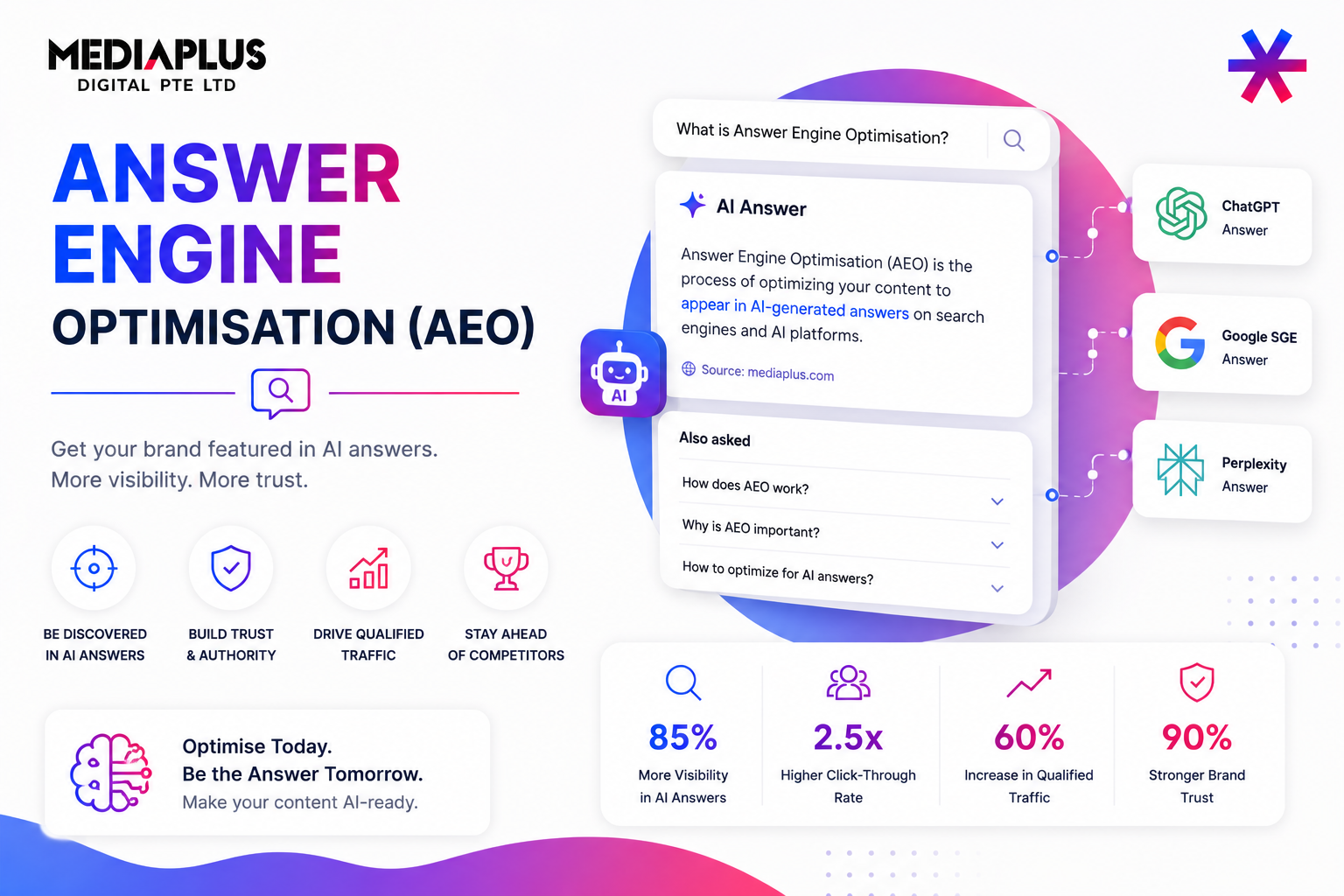
Search is changing fast.
Instead of clicking through multiple links, users now expect direct answers. Whether it’s Google’s AI results, voice assistants, or chat-based tools, search engines are becoming answer engines.
This shift has introduced a new concept: Answer Engine Optimisation (AEO).
In this guide, you’ll learn what AEO is, how it works, and how to optimise your content to stay visible in the AI-driven search landscape.
What Is Answer Engine Optimisation (AEO)?
Answer Engine Optimisation (AEO) is the process of optimising content to provide direct, concise answers to user queries so that search engines and AI systems can easily extract and display them.
Unlike traditional SEO, which focuses on ranking pages, AEO focuses on:
- Getting featured in answer boxes
- Appearing in AI-generated summaries
- Being selected as the “best answer”
In simple terms:
- SEO helps you rank
- AEO helps you get chosen
Why AEO Matters in 2026
Search behaviour has changed significantly.
Users now:
- Ask full questions instead of typing keywords
- Use voice search and AI assistants
- Expect instant, accurate answers
Search engines are responding by prioritising:
- Featured snippets
- AI-generated summaries
- Conversational results
This means fewer clicks but higher competition for visibility.
If your content is not optimised for AEO, it may not appear at all, even if it ranks on page one.
AEO vs Traditional SEO
While AEO and SEO are closely related, they focus on different outcomes.
| Aspect | SEO | AEO |
|---|---|---|
| Goal | Rank higher in search results | Provide direct answers |
| Focus | Keywords and backlinks | Questions and intent |
| Content style | Long-form and optimised | Clear, concise, structured |
| Result | Website traffic | Visibility in answers |
The best strategy today is to combine both.
How Answer Engines Work
Answer engines use AI and natural language processing to understand queries and extract the most relevant answer.
They look for:
- Clear question-and-answer structures
- Well-organised content
- High authority and trust
- Structured data (schema markup)
Instead of ranking entire pages, they identify specific sections of content that best answer a query.
Key AEO Strategies You Should Apply
1. Target Question-Based Keywords
AEO starts with understanding how people ask questions.
Focus on:
- What is…
- How to…
- Why does…
- Best way to…
Use tools like:
- Google “People Also Ask”
- Related searches
- SEO keyword tools
These queries are more likely to trigger answer results.
2. Provide Clear and Direct Answers
The most important rule of AEO is clarity.
Always:
- Answer the question immediately
- Keep answers concise (40–60 words when possible)
- Avoid unnecessary complexity
For example:
Bad: Long paragraphs before answering
Good: A direct answer followed by detailed explanation
3. Structure Content Properly
Content structure plays a major role in AEO.
Use:
- Headings (H1, H2, H3)
- Bullet points
- Numbered lists
- Short paragraphs
This helps AI systems scan and extract information easily.
4. Optimise for Featured Snippets
Featured snippets are a key part of AEO.
To optimise for them:
- Use question-based headings
- Provide direct answers below headings
- Use lists for step-by-step content
- Include tables when relevant
5. Use Schema Markup
Structured data helps search engines understand your content better.
Important schema types include:
- FAQ schema
- How-to schema
- Article schema
These increase your chances of appearing in rich results and AI answers.
6. Focus on Search Intent
AEO is not just about keywords. It’s about intent.
Ask:
- What does the user really want to know?
- What is the simplest way to answer it?
Content that matches intent clearly is more likely to be selected.
7. Build Authority and Trust
Answer engines prioritise reliable sources.
To improve authority:
- Create high-quality, accurate content
- Earn backlinks from reputable sites
- Keep content updated
Trust signals play a major role in whether your content gets selected.
8. Optimise for Voice Search
Voice search is closely linked to AEO.
Voice queries are:
- Longer
- More conversational
- Question-based
To optimise:
- Use natural language
- Answer questions clearly
- Focus on local and intent-based queries
Common AEO Mistakes to Avoid
Many websites struggle with AEO because of these mistakes:
- Writing content without answering questions clearly
- Overusing keywords instead of focusing on intent
- Poor content structure
- Ignoring schema markup
- Providing vague or overly long answers
Fixing these issues can significantly improve visibility.
The Role of AI in AEO
AI is both the driver and the challenge of AEO.
Search engines now:
- Generate answers using AI
- Combine information from multiple sources
- Prioritise clarity and accuracy
This means your content must be:
- Easy to extract
- Factually correct
- Well-structured
AI is raising the standard for content quality.
AEO and the Future of Search
AEO is not replacing SEO. It is evolving it.
In the future:
- More searches will be answered without clicks
- AI-driven search will dominate
- Content will compete for visibility, not just rankings
Businesses that adapt early will have a strong advantage.
Final Thoughts
Answer Engine Optimisation is becoming essential in modern digital marketing.
As search engines evolve into answer engines, visibility depends on how well your content delivers clear, structured, and trustworthy answers.
The most effective strategy is to combine SEO and AEO, ensuring your content both ranks and gets selected.
For businesses looking to adapt quickly, working with experienced teams like MediaPlus Digital Singapore can help implement advanced strategies across AI SEO Singapore, SEO services Singapore, and digital marketing Service Singapore, ensuring your content is optimised for both search engines and AI-driven answer platforms.