When a customer in Singapore asks ChatGPT for the best dental clinic in Tanjong Pagar, or types a question into Google AI Mode, a machine decides which sites get quoted. That machine does not rank ten blue links and walk away. It reads a handful of pages, pulls the cleanest answer it can extract, and cites two or three sources. If your site is not one of them, you are invisible, even if you sit on page one of classic Google.
This is why AI search readiness is not the same job as classic SEO. Traditional SEO optimises a page to rank. AI search optimisation, sometimes called answer engine optimisation or generative engine optimisation, optimises a page to be retrieved, parsed and cited by a language model. The overlap is real, but the gaps matter. AI crawlers such as GPTBot and ClaudeBot have limited JavaScript processing, so content that renders only in the browser is invisible to them. AI engines favour answer-first writing over keyword-dense prose. They lean heavily on entity clarity and off-site mentions, not just on-page signals. And they pull from sources that classic rank trackers never report.
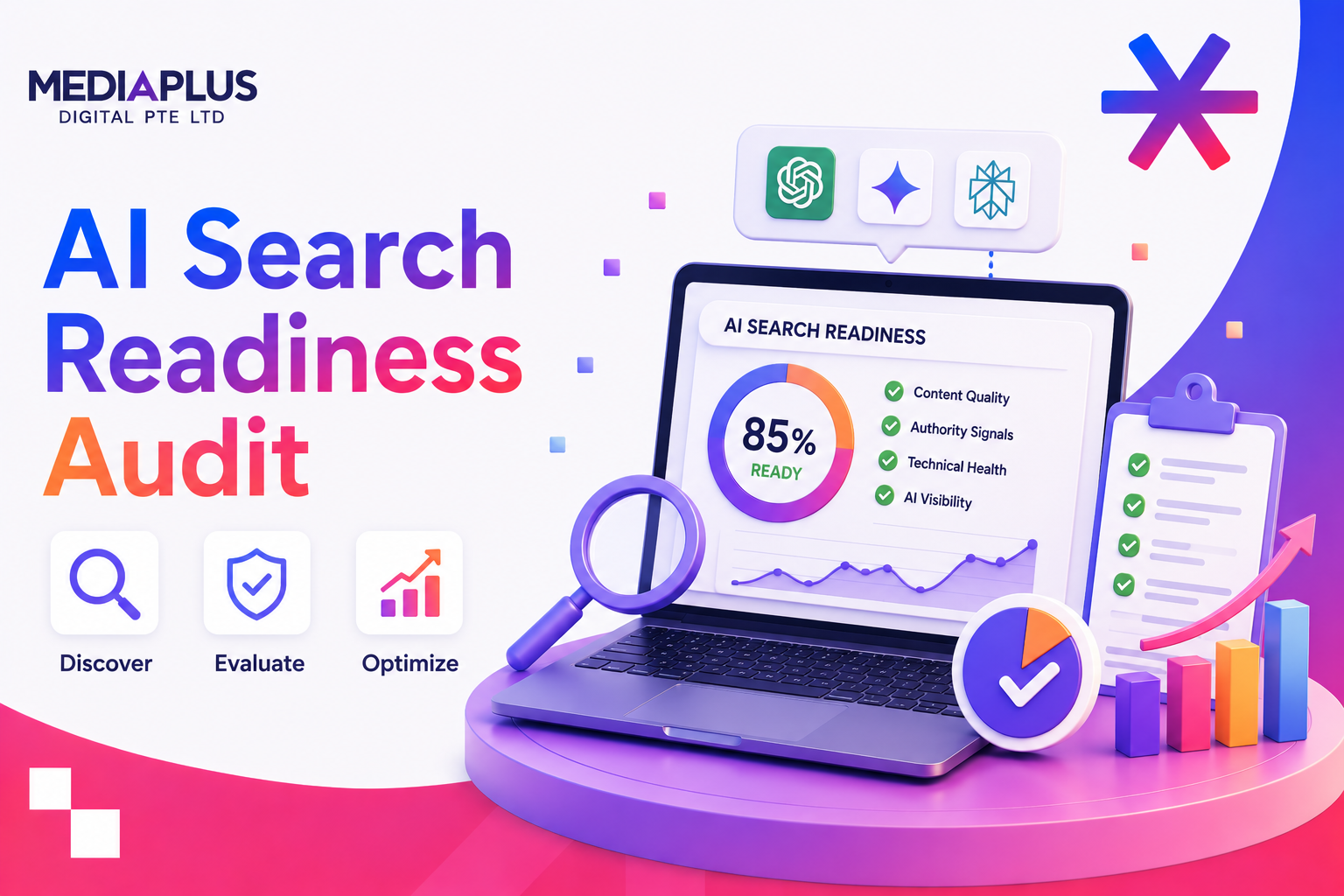
This audit gives you 12 concrete checks. Each one tells you what to inspect, why it matters to AI engines, how to test it yourself, and how to fix it. At the end, you score every point from zero to three for a total out of 36, with banded recommendations. Work through it once a quarter. If you want a structured walk-through alongside your team, our AI SEO services in Singapore page explains how we run the same audit for clients.
The 12-point summary
|
# |
Audit point |
What it governs |
|
1 |
AI crawler access |
Whether bots can fetch your pages at all |
|
2 |
Structured data coverage |
Machine-readable meaning of each page |
|
3 |
Entity and Organisation signals |
Whether the engine knows who you are |
|
4 |
Answer-first, extractable content |
Whether your text is quotable |
|
5 |
FAQ and question blocks |
Coverage of conversational queries |
|
6 |
E-E-A-T and author signals |
Trust and expertise the model can verify |
|
7 |
Freshness and update cadence |
Whether your content stays in the citation pool |
|
8 |
Page speed and Core Web Vitals |
Whether the crawler finishes loading in time |
|
9 |
Clean semantic HTML |
How cleanly the model parses structure |
|
10 |
Internal linking and clusters |
Topical depth the engine can map |
|
11 |
Off-site citations and mentions |
What the web says about you |
|
12 |
AI traffic and citation measurement |
Whether you can see results |
1. Crawlability for AI bots
Check: Confirm that GPTBot, OAI-SearchBot, ClaudeBot, PerplexityBot and Google-Extended are allowed to fetch your pages, and that nothing higher up the stack blocks them.
Why it matters: These are distinct user agents from Googlebot. OpenAI uses GPTBot for training and OAI-SearchBot plus ChatGPT-User for live citations. Anthropic uses ClaudeBot. Perplexity uses PerplexityBot. Google uses Google-Extended for its generative products. If any of these are disallowed, that engine never reads you. A common hidden failure is the CDN or firewall: your robots.txt may welcome GPTBot while Cloudflare bot management quietly returns a 403, with no error showing in your analytics.
How to test: Open yoursite.com/robots.txt and read the directives. Then check your CDN or WAF bot-management dashboard. Finally, filter server logs for the bot user agents above and look at the HTTP status codes they receive. You want 200 responses, not 403 or 404.
Fix: Explicitly allow the AI agents in robots.txt and whitelist their official IP ranges at the firewall. A baseline that allows the main crawlers:
# robots.txt: allow major AI crawlers
User-agent: GPTBot
Allow: /
User-agent: OAI-SearchBot
Allow: /
User-agent: ChatGPT-User
Allow: /
User-agent: ClaudeBot
Allow: /
User-agent: PerplexityBot
Allow: /
User-agent: Google-Extended
Allow: /
Sitemap: https://www.yoursite.com.sg/sitemap.xml
If you would rather allow live-search and citation bots while blocking training bots, keep PerplexityBot, OAI-SearchBot and ChatGPT-User open and disallow GPTBot, ClaudeBot and Google-Extended. For the wider picture, see our guide to AI-friendly websites.
2. Structured data and schema coverage
Check: Verify that your key pages carry valid JSON-LD schema, at minimum Organization, Article, FAQPage and BreadcrumbList, and that the schema is in the raw HTML.
Why it matters: Schema spells out meaning that a model would otherwise have to infer. FAQPage maps directly to conversational queries. Article carries author and date. The trap is rendering: AI crawlers like GPTBot and ClaudeBot do not run JavaScript, so schema injected client-side by a tag manager is invisible to them.
How to test: Run each template page through Google’s Rich Results Test. Then view the raw page source (right-click, View Source, not Inspect) and search for the script tag of type application/ld+json. If it appears in the raw source, AI crawlers can read it.
Fix: Serve schema server-side in the page HTML. Cover Organization site-wide, Article on every post, FAQPage where you answer questions, and Product on commerce pages. Our breakdown of schema and structured data shows how this works on a real store.
3. Entity and Organisation signals
Check: Confirm the engine can identify who you are, what you do and where, with consistent details across your site and the wider web.
Why it matters: Language models reason about entities, not just keywords. A clear Organization schema, a substantive About page and consistent name, address and phone details across LinkedIn, your Google Business Profile and local directories all tell the model this is a real, specific Singapore business worth citing.
How to test: Ask ChatGPT, Gemini and Perplexity directly: “What is [your brand]? Where are they based and what do they offer?” Compare the answer to reality. Vague, wrong or empty answers signal weak entity grounding.
Fix: Write a detailed About page that states your specialism, location and founding. Add Organization schema with a sameAs array linking your LinkedIn, Google Business Profile and other verified profiles. Keep name, address and phone identical everywhere.
4. Fact-dense, answer-first, extractable content
Check: Confirm each important section opens with a direct answer that could stand alone if quoted, followed by supporting detail.
Why it matters: AI engines extract self-contained statements. Content that buries the answer under three paragraphs of preamble rarely gets pulled. Answer-first writing, short paragraphs of two to four sentences, definitions in the “X is…” form, and verifiable claims with sources all raise your odds of being the quoted source.
How to test: Read the first sentence under each heading on its own. Does it answer the implied question without the surrounding text? If not, it is not extractable. You can also paste a section into an AI assistant and ask, “What is the direct answer here?”
Fix: Rewrite section openers to lead with the answer. Add summary sentences, tables and lists. Replace vague claims with specific figures and cite their source. The principles overlap with classic on-page SEO, but the bar for extractability is higher.
5. FAQ and question-and-answer blocks
Check: Confirm your priority pages include genuine question-and-answer blocks that match how people phrase queries to assistants.
Why it matters: AI search is conversational. People ask full questions. A Q&A block, marked up with FAQPage schema, maps one-to-one onto those queries and gives the engine a clean answer to lift.
How to test: List the real questions customers ask you, then search your site for matching headings. Gaps are missed citations. Check that any FAQ markup validates and sits in the raw HTML.
Fix: Add three to six real questions per key page, phrased as a user would ask them, each with a concise answer in the first sentence. Mark them up with FAQPage schema. Avoid padding with questions nobody asks.
6. E-E-A-T and author signals
Check: Confirm content carries named authors with verifiable credentials, and that experience, expertise, authority and trust are visible on the page.
Why it matters: Models weigh who is speaking. Named authors, bios with relevant credentials, and links to their published work give the engine evidence that the content is trustworthy. Anonymous content competes from behind.
How to test: Check whether your articles show an author name, a bio and a credential link. Search the author’s name to see if the wider web corroborates the expertise.
Fix: Add author bylines, bios and Author schema. Link authors to their LinkedIn or published work. Our guide to E-E-A-T and topical authority covers how to build this credibly rather than cosmetically.
7. Freshness and update cadence
Check: Confirm key pages show recent publication or update dates and that you refresh them on a schedule.
Why it matters: AI engines favour current sources. Stale content drops out of the pool that gets considered, and a large share of cited pages change from one month to the next. Visible, honest dates help the model judge recency.
How to test: Look at the dates on your top pages. Anything untouched for well over a year is at risk. Confirm the displayed “last updated” date reflects a genuine edit, not a script that bumps it daily.
Fix: Set a quarterly review for priority pages. Update facts, refresh examples, fix broken links, and show an accurate “last updated” date. Treat this as a cadence, not a one-time pass.
8. Page speed and Core Web Vitals
Check: Confirm pages load fast and deliver complete HTML quickly, with Largest Contentful Paint at or under 2.5 seconds and Cumulative Layout Shift at or under 0.1.
Why it matters: AI crawlers run on tight timeouts of roughly one to five seconds. If your page has not delivered its HTML in that window, the crawler moves on and your content never enters the index. Speed is a crawlability requirement, not only a user-experience nicety.
How to test: Run your templates through PageSpeed Insights and check the Core Web Vitals report in Search Console. Watch HTML page weight; keep it well under one megabyte.
Fix: Compress images, defer non-critical scripts, use server-side rendering for primary content, and trim heavy third-party tags. Our explainer on Core Web Vitals covers the practical fixes for each metric.
9. Clean semantic HTML and headings
Check: Confirm pages use proper semantic markup, a single H1, and a logical heading order where each heading describes the section beneath it.
Why it matters: Models parse structure from HTML. A clean hierarchy, real heading tags rather than styled divs, and headings that match their content all make extraction reliable. Critically, primary content must be present with JavaScript disabled, because GPTBot and ClaudeBot will not render it otherwise.
How to test: Disable JavaScript in your browser and reload the page. What remains is roughly what an AI crawler sees. If the body content vanishes, you have a rendering problem. Use a headings checker to confirm one H1 and a logical order.
Fix: Move primary content into server-rendered HTML. Use one H1, then H2 and H3 in order, with descriptive heading text. Replace styled divs with real heading tags. See our technical SEO explainer for the wider checklist.
10. Internal linking and topical clusters
Check: Confirm related pages link to each other and that you cover topics in depth rather than in one-off posts.
Why it matters: Internal links and topical clusters help an engine map the depth of your expertise on a subject. A well-linked cluster signals that you cover a topic thoroughly, which raises the odds the engine treats you as a primary source for it.
How to test: Pick a core topic and map which pages link to which. Orphan pages and thin single-post topics are weaknesses. Check that anchor text describes the destination.
Fix: Build pillar-and-cluster structures with descriptive internal links between related pages. Our guide to content cluster strategy lays out how to plan one.
11. Off-site citations and brand mentions
Check: Confirm the wider web describes your brand accurately on third-party sites, directories and review platforms.
Why it matters: Models pull heavily from what is written about you, not only what you publish. Consistent mentions across trusted sites, even unlinked ones, strengthen your entity and your odds of citation. A brand quoted often on ChatGPT can be absent from Perplexity because the two read different sources.
How to test: Search your brand across review sites, directories and industry publications. Note where you are missing, inconsistent or described wrongly. Ask each major assistant to describe your brand and watch which sources it leans on.
Fix: Pursue mentions and listings on relevant Singapore directories and industry sites, keep details consistent, and correct inaccurate descriptions at the source. For where AI engines actually surface citations, see our piece on AI Overview citations.
12. Measurement of AI traffic and citations
Check: Confirm you can see AI referral traffic and track whether assistants cite you.
Why it matters: AI crawler activity does not show up in standard Google Analytics, because bots bypass client-side tracking. Referral visits from assistants and citation appearances need deliberate measurement, or you are optimising blind.
How to test: Segment GA4 for referrals from ChatGPT, Perplexity, Gemini and Copilot domains. Manually prompt each assistant with your 20 to 50 priority queries and record whether you are cited. Review server logs for AI bot visits.
Fix: Build a GA4 segment for AI referrers, run a monthly citation check against your priority prompts, and track share of voice against competitors. Our overview of AI Overview tracking tools compares the options.
Score your site
Score each point from zero to three. Zero means absent, one means partial, two means solid, three means strong and verified. Add the 12 scores for a total out of 36.
|
Band |
Score |
What it means |
Priority |
|
AI-ready |
30 to 36 |
Engines can crawl, parse and cite you reliably |
Maintain and measure |
|
Nearly there |
22 to 29 |
Solid foundation with a few real gaps |
Close the lowest-scoring points |
|
At risk |
12 to 21 |
Crawlers reach you, but extraction and trust are weak |
Fix crawlability, schema and answer-first content first |
|
Invisible |
0 to 11 |
Engines cannot read or trust you |
Start with points 1, 8 and 9, then rebuild |
Quick audit checklist
- GPTBot, OAI-SearchBot, ClaudeBot, PerplexityBot and Google-Extended return 200 responses
- CDN or firewall does not block any AI crawler
- Organization, Article and FAQPage schema validate and sit in raw HTML
- About page and sameAs links ground your entity
- Section openers answer the implied question on their own
- Real Q&A blocks cover your common customer questions
- Articles carry named authors with credentials
- Priority pages show accurate, recent update dates
- LCP is 2.5 seconds or less and CLS is 0.1 or less
- Core content renders with JavaScript disabled
- One H1 and a logical heading order on every page
- Related pages link together in topical clusters
- Third-party sites describe your brand accurately
- GA4 segments AI referrals and you check citations monthly
Key takeaways
- AI search readiness is a distinct discipline from classic ranking: the goal is to be retrieved and cited, not only to rank.
- The two most common silent failures are blocked AI crawlers at the CDN and content that renders only in JavaScript.
- Answer-first writing, valid server-side schema and clear entity signals do most of the heavy lifting for citation.
- AI traffic does not appear in default analytics, so measurement has to be set up on purpose.
- Score out of 36, fix the lowest points first, and re-audit every quarter, since cited sources change month to month.
Frequently asked questions
Is AI search readiness different from normal SEO?
Yes. Classic SEO optimises a page to rank in a list of links. AI search readiness optimises a page to be crawled by AI bots, parsed cleanly and quoted in an answer. They share fundamentals like speed and clean HTML, but AI search adds answer-first extractability, entity clarity and off-site mentions. Our comparison of GEO versus SEO goes deeper.
Which AI crawlers should I allow?
At minimum, allow OAI-SearchBot, ChatGPT-User and PerplexityBot, since these power live citations. Allowing GPTBot, ClaudeBot and Google-Extended also lets your content inform model training. If you want to permit citations while blocking training, allow the search bots and disallow the training bots.
Why does my page rank on Google but never get cited by ChatGPT?
Usually one of three reasons: an AI crawler is blocked at the CDN, the answer is buried instead of stated up front, or your content renders only in JavaScript that GPTBot cannot read. Work through points 1, 4 and 9 first.
Do I still need schema if AI engines read plain text?
Yes. Schema removes ambiguity. FAQPage maps to conversational queries, Organization grounds your entity and Article carries author and date. Just make sure it is server-side, because AI crawlers do not execute the JavaScript that many tag managers use to inject it.
How often should I run this audit?
Once a quarter is a sensible cadence. Cited sources change frequently, freshness fades after roughly a year and a half, and engines update how they retrieve. A quarterly re-score keeps you in the pool.
Can I measure whether AI engines cite my site?
Partly. There is no single dashboard. Segment GA4 for AI referral domains, check server logs for AI bot visits, and manually prompt the major assistants with your priority queries each month to record citations and share of voice. See answer engine optimisation for the full method.
Run the audit with us
Work through all 12 points, score your site, and act on the weakest bands first. If you would rather have specialists run the audit, fix the technical gaps and rebuild your content for extraction, our SEO team in Singapore does exactly that, combining classic ranking work with AI search readiness so you stay visible in both Google and the assistants your customers now ask.