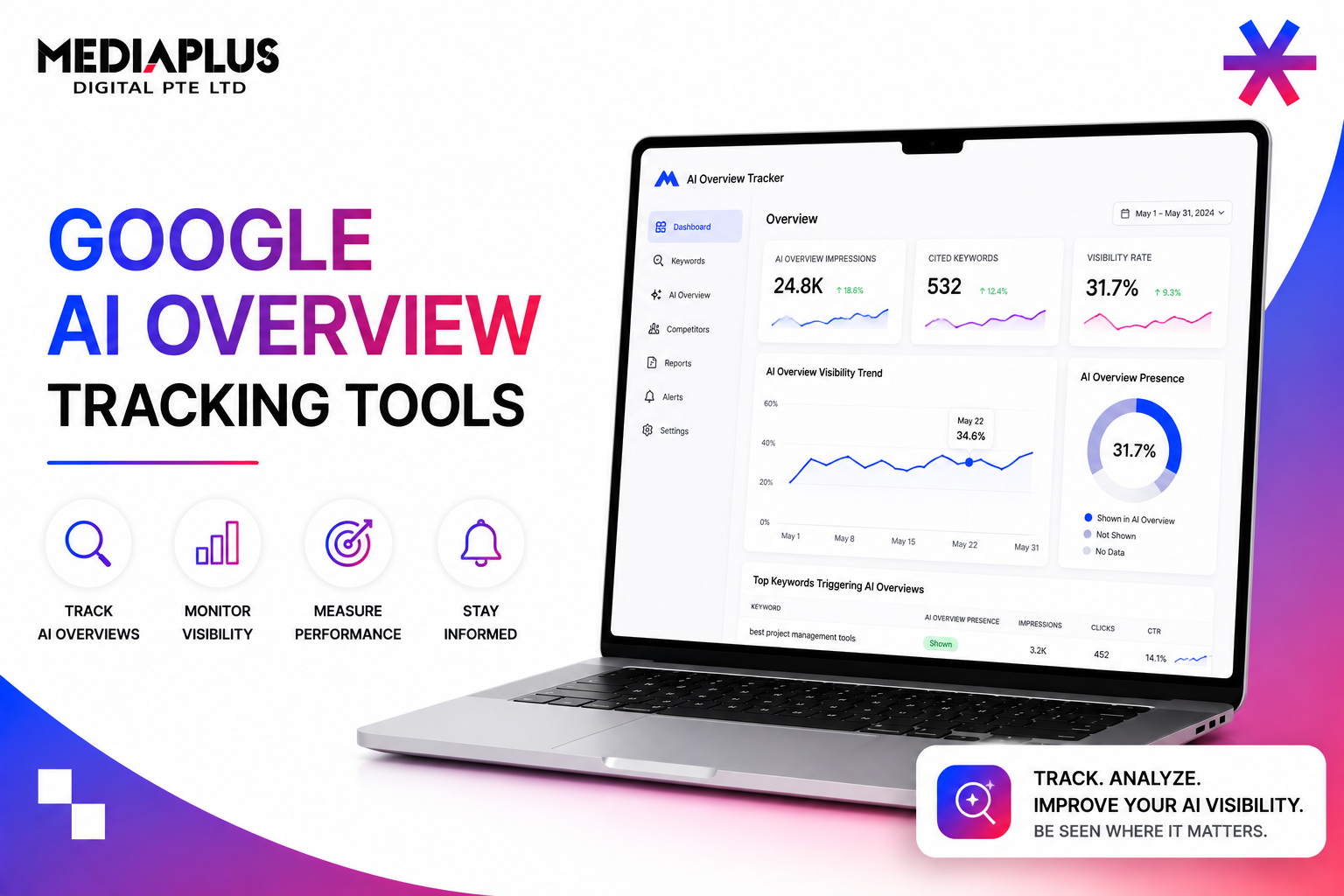
Around 38% of Singapore SERPs now show an AI Overview (BrightEdge 2026), and the share is climbing every quarter. If you are running SEO in Singapore in 2026 and not tracking AI Overview presence, you are flying blind on a quarter of your search visibility. The good news: a dozen credible tools now exist. The less-good news: they all measure slightly different things, with limitations the marketing pages do not advertise.
This guide walks through what AI Overview tracking actually measures, the four credible tools that lead the category in 2026, the lightweight alternatives if budget is tight, and a working methodology for using the data without overinterpreting it.
What AI Overview Tracking Tools Actually Measure
Most tools cluster around four data points. Reading a tool’s feature list with these four in mind reveals what the tool genuinely does versus what is marketing language.
- Presence: does an AI Overview appear for this query at all (yes/no)?
- Citation: is your domain cited as a source inside the AI Overview answer?
- Position: in what position among the cited sources does your domain appear?
- Share of voice: across a basket of queries, what percentage cite your domain vs competitors?
A fifth, harder-to-measure category is starting to emerge: sentiment of the AI Overview answer itself. Some tools attempt this; results are still rough. Treat it as directional rather than decisive.
Why AI Overview Tracking Is Harder Than SEO Rank Tracking
Classic SEO rank tracking is deterministic: rerun the same query, get roughly the same SERP. AI Overviews are not. Three reasons tools differ wildly on the same data:
- AI Overviews show only on a subset of queries, and the subset shifts. The same query may show an AI Overview on Monday and not on Friday.
- The AI Overview answer is generated, not retrieved. Two crawls of the same query can produce slightly different answers and slightly different cited sources.
- Personalisation, location, and language affect the result. A query from a Singapore IP returns different sources than the same query from a US IP.
Useful tracking treats AI Overview data as a moving average over time rather than a single-snapshot rank. Tools that average across multiple crawls per week are more reliable than tools that crawl once and treat the result as definitive.
The Four Credible Tools That Lead the Category in 2026
Profound
Profound positions itself at the enterprise end, with multi-engine monitoring covering Google AI Overviews, Perplexity, ChatGPT, and Copilot. The differentiator is compliance: audit trails, role-based access, and reporting suited to teams that need to present numbers to a CMO or board.
Pricing: Growth plan from USD 399/month, Enterprise plans custom.
Best for: Mid-market and enterprise brands tracking AI search across multiple engines with governance requirements.
Watch-out: Overkill for SMBs running fewer than 50 priority queries.
Otterly AI
Otterly is the budget-friendly entry point. It tracks brand presence across AI Overviews, ChatGPT, and Perplexity with a clean dashboard. Low commitment, easy to evaluate, and the right tool for solo marketers or small teams testing AI search before buying enterprise tooling.
Pricing: From USD 29/month.
Best for: SMBs and solo marketers running a focused query set, especially Singapore startups validating their AI search visibility.
Watch-out: Smaller query caps, less granular multi-market support.
Peec AI
Peec’s differentiator is multi-language and multi-market tracking. For Singapore brands targeting English plus Mandarin, Bahasa Indonesia, or Tagalog audiences, Peec tracks AI Overview presence per language and per locale. The reporting separates performance by market, which matters for regional SaaS and e-commerce brands.
Pricing: From USD 89/month, scaling by language and market count.
Best for: Regional brands operating across multiple Southeast Asian markets and languages.
Watch-out: Higher cost than Otterly for single-market English-only brands.
ZipTie
ZipTie claims to be the first platform to track Google AI Overviews specifically and has built an API-first product. The differentiator is integration: ZipTie data flows into BI tools, custom dashboards, or directly into a brand’s internal analytics. For teams that already have a data stack, this is the cleanest tool to pipe AI Overview tracking into existing dashboards.
Pricing: Custom; typically USD 199 to 499/month based on query volume and API usage.
Best for: Mid-market and enterprise brands with internal data teams.
Watch-out: Requires technical setup; not a self-serve dashboard for non-technical marketers.
Quick Comparison Table
|
Tool |
Starting price (USD/mo) |
Engines tracked |
Best for |
|
Profound |
399 |
Google AI Overviews, ChatGPT, Perplexity, Copilot |
Enterprise with governance needs |
|
Otterly AI |
29 |
AI Overviews, ChatGPT, Perplexity |
SMBs and solo marketers |
|
Peec AI |
89 |
AI Overviews (multi-language) |
Multi-market SEA brands |
|
ZipTie |
199+ |
AI Overviews, ChatGPT, Perplexity |
API-first teams with internal BI |
|
SE Ranking AI Visibility |
79 |
AI Overviews, ChatGPT, Perplexity |
Brands already on SE Ranking |
|
Semrush AI Toolkit |
Bundled |
AI Overviews, ChatGPT, Perplexity |
Brands already on Semrush |
|
Ahrefs AI Search |
Bundled |
AI Overviews |
Brands already on Ahrefs |
The bundled options (Semrush, Ahrefs, SE Ranking) are not always best-in-class on AI tracking specifically, but the convenience of one platform across SEO and AI search is real. For most Singapore SMEs already paying for one of these tools, start with the bundled module before adding a dedicated AI Overview tracker.
A Working Methodology for Using AI Overview Tracking
Tools generate data. Methodology generates insight. The framework below produces numbers a marketing team can act on rather than vanity dashboards.
1. Define a Priority Query Set (30 to 100 Queries)
Pick the queries that matter: high-intent commercial keywords, brand-and-modifier queries (“[brand] alternatives”, “[brand] pricing”), and the top 10 to 20 informational queries that drive your funnel. Forty to sixty queries is a workable size; over 200 is noise.
2. Establish a Baseline Across at Least Two Weeks
Single-snapshot baselines are misleading because of AI Overview volatility. Crawl each query 3 to 5 times across 10 to 14 days. Average the presence rate, citation rate, and position. That is your real baseline.
3. Segment Queries by Stage and Intent
Top-of-funnel (“what is X”) behaves differently from bottom-of-funnel (“best X for Singapore SMEs”). Segment so you can see whether AI Overviews are eating your top-funnel traffic, your comparison-stage traffic, or your branded traffic. Each calls for different remediation.
4. Pair AI Tracking with Branded Search Lift in GSC
The strongest signal that AI search is working is branded search lift in Google Search Console. When ChatGPT or AI Overviews cite your brand consistently, branded queries rise 10 to 25% over 60 to 90 days. Pair the tracking tool data with GSC branded query data; the combined trend is more reliable than either alone.
5. Treat Citations, Not Rankings, as the North-Star Metric
Position in an AI Overview citation list is less important than being cited at all. Optimise for citation share (the percentage of priority queries where you are cited) over citation position. A 40% citation share at position 3 to 5 beats a 10% citation share at position 1.
Free and Lightweight Alternatives
A team validating AI tracking before committing budget can run a useful 60 to 90 day experiment with free or near-free tools:
- Manual tracking spreadsheet: 30 priority queries, weekly check, manual entry. 60 to 90 minutes per week. Works for solo founders.
- Google AI Mode + GSC: combine your own observations with GSC branded-search lift; sufficient for a baseline.
- Tool free tiers: Otterly, ZipTie, and Peec all offer free trial windows or limited free tiers, useful for evaluation.
- Browser extensions: lightweight extensions that flag AI Overview presence on SERPs you check manually.
What Tracking Tools Will Not Give You
It is worth being honest about the limits of AI Overview tracking, because tool marketing pages tend to oversell:
- Causality. A tool will tell you that citation share rose; it will not tell you why. Improvement could be tied to content updates, backlink growth, or AI engine algorithm shifts.
- Pipeline attribution. AI tracking does not connect a citation to a closed deal. Pair with CRM data and self-reported attribution (“how did you find us”) to triangulate.
- Predictive ranking. AI engines change retrieval indexes faster than search engines change their algorithm. A citation share that holds for a quarter can shift in a week.
- Sentiment certainty. Tools that score the sentiment of AI Overview answers are still rough. Treat as directional.
- Coverage of every engine. Most tools cover Google AI Overviews, ChatGPT, and Perplexity well; Gemini, Copilot, and Meta AI are still patchy.
How to Choose the Right Tool for Your Stage
|
Stage |
Recommended approach |
|
Solo founder or SMB, validating AI search visibility |
Start with Otterly (USD 29/mo) or a manual tracking spreadsheet |
|
SMB on a major SEO suite already |
Use the bundled module (Semrush AI Toolkit, Ahrefs AI Search) before adding a dedicated tool |
|
Multi-market regional brand |
Peec AI for the multi-language and multi-locale coverage |
|
Mid-market with internal data stack |
ZipTie for API-first integration into existing dashboards |
|
Enterprise with compliance and governance needs |
Profound for the audit trail and multi-engine coverage |
Where AI Overview Tracking Is Heading
Three shifts to plan for in the next 12 to 18 months:
- Native instrumentation: Google has hinted at exposing AI Overview impression data in Search Console. When that ships, third-party tools will lose some of their edge for basic tracking.
- Conversational attribution: as more buyers go straight to ChatGPT or Perplexity, the link between AI citation and pipeline will get measurable through better source-attribution in CRMs.
- Engine consolidation: today there are 18+ tools. Expect a consolidation wave; the four covered above plus Semrush, Ahrefs, and SE Ranking are most likely to survive.
For Singapore brands building or scaling an AI search programme, the broader context is in our deep dive on AI SEO and Generative Engine Optimisation in Singapore and our companion piece on how AI is transforming digital marketing. Tracking tools work best when they sit inside a structured GEO programme, not as a standalone dashboard.
If you want a candid second opinion on which tracking tool fits your stage, or to fold AI tracking into a wider SEO programme or content cluster strategy, the team at MediaPlus Digital runs both. More on the MediaPlus blog.