
More of your customers are starting their search inside an AI assistant. They ask ChatGPT for “best accounting firm in Singapore”, ask Gemini to compare two clinics, or ask Perplexity which CRM suits an SME on the Productivity Solutions Grant. The AI answers in a paragraph and names a handful of businesses. If yours is not one of them, the customer may never reach your website at all.
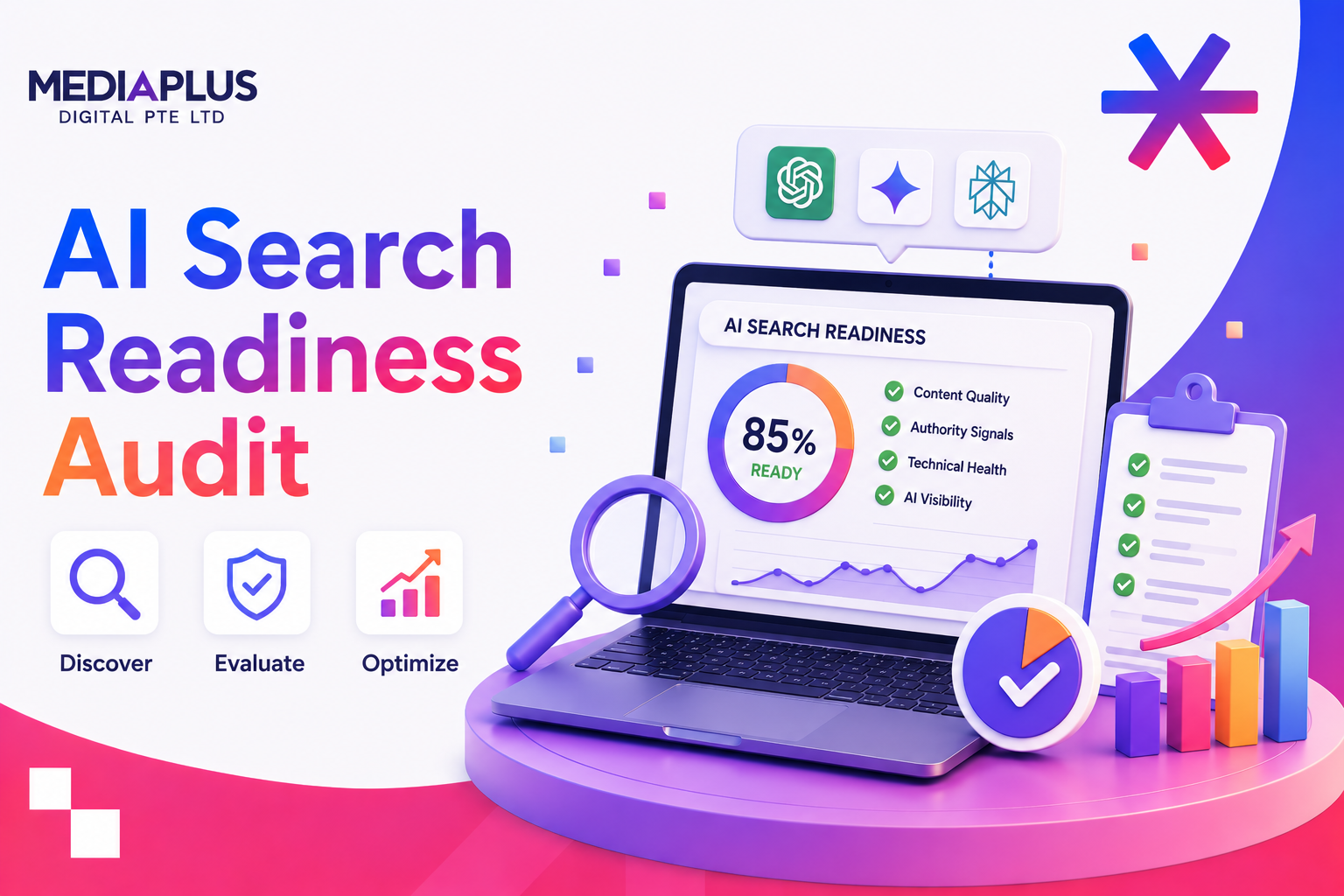
This guide is built as an audit. It walks through how each engine actually finds the businesses it cites, what makes a page quotable, and a checklist you can run against your own site this week. It is written for Singapore business owners and marketers, so the examples, listings and entity signals are local. For the strategy and service side, see our AI SEO services in Singapore, which sits alongside our core SEO services work.
Key takeaways
- Each engine sources citations differently. Perplexity retrieves live, ChatGPT search leans on the Bing index, and Gemini and Google AI Overviews ground answers in Google Search results.
- The most common reason for zero citations is technical. If you block the AI crawlers, no amount of good content will help.
- Citable pages answer the question in the first two sentences, back claims with sourced statistics, and use clean heading structure plus schema.
- Third-party signals matter as much as your own site. Being named on Singapore “best of” lists, directories and review platforms builds the cross-source agreement that engines look for.
- Track citations directly by prompting the engines, and track the referral traffic they send with proper analytics tagging.
How each AI engine sources its citations
Getting cited starts with understanding where each engine looks. The three that matter most for a Singapore audience pull from different places, which changes how quickly your work shows up and what you should prioritise.
- Perplexity runs live retrieval. When a user asks a question, it issues fresh web searches, reads the top pages in real time, and cites them inline. Because it fetches at query time, recency and crawl access matter a lot, and structural fixes tend to appear here fastest.
- ChatGPT search relies heavily on a search index (Microsoft Bing) to find candidate pages, then summarises and cites them. This means your Bing presence and the brand mentions Bing trusts both feed into whether ChatGPT can see you. ChatGPT also draws on training data for general answers, but for current, citeable answers it uses search.
- Google AI Overviews and Gemini ground their answers in Google Search. AI Overviews appear at the top of the results page and cite supporting links, while Gemini uses a “grounding with Google Search” step to fetch and attribute live sources. If you already rank in Google for a query, you have a strong head start on being one of the cited sources.
|
Engine |
How it finds sources |
What to prioritise |
|
Perplexity |
Live web retrieval at query time, inline citations |
Crawl access for PerplexityBot, freshness, answer-first formatting |
|
ChatGPT search |
Search index (Bing) plus brand and entity signals |
Bing indexing, third-party mentions, GPTBot and OAI-SearchBot access |
|
Google AI Overviews |
Grounded in Google Search ranking |
Traditional Google ranking, structured content, Google-Extended access |
|
Gemini |
Grounding with Google Search, live fetch |
Google visibility, clear entities, factual extractable passages |
The practical takeaway: there is no single “AI algorithm” to game. Strong, well-structured pages that already perform in classic search are the foundation, and each engine adds its own retrieval layer on top. This is why generative engine optimisation builds on SEO rather than replacing it, and why a solid GEO foundation starts with the basics done well.
What makes a page citable
An engine cites a passage because it answers the user’s question cleanly and looks trustworthy enough to quote. Across the engines, the same handful of qualities keep coming up.
Answer the question first
Lead each section with a self-contained answer in the first one to two sentences. Engines often lift just the opening of a section, so if that opening only makes sense after reading the rest, it gets skipped. Put the direct answer up top, then expand. This is the heart of answer engine optimisation.
Be specific and factual
Vague marketing copy does not get quoted. Concrete claims do. Use real numbers, dates, prices in S$, and named specifics. For example, stating that the Productivity Solutions Grant supports up to 50 percent of approved costs for eligible Singapore SMEs is a quotable fact. When you cite a statistic, attribute it to its source so the claim carries weight.
Make entities clear
Engines need to know exactly who you are. Use one consistent business name, description and category everywhere. Disambiguating your entity, so the model is confident “MediaPlus Digital” is a Singapore web design and digital marketing agency, correlates strongly with being cited. Clear entities also feed E-E-A-T and topical authority.
Show experience and authorship
Name a real author with credentials and a linked bio. First-hand experience, original data and a track record are signals engines reward, especially for advice and money-related topics.
Keep it fresh
Pages updated recently are favoured, particularly by Perplexity. Add a visible last-updated date and refresh key pages at least quarterly.
Earn agreement across sources
Engines gain confidence when several independent sources say the same thing about you. If your business appears with consistent positioning on your site, on Singapore directories, on review platforms and in industry articles, you become a safer pick to cite. The same thinking sits behind building AI-friendly websites.
The action checklist
Run this against your own site. It is grouped so you can hand each block to the right person on your team.
Technical access
- Confirm your robots.txt allows the major AI crawlers (see the user-agent table below).
- Check that key pages render without requiring JavaScript, since some crawlers struggle with client-side rendering.
- Make sure your site is indexed in both Google and Bing, not just Google.
- Keep an XML sitemap current and submitted to both search engines.
Structured data
- Add Organization schema with your name, logo, address and sameAs links to your profiles.
- Use Article schema with a named author, plus Person schema with the author’s LinkedIn profile.
- Add FAQPage schema to pages with a genuine FAQ block.
- Add LocalBusiness schema with your Singapore address and contact details.
Content formatting
- Open every section with a direct, standalone answer in one to two sentences.
- Include a specific statistic, figure or date in the first part of each key page, with its source.
- Use a single H1 and a clean H2 and H3 hierarchy without skipped levels.
- Use tables and short numbered lists for comparisons and steps.
- Add a focused FAQ of four to six real questions rather than padding with twenty.
Off-site and entity signals
- Get listed on Singapore “best of” and directory pages that the engines pull from.
- Keep your name, address and phone number identical across every listing.
- Build presence on review platforms relevant to your industry.
- Run digital PR to earn mentions in Singapore publications and niche blogs.
Tracking
- Test your priority prompts in each engine monthly and log whether you are cited.
- Tag and segment AI referral traffic in your analytics.
For a deeper structural pass, our AI Overview citations guide covers how to win the cited slots specifically inside Google’s AI Overviews.
Allowing the AI crawlers
The single most common reason a business gets zero AI citations is that its site quietly blocks the crawlers. If a crawler cannot fetch your page, that engine cannot cite you, regardless of how good your content is. Audit your robots.txt first.
|
User-agent |
Engine or owner |
What it does |
Recommended for citations |
|
GPTBot |
OpenAI |
Crawls content used by OpenAI |
Allow |
|
OAI-SearchBot |
OpenAI |
Powers ChatGPT search results |
Allow |
|
PerplexityBot |
Perplexity |
Indexes pages for Perplexity answers |
Allow |
|
ClaudeBot |
Anthropic |
Crawls content for Claude |
Allow |
|
Google-Extended |
|
Controls use in Gemini and AI features |
Allow |
|
Applebot-Extended |
Apple |
Controls use in Apple Intelligence |
Optional |
A note on choice: allowing these crawlers is what makes citation possible, but it also lets your content be used more broadly. For most Singapore businesses chasing visibility, allowing them is the right call. If you want to permit citation while limiting training use, allow the search-oriented agents and review the training-oriented ones case by case.
Here is a simple robots.txt that allows the main AI crawlers while keeping a private folder out of reach:
# robots.txt – allow AI crawlers for citation visibility
User-agent: GPTBot
Allow: /
User-agent: OAI-SearchBot
Allow: /
User-agent: PerplexityBot
Allow: /
User-agent: ClaudeBot
Allow: /
User-agent: Google-Extended
Allow: /
# Default rules for all other crawlers
User-agent: *
Allow: /
Disallow: /private/
Sitemap: https://www.example.com.sg/sitemap.xml
Singapore entity signals
For local queries, the engines lean on the same local signals that power Google Maps and local search. Getting these right makes you far more likely to be the business an engine names when a user adds “in Singapore” or a neighbourhood to their question.
- Google Business Profile. Claim and complete it, with the correct category, address, hours and photos. This is the backbone of local visibility, and our Google Business Profile checklist walks through it step by step.
- Consistent NAP. Your business name, Singapore address and phone number must match exactly across your site, your profile and every directory. Mismatches confuse entity resolution.
- Local listings and directories. Get onto the Singapore business directories and industry-specific listings that show up in local results, since these are often the third-party pages engines cite.
- .sg context and local proof. Reference your Singapore location, serve content in Singapore English, mention local schemes such as the PSG where relevant, and gather reviews from local customers.
These signals overlap heavily with classic local SEO, which remains the fastest route to being the cited choice for “near me” and “in Singapore” questions.
Getting onto third-party lists Singapore engines pull from
When someone asks an AI for the “best digital marketing agency in Singapore”, the engine frequently reads a roundup article or directory rather than any single company website, then names the businesses it finds there. That makes inclusion on these third-party pages one of the highest-leverage moves you can make.
- Identify which roundups, “best of” lists and directories currently rank for your key Singapore queries by searching those queries yourself.
- Reach out to the publishers of relevant lists with a clear, factual pitch for why your business belongs.
- Pursue earned mentions through digital PR, guest contributions and data or survey stories that local publications want to cover.
- Keep your positioning identical across these placements so the engines see one consistent story.
This is reputation building, and it compounds. The more independent Singapore sources describe your business the same way, the more confidently every engine can cite you.
Tracking AI citations and mentions
You cannot improve what you do not measure, and AI citations need two separate kinds of tracking: are you being cited, and is it sending traffic.
Track citations directly. Keep a list of ten to fifteen priority prompts that a real customer might ask, then run them in ChatGPT, Gemini and Perplexity once a month. Record whether you appear, which page is cited, and which competitors show up. This manual log is the most reliable signal of progress, and dedicated AI Overview tracking tools can automate part of it for Google.
Track the referral traffic. AI engines that send clicks often arrive poorly labelled in analytics, sometimes as direct traffic. Set up segments and tagging so you can isolate visits from ChatGPT, Perplexity and Google AI surfaces. Our guide to tracking AI Overview traffic in GA4 and GTM shows how to capture this cleanly so you can prove the value of the work.
Review both monthly. Citations usually move first, often within one to three weeks for Perplexity, with Google surfaces taking longer.
How this fits the rest of AI search
ChatGPT, Gemini and Perplexity are three of the surfaces, and Google is rolling its AI answers deeper into the results page. If you want the wider picture of where Google is heading, our explainer on Google AI Mode covers the conversational search experience that now sits beside traditional results. If you want the conceptual groundwork, our overview of getting your brand cited across ChatGPT, Perplexity, Gemini and Copilot is useful related reading alongside this more checklist-driven audit.
Frequently asked questions
How long does it take to get cited after fixing my site?
Perplexity tends to reflect structural changes fastest, often within one to three weeks, because it retrieves live. ChatGPT and Google surfaces generally take longer, from a few weeks to a couple of months, and reputation-based signals such as new listings or mentions take longest.
Do I need an llms.txt file to get cited?
No. An llms.txt file is optional and there is no strong evidence it drives citations on its own. Prioritise crawler access in robots.txt, clean structure and schema first. If you add llms.txt later as a content map, treat it as a low-priority extra.
Will blocking AI crawlers protect my content without hurting me?
Blocking a crawler makes you invisible to that engine, so you forfeit any chance of being cited there. If visibility is your goal, allow the citation-focused crawlers. You can be selective about training-only agents if you have concerns.
Is being cited the same as ranking number one in Google?
Not quite. Strong Google ranking helps a lot, especially for Gemini and AI Overviews, but engines also weigh structure, freshness, clear entities and third-party agreement. A page can be cited without holding the top organic spot if it answers the question more cleanly.
Does my business need a lot of content to be cited?
No. Quality and structure beat length. A focused page that answers the question in its opening lines, backs claims with sourced figures and uses clean headings will out-cite a long, unfocused article.
How do I know if an AI engine is already mentioning my business?
Ask it. Run your priority customer questions in each engine and note whether and how you appear. Pair that with analytics segments to see whether those surfaces are sending you traffic.
Should small Singapore SMEs bother with this, or only large brands?
SMEs benefit a great deal, because local “in Singapore” queries often pull from directories and reviews where a focused SME can earn a place faster than in broad national rankings. Strong local entity signals are within reach of any well-run small business.
Get cited where your customers are now searching
Getting named by ChatGPT, Gemini and Perplexity is earned, not bought, and it rewards businesses that combine clean technical setup, genuinely citable content and consistent Singapore entity signals. If you want a team to run the audit, fix the crawler and schema issues, and build the third-party presence that wins citations, explore our AI SEO services in Singapore and let us help your business show up in the answers that matter.