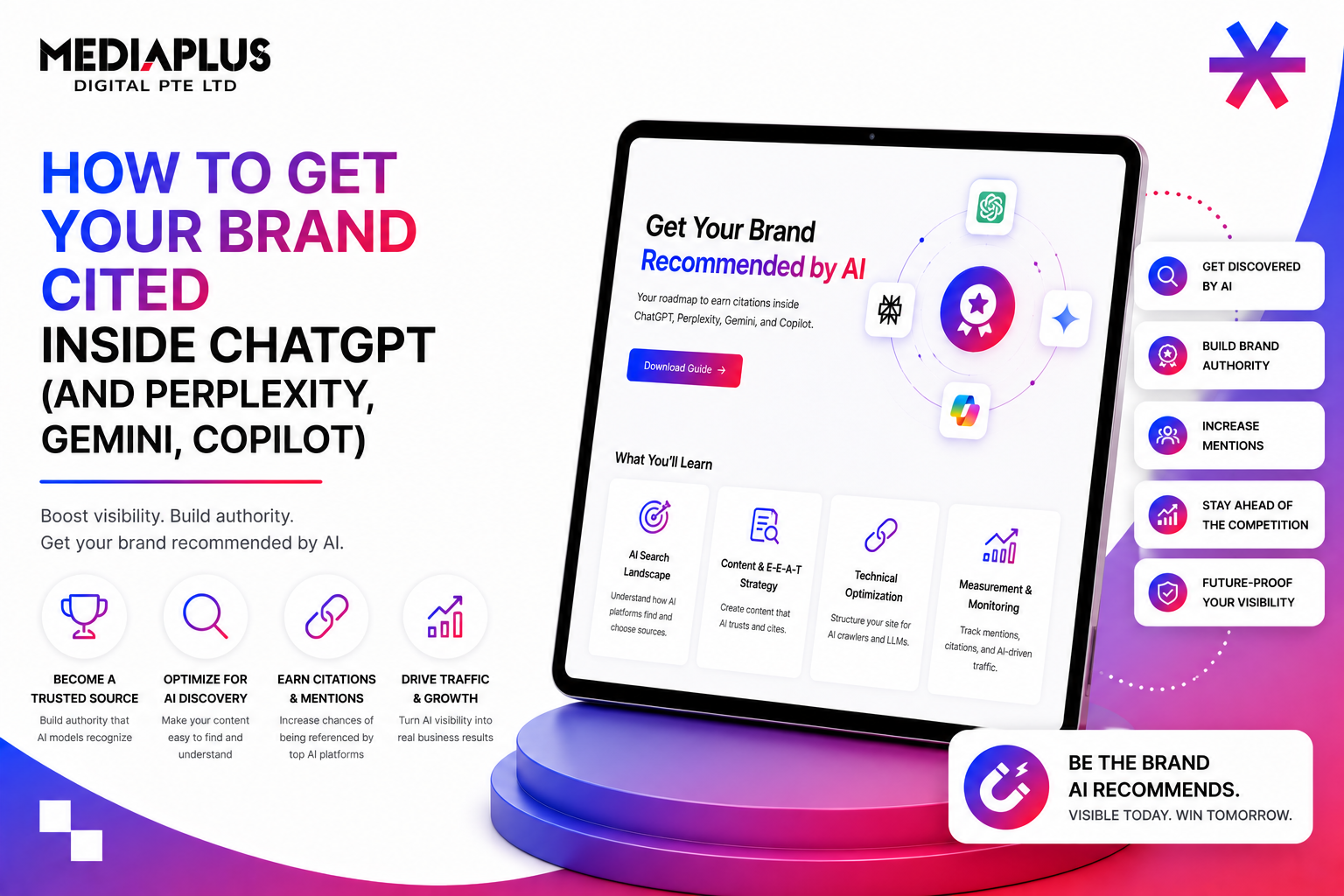
Around 38% of Singapore SERPs now show an AI Overview (BrightEdge 2026), and a growing share of B2B and SaaS buyers ask ChatGPT and Perplexity for vendor shortlists before they click a single result. If your brand is not in the answer, you are not in the consideration set. This is the central pitch of AI SEO and Generative Engine Optimisation, and the difference between SEO in 2022 and SEO in 2026.
The interesting question is no longer “how do I rank on Google”. It is “how do I become one of the eight sources ChatGPT actually quotes when someone asks about my category”. This guide is a working answer.
How AI Search Engines Actually Choose Who to Cite
ChatGPT, Perplexity, Gemini, and Copilot do not all work the same way, but the citation mechanism converges on a similar pipeline. Understanding the pipeline tells you which levers to pull.
- Retrieval: the engine searches a large index (live web, Bing, Google, internal training data) for sources relevant to the prompt.
- Ranking: the engine ranks retrieved sources by relevance, authority, freshness, and structural quality.
- Selection: the top 5 to 12 sources are passed to the language model as context.
- Synthesis: the model writes an answer, attributing claims to whichever sources support them.
- Citation: a subset of sources is shown to the user as the visible footnotes.
The implication: to be cited, you must be retrievable, you must rank well in the engine’s retrieval index, you must be structurally easy for the model to quote, and you must be supported by enough authority signals that the model trusts you. Each layer has different optimisation moves.
The On-Site Signals That Get You Cited
Princeton’s 2024 GEO study and the larger 2025-2026 industry analyses converge on five on-site patterns that materially lift citation rates.
1. Fact density
Pages packed with named statistics, dated sources, and direct quotations get cited up to 40% more often than equivalent pages without them (Princeton GEO study, 2024). The reason is mechanical: LLMs generate answers that need supporting claims, and pages that supply ready-made claims are easier to quote than pages that only paraphrase.
Practical move: every important paragraph should contain at least one specific fact, statistic, or quotable claim with an attribution year.
2. Direct-answer blocks
Short, self-contained paragraphs (40 to 60 words) that begin with a direct answer to a specific question are far more likely to be quoted verbatim. These look almost identical to Featured Snippet-optimised paragraphs, with one difference: they should appear throughout the body, not only at the top of the page.
3. FAQ structures
Pages with explicit FAQ sections average 4.9 citations per source vs 4.4 for pages without (Princeton). FAQ schema makes the citation lift larger still, because it tells the retrieval engine which paragraph answers which question.
4. Quotability of structure
Headings, bullet lists, and numbered steps make content easier for the model to lift cleanly. Pages that bury insight inside 800-word essay paragraphs get summarised; pages that surface insight as a 6-item list get quoted as a 6-item list.
5. Freshness
Pages with a dateModified within the past 90 days receive priority for time-sensitive queries (anything containing “best”, “latest”, “2026”, or a recent event). Republishing evergreen content quarterly with an updated dateModified produces real citation lift.
The Off-Site Signals Most Brands Underestimate
You can have perfect on-site structure and still be invisible inside ChatGPT if the broader web does not vouch for you. AI engines treat earned mentions and community presence as proxies for credibility.
- Backlinks from authoritative domains. Sites with 32,000+ referring domains are roughly 3.5x more likely to be cited by ChatGPT than lower-authority counterparts.
- Community presence on Reddit, Quora, Stack Overflow, and Discord. These platforms are heavily indexed by AI engines and disproportionately quoted.
- Review platforms: G2, Trustpilot, Capterra, Clutch. AI engines pull quoted reviews and aggregated ratings into answers about “best X” or “top X” queries.
- Earned media citations: Tech in Asia, The Business Times, e27, DealStreetAsia for Singapore B2B and SaaS audiences.
- YouTube and podcast appearances. Transcripts are increasingly indexed by GPT-class models. A guest spot on a relevant Singapore podcast can earn citations indirectly.
- Wikipedia mentions, where eligible. Strong corroborating evidence the model treats as authoritative.
Most Singapore brands obsess over on-page tweaks and ignore off-site signal-building. The brands that actually get cited in 2026 are running SEO programmes in Singapore that allocate at least 40% of effort to off-site work: digital PR, expert quotes, community engagement, review-platform optimisation.
How the Four Major Engines Differ
|
Engine |
Retrieval source |
Biases |
Best lever |
|
ChatGPT (browsing on) |
Bing index + selected sources |
Authority, structural clarity, freshness |
Backlinks + FAQ schema |
|
Perplexity |
Live web + academic sources |
Citation density, recency, primary sources |
Fact density + earned media |
|
Google Gemini / AI Overviews |
Google index |
Classic Google SEO + E-E-A-T |
Schema + topical authority |
|
Microsoft Copilot |
Bing index + Microsoft Graph |
Authority, structural clarity |
Bing Webmaster optimisation |
|
Meta AI |
Meta proprietary + open web |
Conversational tone, social signals |
Community presence |
A brand serious about GEO does not optimise for one engine. The structural moves that help one help most, but the off-site mix differs per engine: ChatGPT rewards backlinks, Perplexity rewards published primary research, Gemini rewards classic SEO depth, Copilot rewards Bing-specific optimisation.
Schema Markup That Matters in 2026
Schema.org markup has stopped being a nice-to-have. AI engines parse structured data to understand entities and relationships. The schemas that lift citation rates most:
- HowTo : step-by-step instructions for procedural queries.
- Article + author + dateModified : for editorial content with named experts.
- Organization + sameAs : links your brand entity to LinkedIn, Crunchbase, Wikipedia, etc.
- Product + AggregateRating + Review : for category and comparison queries.
- BreadcrumbList : helps engines understand site hierarchy.
- WebSite + SearchAction : improves discoverability in retrieval indexes.
Test every schema implementation with Google’s Rich Results Test and the Schema.org validator before launch. Broken schema is worse than no schema. Our web design team builds schema into every site by default, not as a post-launch add-on.
Five Content Patterns That Get Quoted Repeatedly
Analysis of the most-cited sources in ChatGPT, Perplexity, and Gemini across software, B2B SaaS, marketing, and finance queries surfaces five repeatable patterns.
- Definitive lists. “The 10 best [thing] in [year]” gets cited because the model is often answering exactly that question.
- Original research and proprietary data. “We surveyed 500 Singapore SMEs” content has near-monopoly citation power because no other source has the data.
- Comparison tables. “[Tool A] vs [Tool B]” pages with explicit feature matrices get quoted in vendor-comparison answers.
- Definitional explainers. “What is [term]” pages with concise, encyclopedic answers are cited as canonical references.
- Step-by-step procedural guides. “How to [task]” with explicit numbered steps gets quoted by procedural queries.
These patterns also drive classic SEO performance, which is convenient. Our content cluster strategy and E-E-A-T and topical authority guides go deeper on how to organise a programme around these formats.
A 30-Day GEO Implementation Track
You will not become the most-cited source in your category in a sprint. But you can meaningfully lift citation share in 30 days with the following sequence.
|
Week |
Action |
Outcome to expect |
|
Week 1 |
Audit current visibility in ChatGPT, Perplexity, Gemini for 30 priority queries. Record baseline. |
Honest starting position |
|
Week 1 to 2 |
Implement FAQ schema and dateModified on the top 20 commercial pages. |
Faster retrieval, better quotability |
|
Week 2 to 3 |
Rewrite the top 10 pages with direct-answer blocks (40-60 words) for each priority query. |
Lifts on Perplexity within days, ChatGPT within 2-4 weeks |
|
Week 3 |
Publish one piece of original research or proprietary data (a survey, a benchmark, a study). |
Earns citations and links for months |
|
Week 3 to 4 |
Pitch the research to industry media (Tech in Asia, e27, The Business Times). |
Off-site signals start compounding |
|
Week 4 |
Engage authentically in 3 to 5 high-relevance Reddit, Quora, or LinkedIn threads per week. |
Builds the community footprint AI engines weigh heavily |
|
Week 4+ |
Re-test the same 30 queries from Week 1 against ChatGPT and Perplexity. |
Measurable lift in citation share |
How to Measure GEO Without Pretending the Numbers Are Precise
GEO measurement is not yet as clean as SEO. There is no Google Search Console for ChatGPT. The working approach is mixed-method:
- Manual testing: run 30 to 50 priority queries through each engine monthly. Record whether you are cited, in what position, and what the AI says about you.
- Branded search lift: AI citation typically lifts branded search 10 to 25% over 90 days. Track in Google Search Console.
- Referral traffic from ChatGPT, Perplexity, and Copilot. Tag these as distinct sources in GA4.
- Tools that monitor citation: Profound, Otterly.AI, Peec AI, ZipTie. None are perfect; treat as directional.
- Pipeline impact: when sales says “they said ChatGPT recommended us”, log it.
What Does Not Work (Yet) in 2026
- Stuffing content with AI-friendly keywords. Engines deprioritise obviously over-optimised pages.
- Buying mass low-quality backlinks. Worked for SEO in 2014, fails for GEO in 2026; engines weight authority and topical relevance heavily.
- Generating thousands of AI-written pages. Engines deduplicate aggressively; near-identical content from one domain does not lift citation count.
- Optimising for ChatGPT only. Engines change retrieval indexes; diversification across Perplexity, Gemini, Copilot protects you from any single platform shift.
- Treating GEO as a separate workstream from SEO. The compounding wins come from doing both with the same content programme.
For a Singapore-specific GEO programme that integrates with classic SEO, content, and PR, talk to MediaPlus AI SEO and GEO. The companion read on how AI is transforming digital marketing covers the broader trend; the MediaPlus blog has more deep dives.