
Creating content that ranks today is no longer about publishing random blog posts.
Search engines now prioritise structure, depth, and user experience. That’s why content cluster strategy has become one of the most effective SEO frameworks.
If done correctly, it helps you rank faster, build topical authority, and turn content into a scalable growth engine.
What Is a Content Cluster Strategy?
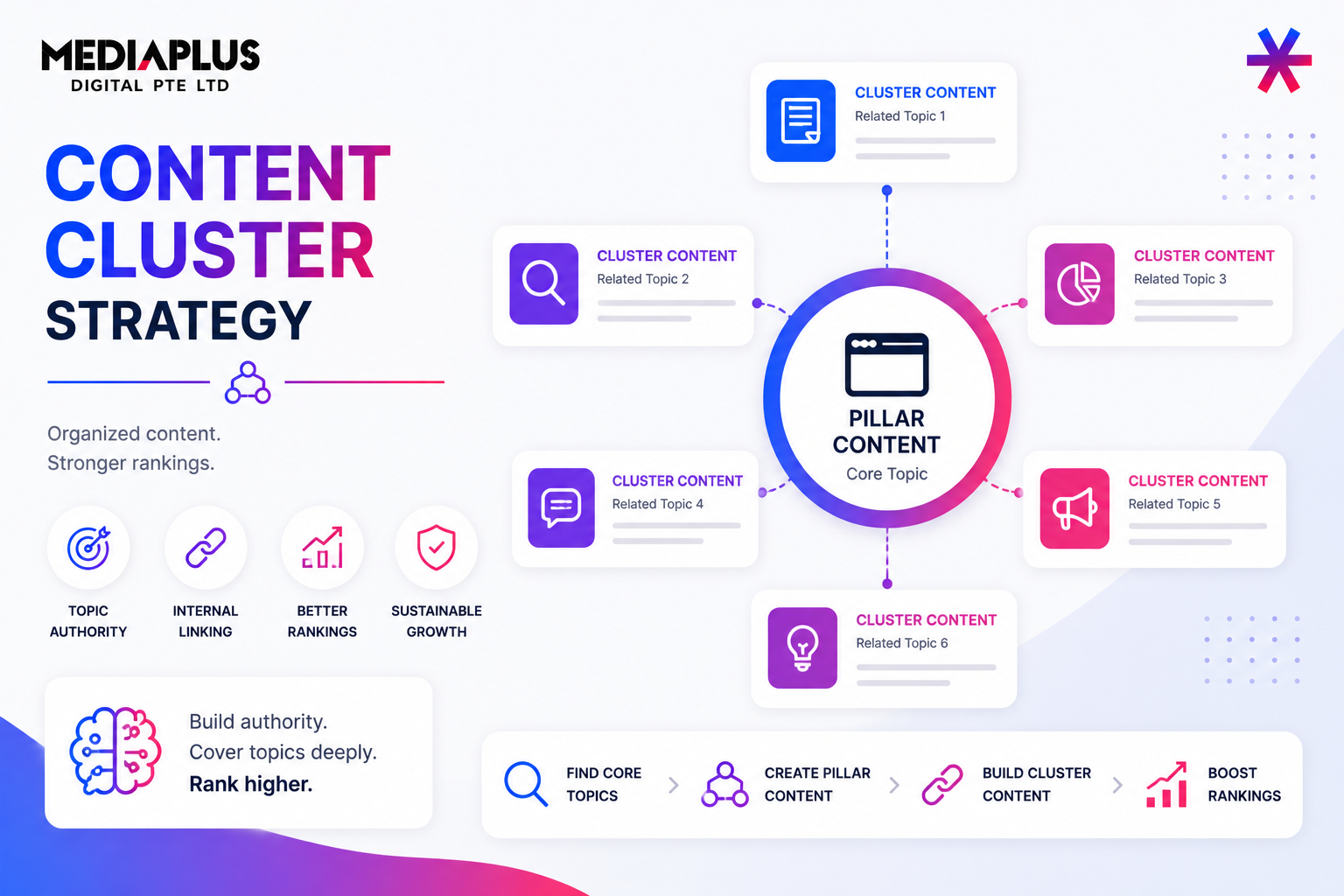
A content cluster strategy is a structured approach to content creation where multiple pieces of content are grouped around a central topic.
It consists of three core elements:
- Pillar page: A comprehensive page covering a broad topic
- Cluster content: Supporting articles that dive deeper into subtopics
- Internal links: Connections between all related content
Instead of publishing isolated articles, you create a connected ecosystem of content that improves both SEO and user experience .
Why Content Clusters Matter in Modern SEO
Search engines have evolved beyond simple keyword matching.
With advancements like machine learning and intent-based ranking, Google now evaluates:
- How well you cover a topic
- How your content is structured
- How users interact with your website
Content clusters help you:
- Build topical authority
- Improve internal linking
- Reduce keyword cannibalisation
- Guide users through the funnel
This makes your website easier to understand for both users and search engines.
How a Content Cluster Strategy Works
To understand this better, think of your website as a knowledge hub.
Example:
Pillar topic: Digital Marketing
Cluster content:
- SEO strategies
- Google Ads strategy
- Social media marketing
- Email marketing
Each cluster article links back to the pillar page and to other related articles.
This creates a strong network that signals relevance and authority.
Key Benefits of Content Clusters
1. Improve SEO Performance
Content clusters help search engines understand your expertise.
By covering a topic in depth, you increase your chances of ranking for:
- Primary keywords
- Long-tail keywords
- Related search queries
2. Increase Time on Site
Users can easily navigate between related topics.
This leads to:
- Longer session duration
- Lower bounce rates
- Higher engagement
3. Support the Full Customer Journey
Clusters allow you to create content for every stage:
- Awareness (informational content)
- Consideration (comparison, guides)
- Decision (service or product pages)
4. Build Authority and Backlinks
Well-structured content makes your site appear more credible.
This increases the likelihood of:
- Earning backlinks
- Being referenced by other sites
- Becoming a trusted resource
How to Create a Content Cluster Strategy
Step 1: Define Your Core Topics
Start with 3–5 main topics that align with your business.
These should be:
- Relevant to your services
- High in search demand
- Valuable to your audience
Example:
- SEO
- Paid Ads
- Web Design
- E-commerce
Step 2: Perform Keyword Research
Identify:
- Primary keywords (pillar topics)
- Secondary keywords (supporting topics)
- Long-tail keywords (specific queries)
Also include:
- Question-based keywords
- Intent-based variations
This ensures your content covers the topic comprehensively .
Step 3: Group Keywords into Clusters
Organise keywords into logical groups.
Each group should represent a subtopic under your pillar.
Example:
Pillar: SEO
Clusters:
- On-page SEO
- Technical SEO
- Link building
- Local SEO
Step 4: Create Pillar Pages
Pillar pages should:
- Cover the topic broadly
- Link to all supporting content
- Provide high-level insights
Think of them as the main hub for your topic.
Step 5: Create Cluster Content
Each cluster article should:
- Focus on one specific topic
- Target a specific keyword
- Provide detailed, actionable insights
Also:
- Link back to the pillar page
- Link to related cluster articles
Step 6: Build Internal Links
Internal linking is critical.
Best practices:
- Link naturally within content
- Use relevant anchor text
- Connect related topics
This strengthens your site structure and improves SEO performance .
Step 7: Measure and Optimise
Track performance regularly.
Key metrics:
- Organic traffic
- Keyword rankings
- Engagement metrics
- Conversions
Update content based on performance and trends.
Advanced Strategies Most Guides Miss
1. Map Clusters to Search Intent
Don’t just group by topic. Group by intent:
- Informational
- Commercial
- Transactional
This ensures you capture users at every stage.
2. Create Multiple Pillar Pages
Instead of one pillar page, build several:
- Service-based pillars
- Industry-specific pillars
- Knowledge hubs
This expands your reach across different audiences.
3. Repurpose Content Across Formats
Clusters don’t have to be only blog posts.
You can include:
- Videos
- Infographics
- Case studies
- Webinars
This increases engagement and reach.
4. Identify Content Gaps
Look at competitors and find:
- Missing topics
- Weak content areas
- Untapped keywords
Filling these gaps gives you a competitive advantage.
5. Combine with E-E-A-T
To maximise results:
- Add expert insights
- Include real examples
- Show experience and credibility
This strengthens both rankings and trust.
Common Mistakes to Avoid
Avoid these common issues:
- Publishing unrelated content
- Weak internal linking
- Overlapping keywords (cannibalisation)
- Thin or low-quality articles
- Ignoring user intent
These can weaken your entire cluster strategy.
Final Thoughts
A content cluster strategy is one of the most effective ways to scale SEO in 2026.
Instead of creating isolated content, you build a structured ecosystem that:
- Improves rankings
- Strengthens authority
- Enhances user experience
- Drives long-term growth
For businesses that want to implement this at scale, working with experienced teams like MediaPlus Digital Singapore can help structure content across SEO services Singapore, content strategy, and conversion rate optimization services, ensuring your content not only ranks but also converts.