Search engines are no longer just ranking pages. They are evaluating who you are, what you know, and whether you can be trusted.
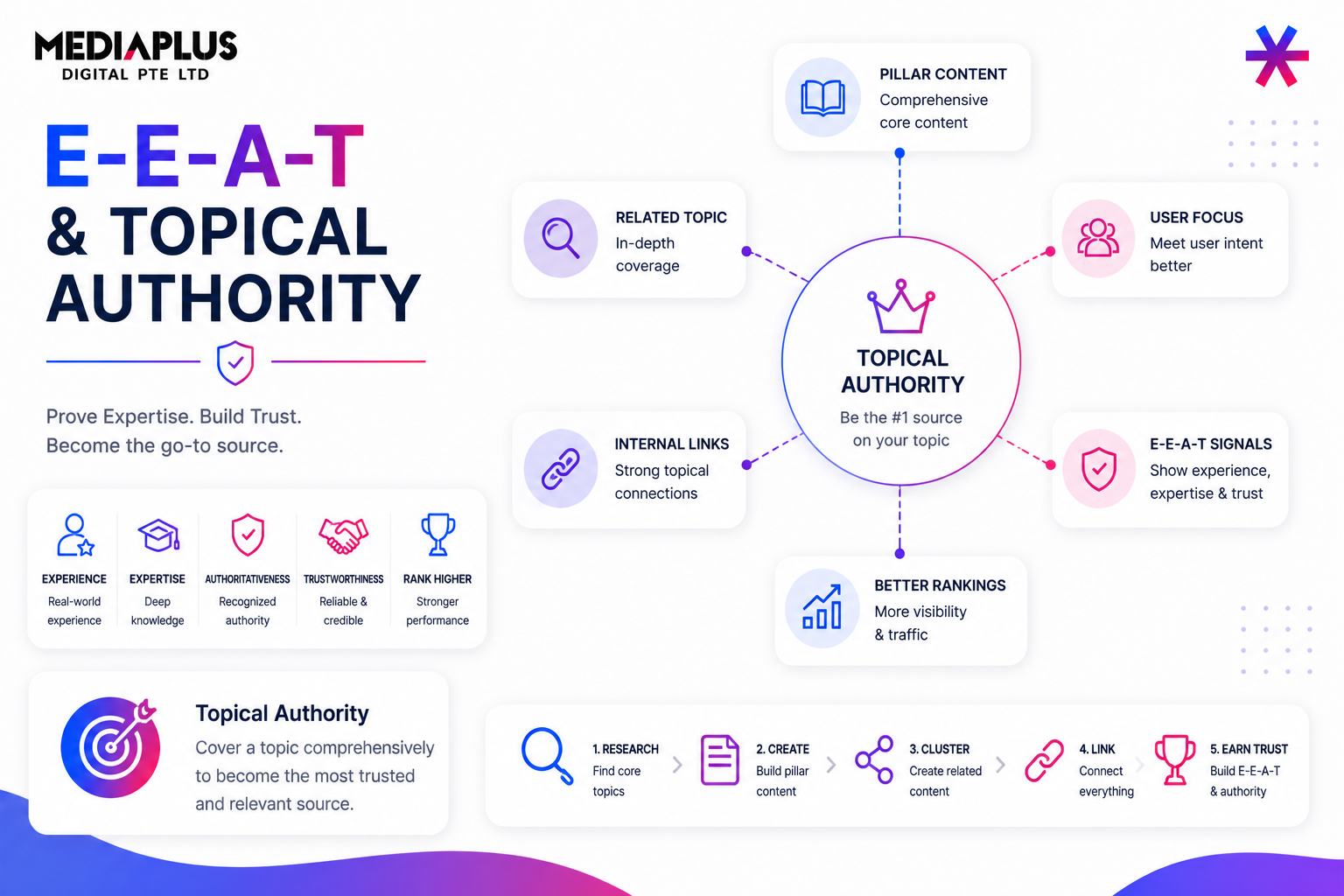
That’s where E-E-A-T (Experience, Expertise, Authoritativeness, Trustworthiness) and Topical Authority come in.
Together, they form the foundation of modern SEO. If you want consistent rankings and long-term growth, you need both.
What Is Topical Authority?
Topical authority refers to how strongly your website is recognised as a trusted source on a specific subject.
Instead of covering broad topics, search engines now favour websites that go deep into a niche.
For example:
- A general “fitness” site has low topical authority
- A site focused on “keto diet for athletes” has stronger topical authority
When your website consistently publishes high-quality content around a specific theme, search engines begin to associate your domain with that topic.
As a result:
- Your pages rank faster
- You gain visibility across related keywords
- You build long-term SEO momentum
This aligns with how Google evaluates expertise within a niche, not just individual pages .
Why Topical Authority Matters More Than Ever
SEO is becoming more competitive, especially with AI-generated content flooding the internet.
To stand out, Google looks for:
- Depth of coverage across a topic
- Consistency in content
- Internal linking between related pages
- Authority signals across your domain
Topical authority acts as a ranking multiplier.
Instead of ranking one page, you start ranking entire clusters of content.
What Is E-E-A-T?
E-E-A-T stands for:
- Experience
- Expertise
- Authoritativeness
- Trustworthiness
These are the criteria Google uses to evaluate content quality and credibility.
Let’s break them down.
Experience
This is about first-hand knowledge.
Google now prioritises content that shows real-world experience.
Examples:
- Product reviews based on actual use
- Case studies with real data
- Personal insights and results
Content written from experience feels more authentic and valuable.
Expertise
Expertise refers to the depth of knowledge on a subject.
This can be demonstrated through:
- Detailed explanations
- Accurate information
- Industry-specific insights
For technical or sensitive topics, expertise becomes even more important.
Authoritativeness
Authority is built over time.
It comes from:
- Backlinks from reputable websites
- Mentions across the web
- Strong brand presence
If other trusted sources reference your content, your authority increases.
Trustworthiness
Trust is the foundation of everything.
Google looks for signals such as:
- Accurate and updated content
- Secure website (HTTPS)
- Clear authorship and transparency
- Reliable sources and references
Without trust, rankings are difficult to sustain.
How E-E-A-T and Topical Authority Work Together
Topical authority and E-E-A-T are not separate concepts. They reinforce each other.
- Topical authority shows what you cover deeply
- E-E-A-T shows how credible you are in that topic
For example:
- You publish 50 articles about skincare → topical authority
- Your content includes expert insights, real reviews, and backlinks → E-E-A-T
When combined, they significantly improve your ability to rank.
Building Topical Authority Through Content Structure
One of the most effective ways to build authority is through structured content.
1. Create Topic Clusters
Start with a core topic, then build supporting content around it.
Example:
Core topic: “Digital Marketing Strategy”
Supporting content:
- SEO strategies
- Paid ads
- Content marketing
- Social media marketing
All pages should link back to the main topic and to each other.
This creates a strong topical network.
2. Organise Content into Clear Categories
Your website structure should reflect your expertise.
- Use logical categories
- Group related content together
- Make navigation simple and intuitive
This improves both user experience and SEO signals .
3. Strengthen Internal Linking
Internal links help search engines understand relationships between topics.
Best practices:
- Link related articles naturally
- Use descriptive anchor text
- Connect blog content to service pages
This reinforces topical relevance across your site.
Using Commercial Pages to Build Authority
Many websites overlook the SEO potential of service and product pages.
But these pages can contribute significantly to topical authority.
To optimise them:
- Add detailed descriptions
- Include FAQs and supporting content
- Use relevant keywords naturally
- Improve UX and page speed
Well-optimised commercial pages signal both expertise and intent .
Leveraging Blog Content for E-E-A-T
Blog content plays a key role in building both authority and trust.
To maximise impact:
- Focus on real user questions
- Share insights based on experience
- Provide actionable value
A strong strategy is to:
- Choose 3–5 core topics
- Create multiple supporting articles for each
- Link them together strategically
This builds depth and consistency across your content.
Advanced Strategies Most Guides Don’t Cover
Here are additional tactics that go beyond the basics.
1. Build Author Entities
Instead of anonymous content, create identifiable authors.
Include:
- Author bios
- Credentials
- Linked profiles
This strengthens both expertise and trust.
2. Use First-Hand Proof
Add elements like:
- Screenshots
- Data results
- Case studies
This directly improves the “Experience” component of E-E-A-T.
3. Update Content Regularly
Freshness is a trust signal.
Update:
- Statistics
- Examples
- Outdated sections
This shows that your content remains relevant.
4. Align with Search Intent Clusters
Instead of targeting isolated keywords, group them by intent.
For example:
- Informational
- Commercial
- Transactional
This helps you cover the full user journey and strengthens topical depth.
5. Optimise for AI and AEO
With AI search growing, your content should be:
- Structured clearly
- Easy to extract
- Direct in answering questions
This increases your chances of being featured in AI-generated results.
Common Mistakes to Avoid
Many websites struggle with E-E-A-T and topical authority because of:
- Publishing random, unrelated content
- Focusing on quantity over depth
- Ignoring internal linking
- Lacking author credibility
- Thin or generic AI-generated content
Fixing these issues can significantly improve performance.
Final Thoughts
E-E-A-T and topical authority are no longer optional. They are essential for SEO success in 2026.
To succeed, your strategy should focus on:
- Deep expertise in a specific niche
- High-quality, experience-driven content
- Strong internal structure and linking
- Building trust and authority over time
For businesses that want to scale this effectively, working with experienced teams like MediaPlus Digital Singapore can help implement structured strategies across seo services singapore, ai seo singapore, and content-driven performance marketing singapore, ensuring long-term visibility and sustainable growth.