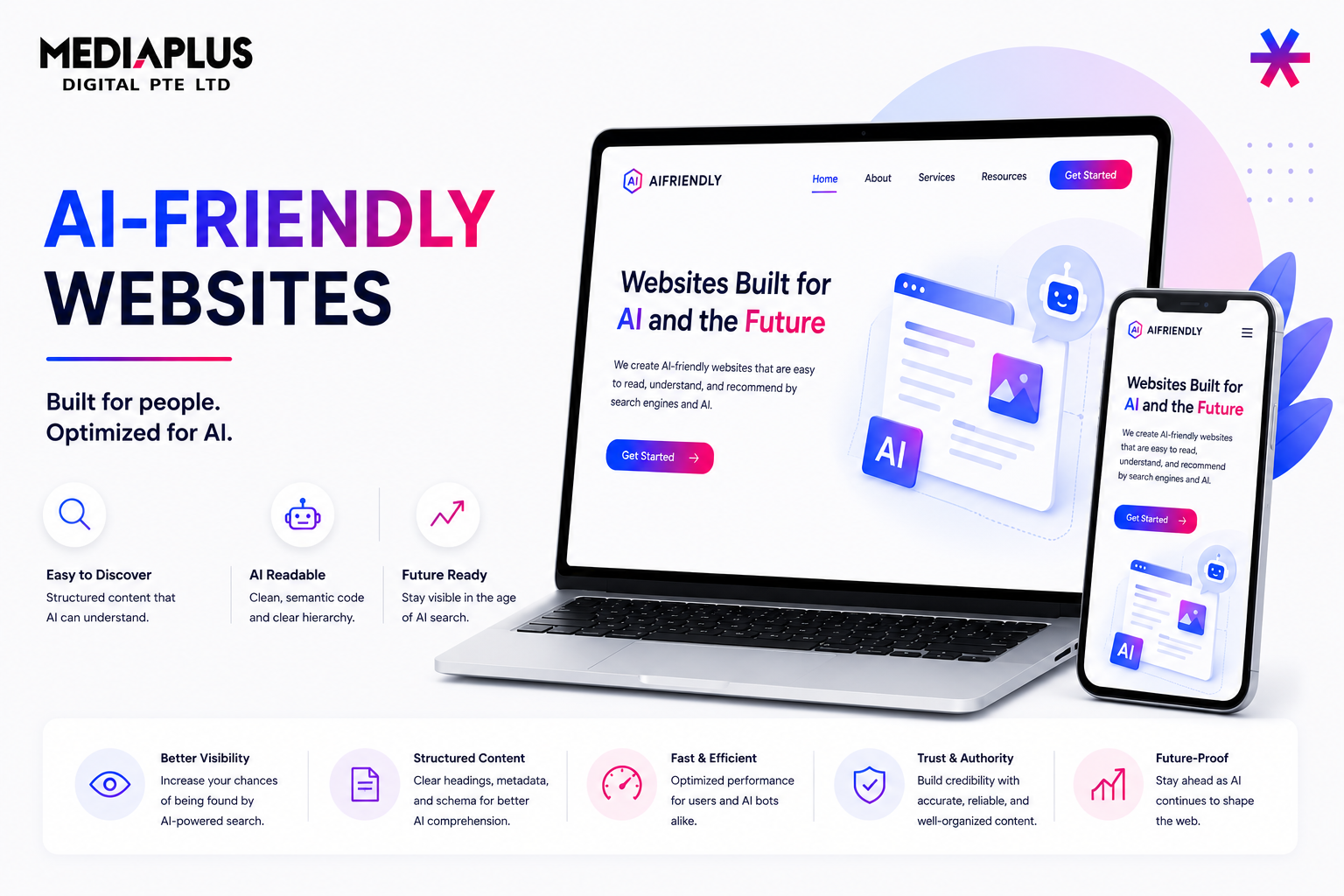
Search no longer ends on a results page. A growing share of buyers ask ChatGPT, Perplexity, Gemini, and Google AI Overviews first, then visit only the sites those tools cite. AI search traffic has grown more than 500% year on year, yet roughly 78% of businesses report zero visibility in AI generated answers. The gap is not about budget. It is about whether your site is built for machines to read.
Being AI ready is the design and technical layer underneath Generative Engine Optimisation. This checklist covers the eight things that decide whether an AI engine can find, understand, and cite your content. Most can be done in an afternoon.
Why AI Readiness Matters Now
Traditional SEO gets you ranked. AI readiness gets you quoted. The two overlap, but AI engines extract and synthesise content differently from a classic search crawler. They favour clear answers, explicit structure, and sources they can trust. A site that ranks on Google can still be invisible inside an AI answer if its content is hard to parse.
The 8-Point AI Readiness Checklist
1. Do Not Block AI Crawlers
The most common reason a site is invisible to AI is the simplest: it blocks the bots. Check your robots.txt and server headers to confirm you are not accidentally blocking the crawlers that feed AI engines.
The crawlers to allow if you want AI visibility:
- GPTBot and ChatGPT-User (OpenAI)
- PerplexityBot (Perplexity)
- ClaudeBot (Anthropic)
- Google-Extended (Google AI training and AI features)
Also set up Bing Webmaster Tools and submit your sitemap there. ChatGPT Search is powered partly by Bing, so a site indexed well on Bing tends to surface in ChatGPT. This sits alongside standard technical SEO.
2. Add an llms.txt File
llms.txt is an emerging file standard, placed at the root of your domain, that points AI crawlers to your most important content in a clean, machine readable format. Think of it as a sitemap written for language models rather than search engines.
It takes about thirty minutes to create and still puts you ahead of most competitors, since adoption is early. List your key pages, a short description of each, and links to the canonical version of your best content.
3. Implement Structured Data with JSON-LD
Structured data gives AI explicit context instead of forcing it to guess. Move beyond basic rich snippet markup and validate proper JSON-LD for the entity types that matter to your business.
|
Schema type |
Use it on |
|
Organization |
Homepage and About page, to define your brand as an entity |
|
Article / BlogPosting |
Every blog post, with author and date |
|
FAQPage |
Service pages and guides with question and answer blocks |
|
Product |
E-commerce product pages |
|
BreadcrumbList |
All pages, to expose site structure |
Schema is also a ranking aid in classic search, so this work pays off twice. See on-page SEO for the wider context.
4. Write Answer-First Content
AI engines extract answers, not paragraphs. Start each section with a direct answer in the first one or two sentences, then expand. Leading with a clear answer has been reported to increase AI citation chance by around 40%.
A simple rule for every section:
- Sentence one answers the implied question directly.
- The next sentences add evidence, numbers, or nuance.
- Named statistics with sources are more quotable than vague claims.
Identify your top ten pages and rewrite their opening paragraphs to lead with the answer. This pairs naturally with a content cluster strategy.
5. Add FAQ Sections with FAQPage Schema
Question and answer blocks are some of the most extractable content on the web. They map directly to how people prompt AI tools. Add an FAQ section to every service page and key blog post, and mark it up with FAQPage schema.
Write the questions the way a user would actually ask an AI assistant, in natural language, and keep each answer tight and self contained.
6. Build Entity Clarity
AI needs to recognise your brand, products, and authors as distinct, real entities. Keyword stuffing does the opposite. Make the relationships explicit so the model can connect the dots.
- Give every article a named author with a real bio and credentials.
- Keep your business name, address, and phone consistent across the web.
- Maintain a strong About page that states who you are and what you do.
- Link products, services, and authors together with internal links.
This is the AI facing side of E-E-A-T and topical authority. Entities and trust are what AI engines lean on when they choose who to cite.
7. Keep the Technical Foundation Clean and Fast
AI crawlers, like search crawlers, reward sites that are fast, semantically structured, and easy to render. Clean HTML with a logical heading hierarchy is far easier to extract than content buried in heavy scripts.
- Use one H1 and a logical H2 and H3 structure on every page.
- Keep the site fast and stable, since speed affects crawl and render. See Core Web Vitals explained.
- Build on a clean, crawlable foundation, the same one behind SEO friendly web design.
8. Monitor Your AI Citations
What you do not measure, you cannot improve. Track whether your domain appears in AI answers for your priority topics, and watch the trend over time.
- Manually prompt ChatGPT, Perplexity, and Gemini with your target queries and log whether you are cited.
- Use AI visibility tools such as Semrush AI Toolkit, BrightEdge, or Authoritas.
- Track referral traffic from AI assistants in your analytics.
For a Singapore specific measurement setup, see how to track traffic from AI Overviews and the Google AI Overview tracking tools overview.
The 8-Point Checklist at a Glance
|
# |
Action |
Effort |
|
1 |
Allow AI crawlers, submit sitemap to Bing |
Low |
|
2 |
Add an llms.txt file |
Low |
|
3 |
Implement JSON-LD structured data |
Medium |
|
4 |
Rewrite openings to lead with the answer |
Medium |
|
5 |
Add FAQ blocks with FAQPage schema |
Medium |
|
6 |
Build entity clarity: authors, About, consistency |
Medium |
|
7 |
Keep the site fast and semantically clean |
Ongoing |
|
8 |
Monitor AI citations and iterate |
Ongoing |
What This Means for Singapore Businesses
Around 38% of Singapore search results already show an AI Overview, and B2B and SaaS buyers increasingly research through AI assistants before contacting a vendor. Getting cited is becoming as important as ranking. For the playbook on the content side, see how to get your brand cited inside ChatGPT and Perplexity and Answer Engine Optimisation.
If you would rather have it handled end to end, MediaPlus offers AI SEO services in Singapore that cover both AI readiness and traditional SEO. Get in touch for a free AI readiness audit of your site.
Related Reads