
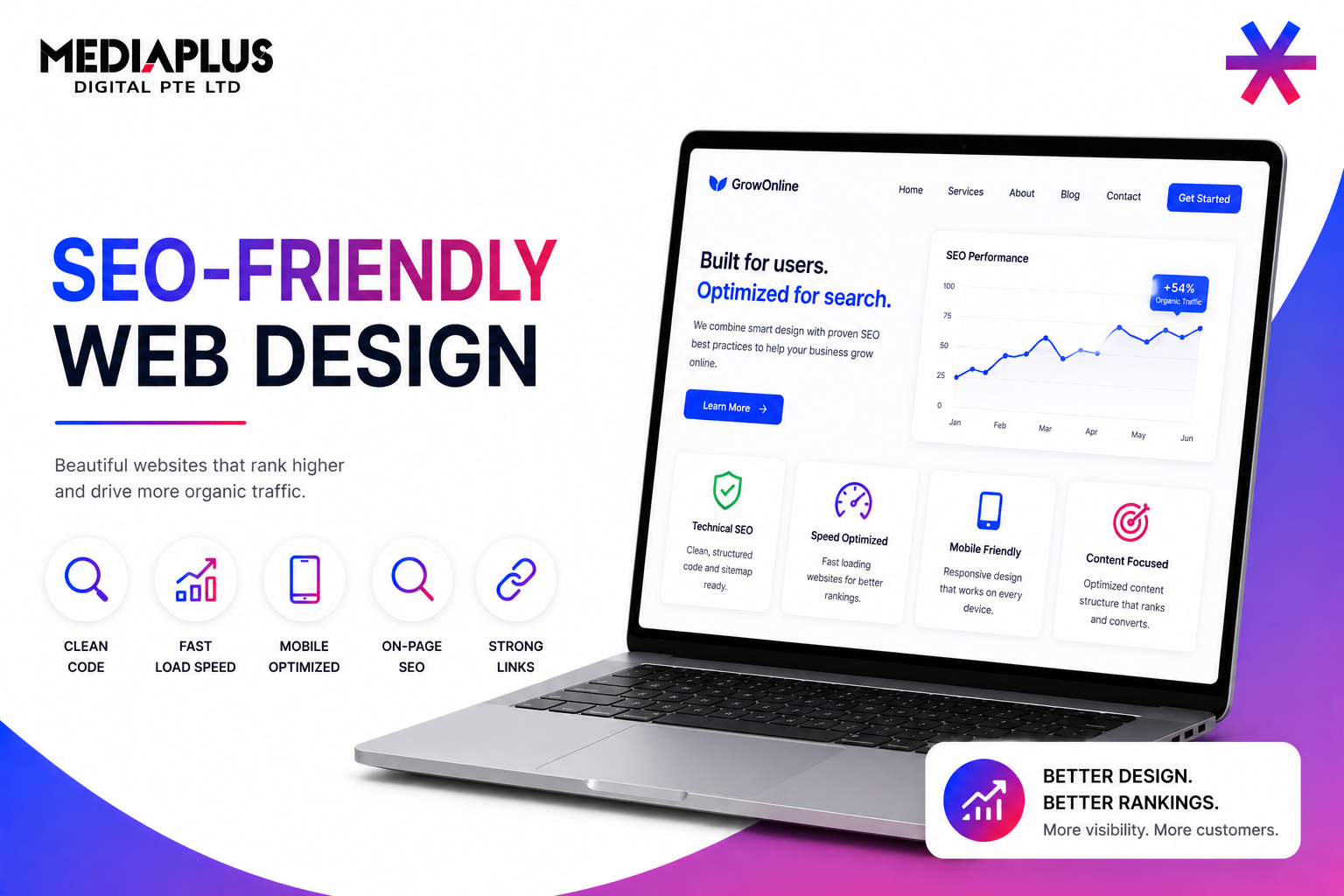
A beautiful website that nobody finds is a business card in a drawer. SEO website design builds search visibility into the site from the start, so it looks good and ranks well, instead of needing an expensive SEO rescue later. This guide explains what website design for SEO involves, the elements that matter most, a practical checklist, and the mistakes that quietly keep sites off page one.
Quick answer: SEO website design (or website design for SEO) means building a site so search engines can crawl, understand, and rank it, while people find it easy and fast to use. The essentials are a fast, mobile-first build, a clean site structure and URLs, proper headings and on-page basics, optimised images, internal linking, and structured data. Design and SEO are not a trade-off; the same choices that help Google also help users convert.
What is SEO website design?
SEO website design is the practice of designing and building a website with search engine optimisation baked in, rather than added afterwards. It covers how the site is structured, how fast it loads, how it works on mobile, how content and headings are organised, and how search engines read the code behind it.
The point is that SEO is far cheaper and more effective when it is designed in. Retrofitting SEO onto a site that was built purely for looks often means rebuilding navigation, speeding up a heavy theme, and restructuring content. Getting it right at the design stage avoids all of that. It sits at the intersection of web design and SEO.

Why website design for SEO matters
- Most clicks go to the top few results. If your site cannot rank, most of your potential customers never see it.
- Design decisions affect rankings. Site speed, mobile usability, and structure are ranking factors, and they are set by design.
- It saves money. Building SEO in from day one is far cheaper than fixing a site that was not.
- It converts. The same fast, clear, well-structured experience that ranks also turns more visitors into customers.
The elements of an SEO-friendly website
1. Mobile-first, responsive design
Google ranks the mobile version of your site first, and most visitors arrive on a phone. The site must adapt cleanly to every screen, with readable text and tappable buttons. See responsive web design best practices.
2. Fast load speed and Core Web Vitals
Speed is both a ranking factor and a conversion factor. Google measures the experience through Core Web Vitals: loading (LCP), interactivity (INP), and visual stability (CLS). Compress images, use clean code and a light theme, and reliable hosting so pages load in a couple of seconds. See Core Web Vitals explained.
3. Clear site architecture and URLs
Structure the site so any page is reachable in about three clicks, with a logical hierarchy (home to category to page). Use short, descriptive, keyword-relevant URLs and breadcrumbs. Good structure helps Google crawl the site and helps users find what they need.
4. Crawlability and indexation
Search engines must be able to reach and index your pages. That means a clean internal link structure, an XML sitemap, a sensible robots setup, and no important pages accidentally blocked or set to noindex.
5. On-page SEO foundations
Every page needs the basics built in: one clear H1, a logical heading structure, a unique title tag and meta description, and content that matches search intent. See what on-page SEO is.
6. Optimised images and media
Images are often the biggest cause of slow pages. Compress them, serve modern formats, use descriptive filenames and alt text, and lazy-load where sensible. This helps speed and image search at once.
7. Structured data (schema)
Schema markup is code that tells search engines what your content means, which can earn rich results like star ratings, FAQs, and breadcrumbs in the SERP. Build the relevant types (Organization, LocalBusiness, Product, FAQ, Breadcrumb) into the templates.
8. Internal linking
Link related pages together with descriptive anchor text, so authority flows to your important pages and Google understands how the site fits together. This is a lever you fully control.
9. Secure and accessible
Use HTTPS across the site, and design for accessibility (contrast, alt text, keyboard navigation). Both are expected, and accessibility widens your audience while supporting SEO.
10. Content designed to rank
Leave room in the design for real content: headings, body text, and supporting media that answer the query. A design that only has images and slogans gives Google little to rank.

The SEO website design checklist
|
Area |
Build this in |
|
Mobile |
Responsive, mobile-first layout |
|
Speed |
Compressed images, light code, fast hosting, pass Core Web Vitals |
|
Structure |
Logical hierarchy, 3-click reach, clean URLs, breadcrumbs |
|
Crawlability |
XML sitemap, sensible robots, no blocked key pages |
|
On-page |
One H1, clear headings, unique titles and meta descriptions |
|
Images |
Alt text, descriptive filenames, next-gen formats |
|
Schema |
Organization, LocalBusiness, Product, FAQ, Breadcrumb |
|
Internal links |
Descriptive anchors to money pages |
|
Security |
HTTPS site-wide |
|
Content |
Space for headings and real, useful copy |
Design vs SEO: not a trade-off
There is a myth that you must choose between a beautiful site and one that ranks. In practice the same decisions serve both. A fast page pleases users and Google. A clear structure helps people navigate and helps crawlers. Real content that answers questions builds trust and rankings. The only real trade-offs are the bad habits, like giant unoptimised hero videos or text baked into images, and those hurt users too. Good SEO website design is good design.
Common SEO web design mistakes
- Heavy themes and unoptimised images that make pages slow.
- Text inside images, which search engines cannot read.
- A pretty but confusing navigation that buries important pages.
- Ignoring mobile or treating it as an afterthought.
- No heading structure, so pages are one block of text or all H1s.
- Blocking pages by accident with noindex or robots rules.
- Launching a redesign without redirects, losing existing rankings. See how to redesign without losing SEO traffic.

Redesigning an existing site for SEO
If you already have a site, an SEO-focused redesign can lift both rankings and conversions, but it must protect what you already have. Map old URLs to new ones and set 301 redirects, keep your best-performing content, and improve speed and structure rather than starting from zero. Done carelessly, a redesign can wipe out rankings overnight; done properly, it compounds them.
Frequently asked questions
What is SEO website design?
It is designing and building a website with SEO built in, so it is fast, mobile-friendly, well-structured, and easy for search engines to crawl and rank, from day one rather than as an afterthought.
Does web design really affect SEO?
Yes. Site speed, mobile usability, structure, headings, and crawlability are all set by design, and they are ranking factors. A poorly built site struggles to rank no matter how much content you add.
Is a fast website better for SEO?
Yes. Speed is a ranking factor through Core Web Vitals, and faster pages also convert better. Image and code optimisation are among the highest-impact design choices.
Do I need to choose between a good-looking site and an SEO-friendly one?
No. The same choices that help SEO (fast, clear, structured, real content) also improve the user experience. Good SEO website design is simply good design.
Can I make my existing website SEO-friendly?
Often yes. You can improve speed, structure, headings, and schema on an existing site, or plan an SEO-focused redesign that preserves rankings with proper redirects.
What platform is best for SEO?
WordPress and well-built Shopify or custom sites can all rank well. What matters more is how the site is built: speed, structure, and clean code beat any single platform.
Build a website designed to rank
An SEO-friendly website is not a luxury; it is the difference between being found and being invisible. If you want a site designed to rank and convert from the start, talk to MediaPlus Digital. Explore our web design in Singapore and SEO services, built fast, structured, and SEO-ready, with PSG support for eligible SMEs.