Quick answer
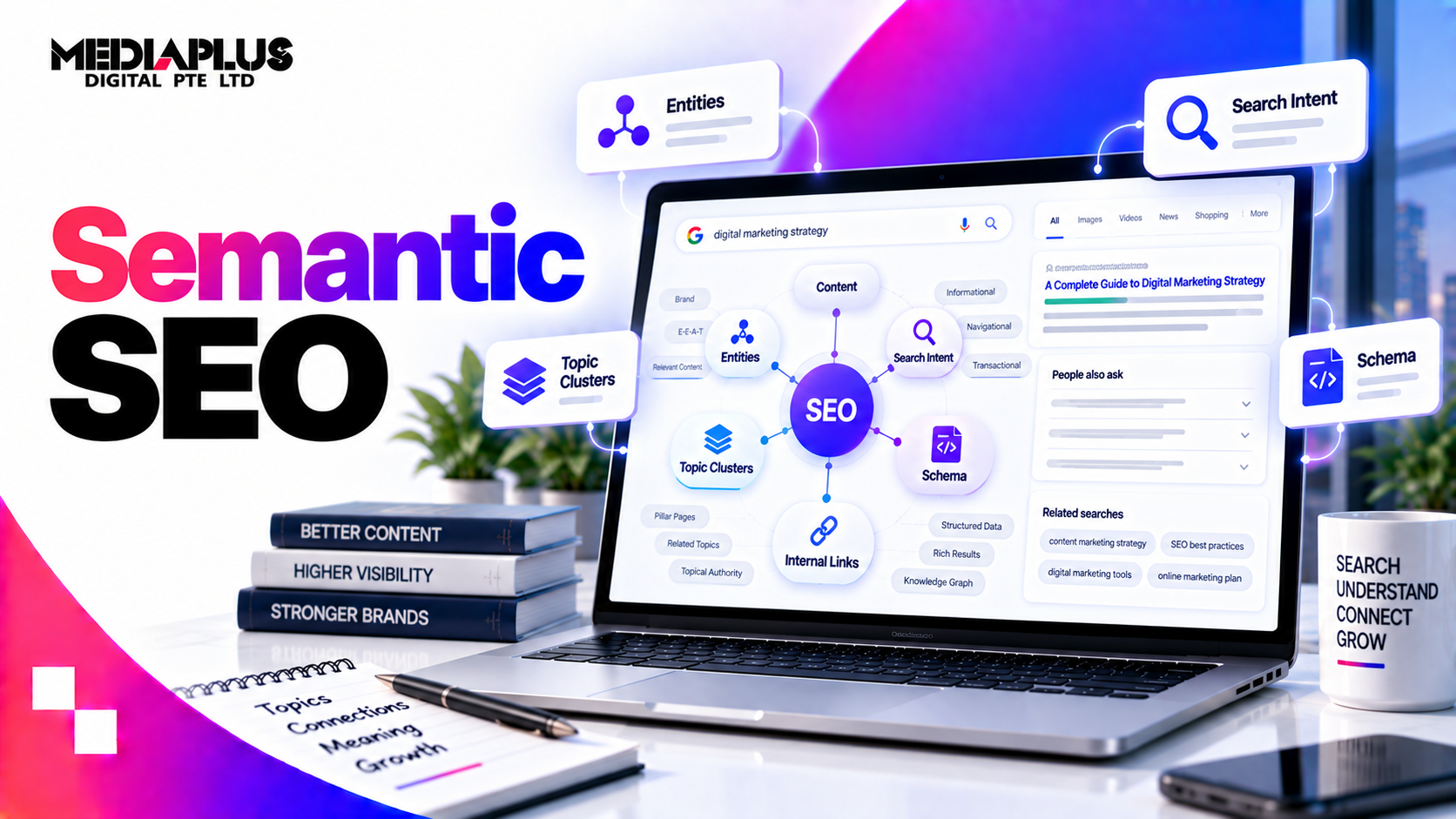
Semantic SEO means optimising for what a page is about rather than for a string of words. Instead of asking “how many times should this keyword appear”, it asks “does this page cover the subject completely, and does it connect to the other things we publish on it”.
Two shifts made this necessary. Search engines now interpret meaning and intent rather than matching text, and AI answers assemble responses from pages they have understood well enough to quote.
The practical work is unglamorous: one clear topic per page, coverage of the questions a reader actually has, consistent naming of the things you talk about, internal links that connect related pages, and structured data that labels the facts.
Keyword SEO and semantic SEO, side by side
|
Keyword-led approach |
Semantic approach |
|
|
Unit of planning |
A keyword |
A topic and the questions inside it |
|
Page goal |
Rank for one phrase |
Answer a subject completely |
|
Success signal |
Position for that phrase |
Rankings across many related phrases |
|
Content structure |
Keyword in title, H1, first paragraph, repeated |
Headings that mirror how people ask |
|
Risk |
Thin pages per keyword variant, competing with each other |
Pages that sprawl without focus |
|
Internal links |
Added afterwards |
Part of the structure |
Google’s own guidance closes the door on the old approach: “Excessively repeating the same words over and over (even in variations) is tiring for users, and keyword stuffing is against Google’s spam policies.” There is no density target to hit.
The three ideas that matter
1. Entities
An entity is a thing: a company, a place, a product, a person, a concept. Search engines try to identify the entities on a page and how they relate, rather than treating words as text.
What this changes for you:
- Name things consistently. If your company is “MediaPlus Digital Pte Ltd”, do not call it MediaPlus Digital in one place and MediaPlus SG in another.
- Connect your brand to the things it is associated with: services, locations, people, clients, industries.
- Use structured data to state facts explicitly rather than hoping they are inferred.
- Keep your details identical across your site, Google Business Profile, LinkedIn and directories. Contradictions weaken the association.
2. Intent
The same words can mean different jobs. “web design cost” wants numbers. “web design agency singapore” wants a shortlist. “what is web design” wants an explanation. A single page cannot serve all three well.
Check intent before writing: search the term, look at what currently ranks, and note the format. If the results are all comparison lists, a service page will struggle no matter how well written.
3. Topical coverage
Ranking for a competitive subject usually requires covering it properly across several connected pages, not one long article. That is what people mean by topical authority: enough depth, linked together, that a search engine can see you cover the subject rather than mention it. Our guide to topical authority covers the concept in full.
How to build a topic cluster
This is the core technique of semantic SEO, and it is mostly organisation rather than writing.
Step 1: Pick the subject you want to own. It should map to something you sell. “Ecommerce SEO” is a subject. “SEO” is too broad for most businesses.
Step 2: Write the pillar page. A complete overview of the subject that answers the main question and links out to the detail. This page targets the head term.
Step 3: List the questions inside the subject. Sources, in order of usefulness:
- Search Console queries your site already gets impressions for
- People Also Ask boxes on the main search
- Autocomplete suggestions
- The questions your sales team hears every week
- The subheadings used by the pages currently ranking
- Questions asked of AI assistants about your category
Step 4: Group them. Several questions usually belong on one page. Do not create a page per question, or you rebuild the thin-page problem semantic SEO exists to solve.
Step 5: Assign one page per group, and record it in a keyword map so nothing gets written twice. See keyword mapping.
Step 6: Link them properly. Pillar links to each supporting page. Each supporting page links back to the pillar and sideways to its closest siblings. Anchor text should describe the destination.
Step 7: Review for overlap quarterly. Two pages drifting towards the same query is the most common failure, and it is why older sites lose rankings without any external cause.
Writing a semantically complete page
A page does not need to be long. It needs to finish the job.
|
Element |
What to do |
|
Opening answer |
Answer the main question in the first two sentences, before any background |
|
Headings |
Phrase them as the questions readers ask, in the order they ask them |
|
Definitions |
Define the terms you use, once, clearly |
|
Entities named |
Name the tools, standards, places and organisations involved, precisely |
|
Specifics |
Prices, timelines, measurements, versions, dates |
|
Related questions |
Cover the adjacent questions a reader will have next |
|
Comparisons |
Where a decision is involved, show the alternatives honestly |
|
Structured data |
Organisation, Article or Product markup that matches the visible content |
|
Internal links |
To the pillar, to siblings, with descriptive anchors |
|
Freshness |
Visible updated date, with facts actually rechecked |
A useful test: read only the headings. If the sequence makes sense as a conversation and covers the subject, the structure is right. If it reads like a list of keywords, it is not.
Semantic SEO and AI search
This is where the work pays twice. AI systems break pages into pieces and assemble answers from the useful ones, so content written for meaning is easier to cite.
Google’s guidance on generative AI search is worth reading before anyone sells you a separate “AI SEO” package: “From Google Search’s perspective, optimizing for generative AI search is optimizing for the search experience, and thus still SEO.” The same page adds that “structured data isn’t required for generative AI search, and there’s no special schema.org markup you need to add.”
Microsoft’s advertising guidance explains why structure matters in practice: “AI assistants don’t read a page top to bottom like a person would. They break content into smaller, usable pieces.”
What that means for your pages:
- Each section should stand alone and make sense if quoted without the rest
- Facts should be stated plainly, not implied
- Hidden content in tabs and accordions may not be read
- Content that only appears after JavaScript runs may not be read at all by AI crawlers
See our AI search readiness audit for the technical checks, and GEO vs SEO for how the two disciplines relate.
What semantic SEO is not
- It is not writing longer. Length correlates with coverage, it does not create it.
- It is not stuffing synonyms. Listing every variation of a phrase is the old tactic with a new name.
- It is not an LSI keyword list. “LSI keywords” is a tool-vendor concept, not something Google has described using.
- It is not a schema plugin. Markup labels facts; it does not supply understanding.
- It is not a replacement for technical SEO. A page that is not indexed cannot demonstrate anything.
A practical 30-day implementation
|
Week |
Task |
Output |
|
1 |
Inventory |
List every page and the primary topic it targets. Flag duplicates |
|
1 |
Cannibalisation check |
Search Console query report: which queries return more than one of your pages |
|
2 |
Consolidate |
Merge or redirect the overlapping pages, keeping the strongest URL |
|
2 |
Question research |
Build the question list for your two priority subjects |
|
3 |
Pillar and gaps |
Improve the pillar page, list the supporting pages that are missing |
|
3 |
Internal links |
Connect pillar and supporting pages properly, with descriptive anchors |
|
4 |
Entity cleanup |
Consistent business naming, structured data, matching details across profiles |
|
4 |
Baseline |
Record impressions and positions by page so you can measure the change |
Expect movement in six to twelve weeks, most visibly on the long-tail queries around your pillar.
How to measure it
Semantic work rarely shows up as one keyword jumping. Look for these instead:
- Number of queries per page in Search Console, which should rise as coverage improves
- Impressions on queries you never targeted, a sign the page is understood broadly
- Average position across the cluster, not one term
- Reduced cannibalisation: fewer queries returning multiple URLs from your site
- Citations in AI answers, checked manually or through Bing Webmaster Tools’ AI performance report
Frequently asked questions
What is semantic SEO?
Optimising a page for a subject and the intent behind searches, rather than for a keyword string. In practice it means complete coverage, clear structure, consistent naming of entities and connected internal links.
How is semantic SEO different from traditional SEO?
Traditional keyword SEO plans one page per phrase. Semantic SEO plans one page per topic, then groups the phrases that belong to it. The technical foundations are the same.
Do I still need keywords?
Yes, as research. Keywords tell you how people phrase the problem. They are the input to planning, not a quota to hit in the text.
Are LSI keywords real?
No. Latent semantic indexing is an older information retrieval technique, and Google has not described using LSI keywords. Cover the subject properly instead of chasing a list.
Does semantic SEO help with AI search?
Yes. Content structured into self-contained, factual sections is easier for AI systems to quote. Google states that optimising for its generative AI features is still SEO.
How long does it take to see results?
Usually six to twelve weeks for the first signals, longer for competitive head terms. Consolidating duplicate pages often produces the fastest change.
Is schema markup part of semantic SEO?
It supports it by stating facts explicitly. It is not a substitute for content that actually covers the subject, and Google says it is not required for generative AI search.
How many pages does a topic cluster need?
As many as the subject genuinely has distinct questions, usually five to fifteen. More pages than questions produces thin content.
Building topical authority properly
MediaPlus Digital plans content as connected clusters rather than one-off articles, because that is what produces rankings across a subject instead of a single term. Thirteen years in the Singapore market, a team of 60 and more than 1,800 projects delivered.
See our SEO services in Singapore or AI SEO services if AI search visibility is the priority.