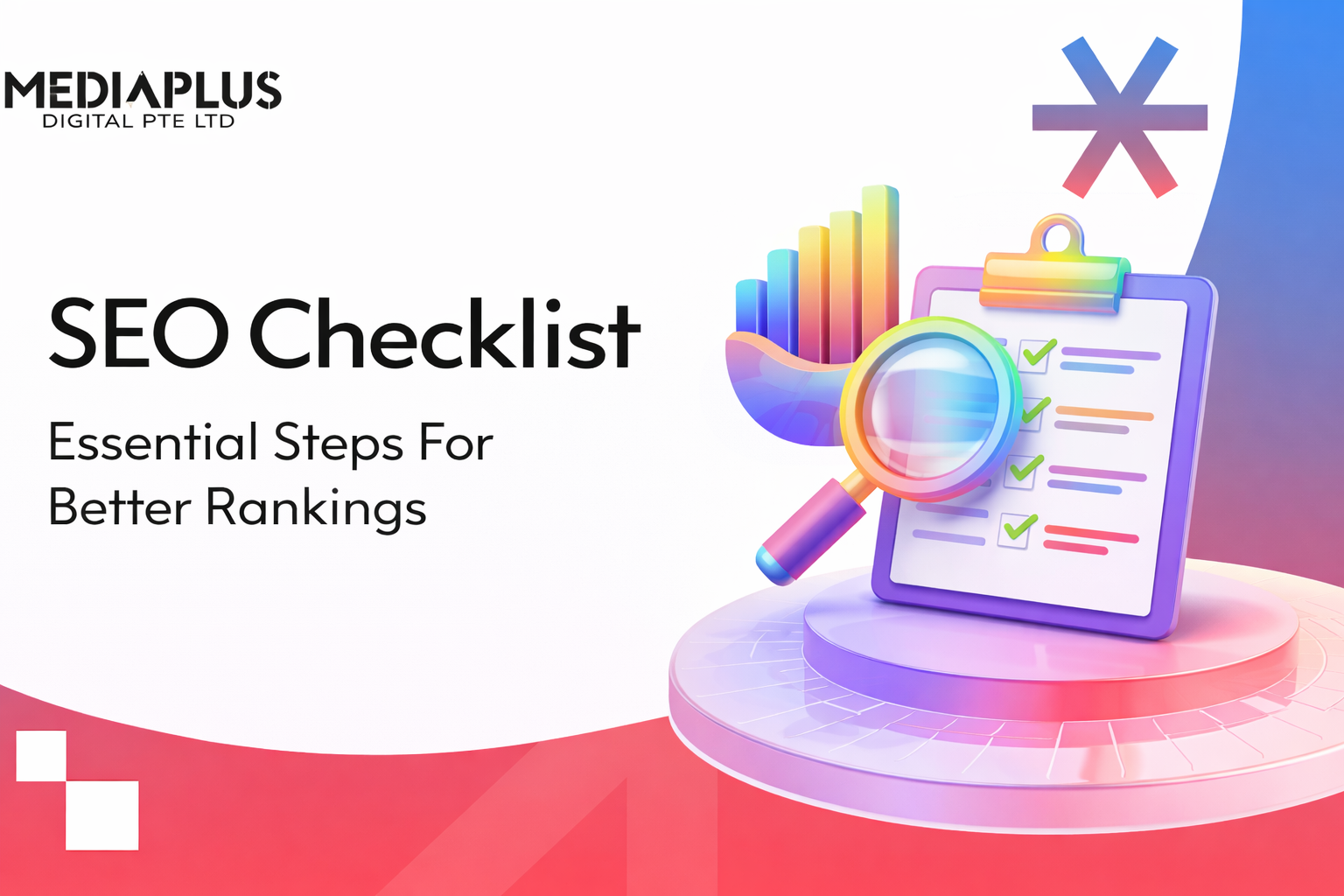
An SEO checklist is only useful if it helps you take action. The goal is not to “tick boxes,” but to systematically remove the things that stop your website from ranking, getting clicks, and converting traffic into revenue.
This SEO checklist is designed for real websites: business sites, service companies, ecommerce stores, and content-driven brands. You do not need to implement everything at once. Work through the sections that match your current bottleneck.
According to data from Semrush, websites that address technical SEO, content relevance, and internal linking together tend to outperform sites that focus on just one area in isolation.
How to Use This SEO Checklist
Start with SEO basics if your site is new or underperforming across the board.
Focus on content and on-page SEO if you publish regularly but see low organic growth.
Prioritise technical SEO if your site is slow, unstable, or losing rankings.
Invest in link building and authority once your foundations are solid.
SEO is cumulative. Fixing small issues consistently often leads to outsized gains over time.
SEO Basics Checklist (Foundation First)
1. Set up Google Search Console correctly
Google Search Console tells you how Google actually sees your site. Without it, you are guessing.
Make sure you:
-
Verify domain ownership
-
Submit your XML sitemap
-
Monitor indexing and Core Web Vitals
Google itself confirms that Search Console is the primary diagnostic tool for search performance.

2. Connect Google Analytics 4 and align events
Traffic without behaviour data is meaningless. GA4 helps you understand what users do after they arrive.
Track:
-
Organic sessions
-
Engagement rate
-
Conversions tied to SEO pages
Connect GA4 with Search Console so query data appears alongside behaviour metrics.
3. Define SEO KPIs tied to business outcomes
Rankings alone are not a business metric.
At minimum, track:
-
Organic traffic growth
-
Keyword visibility for commercial terms
-
Leads or revenue from organic search
This alignment is critical. A study by HubSpot found that teams who align SEO KPIs with revenue are significantly more likely to scale organic traffic year over year.
Keyword Research Checklist (Intent Over Volume)
4. Identify your real search audience
Before tools, clarify:
-
Who is searching
-
Why they are searching
-
What decision stage they are in
This prevents targeting keywords that bring traffic but no conversions.
5. Prioritise search intent, not just volume
High-volume keywords often hide mixed intent. Analyse the top-ranking pages and ask:
-
Are they informational, commercial, or transactional?
-
Do they match your page type?
If intent does not align, rankings will be unstable.
6. Use long-tail keywords for faster traction
Long-tail keywords convert better and are easier to rank for.
According to Ahrefs, long-tail queries account for over 90 percent of all search queries. These are where newer or mid-authority sites should focus first.
7. Create a keyword-to-page map
Every important keyword cluster should map to one primary page.
This avoids:
-
Keyword cannibalisation
-
Thin or overlapping content
-
Internal competition between pages

On-Page SEO Checklist (Make Relevance Obvious)
8. Use clean, descriptive URLs
Short URLs with the main keyword outperform long, parameter-heavy URLs.
Keep them readable for humans, not just search engines.
9. Optimise title tags for clicks and clarity
Place the main keyword early in the title and add a modifier that sets expectations, such as:
-
Checklist
-
Guide
-
Best practices
-
Updated for 2026
CTR matters. Better titles mean more clicks even without ranking changes.
10. Write meta descriptions for humans
Meta descriptions are not a ranking factor, but they influence clicks.
Explain:
-
Who the page is for
-
What problem it solves
-
Why it is worth clicking
11. Use headings to structure meaning
Your H1 should clearly describe the page topic.
H2 and H3 headings should break content into logical sections.
This improves readability and helps search engines understand page structure.
Content Quality Checklist (Information Gain)
12. Answer the query better than existing results
Google rewards pages that add something new.
Ask:
-
What is missing from the current top results?
-
Can you add examples, data, or clearer explanations?
This concept of “information gain” is increasingly important in competitive SERPs.
13. Write for skimming and scanning
Users do not read line by line.
Use:
-
Short paragraphs
-
Clear subheadings
-
Visual separation
This reduces bounce rates and improves engagement.
14. Support claims with credible sources
Linking to trusted sources improves credibility.
Well-cited content is more likely to be referenced by other sites and AI-driven search summaries.
Technical SEO Checklist (Remove Hidden Friction)
15. Ensure all important pages are indexable
Check for:
-
Noindex tags
-
Robots.txt blocks
-
Incorrect canonical URLs
If Google cannot index a page, nothing else matters.
16. Improve Core Web Vitals
Page speed is both a ranking factor and a conversion factor.
Google data shows that pages loading under 2.5 seconds consistently perform better in search and engagement.
17. Fix broken links and redirect chains
Broken internal links waste crawl budget and frustrate users.
Redirect chains slow down crawling and dilute link equity.
18. Make mobile usability a priority
Google uses mobile-first indexing.
If your mobile experience is weak, your rankings will be capped.
Internal Linking Checklist (Authority Flow)
19. Link strategically between related pages
Internal links help distribute authority and clarify topical relevance.
Link from:
-
High-performing pages
-
Foundational content
-
Relevant service pages
20. Avoid orphan pages
Every important page should be reachable within three clicks from the homepage.
Pages without internal links are often ignored by search engines.
Link Building Checklist (Authority Signals)
21. Earn links, do not manufacture them
Avoid shortcuts. Google penalties are expensive and slow to recover from.
Focus on:
-
Digital PR
-
Original data
-
Thought leadership
22. Build links to pages that matter
Not all backlinks are equal.
Prioritise links to:
-
Core service pages
-
High-converting content
-
Authority-building guides
AI & Modern SEO Checklist
23. Optimise for AI summaries and citations
AI-powered search experiences pull from well-structured, authoritative pages.
Use:
-
Clear definitions
-
Concise explanations
-
Structured sections
24. Monitor how your brand appears in AI results
Brand perception matters.
If AI tools summarise your brand incorrectly, it often traces back to outdated or weak third-party content.
Treat SEO as an Ongoing Process
25. Review performance monthly
SEO compounds over time, but only if reviewed regularly.
A healthy SEO workflow includes:
-
Monthly audits
-
Content updates
-
Technical monitoring
According to BrightEdge, companies that treat SEO as an ongoing process consistently outperform those that approach it as a one-time project.
Putting This SEO Checklist Into Action
This checklist works best when applied systematically, not all at once. Most websites see the biggest gains by fixing fundamentals before chasing advanced tactics.
If your site already has traffic but not results, the issue is rarely “more keywords.” It is usually structure, intent mismatch, or technical friction.
When to Get Professional SEO Support
Executing this SEO checklist properly takes time, experience, and cross-functional coordination between content, development, and analytics.
At MediaPlus Digital Singapore, SEO is treated as a growth channel, not a ranking exercise. Our SEO service focuses on:
-
Technical stability and crawl efficiency
-
Keyword strategies aligned with buyer intent
-
Content that supports conversions, not just traffic
-
Long-term authority building for competitive markets
For businesses in Singapore, this approach matters. Local competition is high, and SEO mistakes compound quickly if left unaddressed.
If your website is not generating consistent leads or revenue from organic search, applying this SEO checklist with the right strategy and execution can change that. Working with an experienced SEO agency can help you move faster and avoid costly missteps.
If you want SEO to drive real business outcomes, not just rankings, it may be time to approach it more strategically.