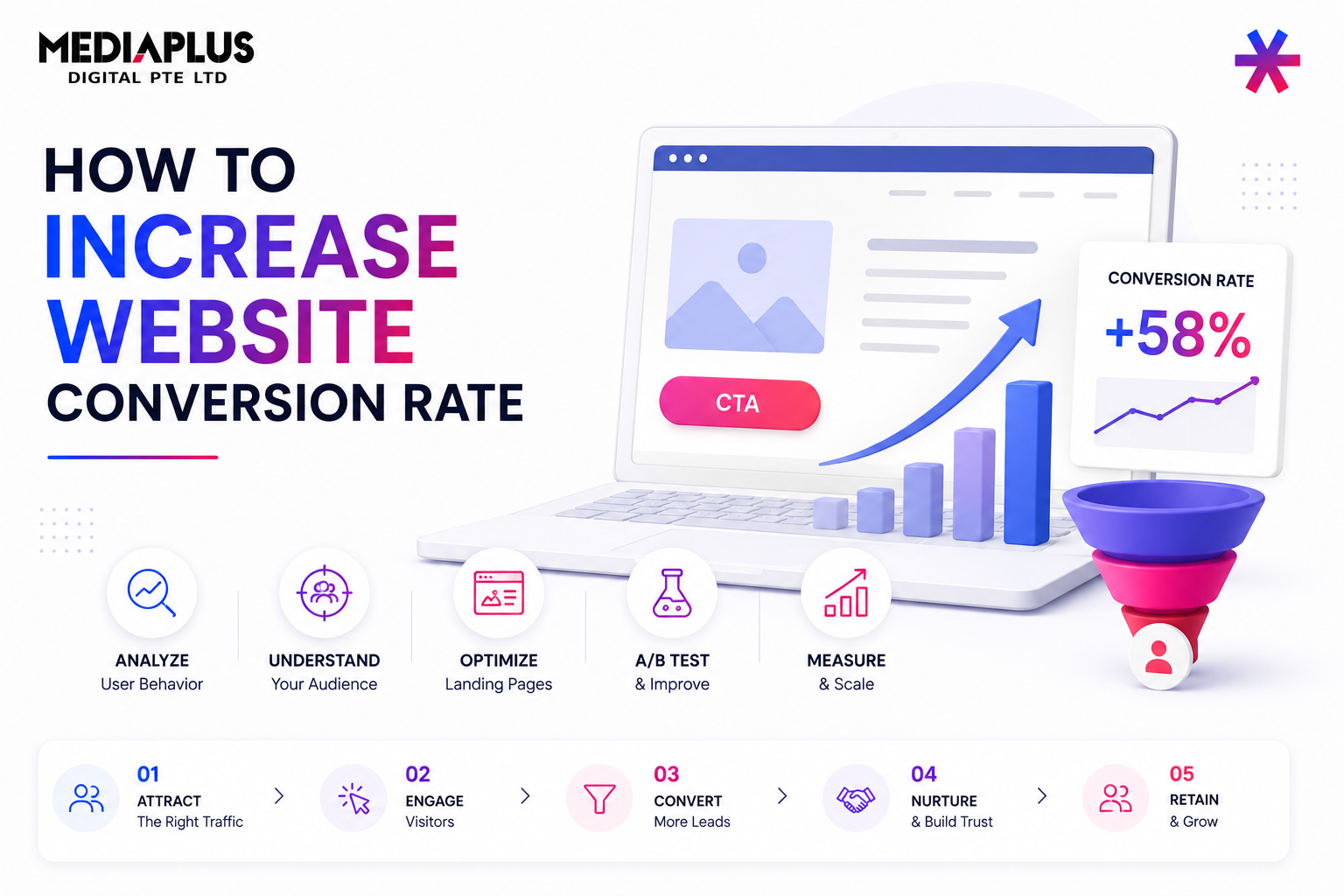
Driving traffic to your website is only half the battle. The real challenge is turning those visitors into leads, subscribers, or customers. That’s where conversion rate optimization (CRO) comes in.
Learning how to increase website conversion rate is one of the most powerful ways to grow revenue without increasing advertising spend. Even small improvements in conversion rate can lead to significant gains in sales and business performance.
In this guide, we’ll explore proven strategies that help businesses improve their website conversions and turn more visitors into customers.
What Is Website Conversion Rate?
Website conversion rate refers to the percentage of visitors who complete a desired action on your website.
This action could include:
-
Making a purchase
-
Signing up for a newsletter
-
Downloading a resource
-
Requesting a quote
-
Filling out a contact form
The formula is simple:
Conversion Rate = (Conversions ÷ Total Visitors) × 100
For example, if 1000 people visit your website and 50 make a purchase, your conversion rate is 5%.
Improving this percentage can dramatically increase revenue without needing more traffic.
Why Conversion Rate Optimization Matters
Many businesses focus heavily on generating traffic through SEO or paid ads but overlook conversion optimization.
Improving conversion rates helps businesses:
-
Generate more revenue from existing traffic
-
Lower customer acquisition costs
-
Improve marketing ROI
-
Deliver better user experiences
-
Increase lead generation
Instead of constantly chasing more traffic, optimizing conversions allows businesses to maximize the value of every visitor.
13 Proven Ways to Increase Website Conversion Rate
1. Define a Clear Website Goal
Before optimizing anything, your website must have a clear goal.
Every page should guide users toward a specific action such as:
-
Buying a product
-
Booking a consultation
-
Signing up for a trial
Without a measurable goal, it becomes impossible to evaluate and improve performance.
2. Run A/B Tests
A/B testing compares two versions of a webpage to determine which performs better.
You can test elements such as:
-
Headlines
-
Call-to-action buttons
-
Page layouts
-
Images or videos
-
Pricing displays
By testing variations with real traffic, businesses can identify the most effective design and messaging.
Continuous experimentation leads to steady conversion improvements.
3. Strengthen Your Value Proposition
Your value proposition answers one critical question:
Why should customers choose you instead of your competitors?
A strong value proposition should:
-
Clearly communicate benefits
-
Highlight what makes your business unique
-
Address customer needs instantly
Visitors should understand your value within seconds of landing on your website.
4. Build an Effective Sales Funnel
Many businesses ask for a purchase too quickly.
Instead, guide visitors through a structured funnel:
-
Awareness
-
Interest
-
Consideration
-
Conversion
Providing educational content, free resources, or email newsletters helps nurture trust before asking for a sale.
5. Use Clear and Simple Messaging
Complicated marketing language often confuses visitors.
Your website copy should be:
-
Clear
-
Conversational
-
Easy to understand
Avoid corporate jargon and explain your product or service in simple terms.
Clarity improves both user experience and conversion rates.
6. Address Customer Objections
Visitors often hesitate because they have unanswered concerns.
Common objections include:
-
Price concerns
-
Product effectiveness
-
Trust in the company
-
Compatibility with their needs
Address these questions directly through FAQs, product explanations, and customer testimonials.
7. Build Trust Signals
Trust plays a major role in online purchasing decisions.
You can increase credibility by including:
-
Customer testimonials
-
Case studies
-
Certifications
-
Media mentions
-
Secure payment badges
-
Real contact information
Trust signals reassure visitors that your business is legitimate and reliable.
8. Simplify the Buying Process
Complex checkout or sign-up processes reduce conversions.
To improve usability:
-
Reduce the number of form fields
-
Allow guest checkout
-
Minimize required steps
-
Make navigation intuitive
The easier it is to complete an action, the more likely users will convert.
9. Provide Detailed Product Information
Insufficient product information can prevent visitors from making a purchase decision.
Effective product pages should include:
-
Clear descriptions
-
High-quality images
-
Product videos
-
Feature explanations
-
Customer reviews
More information helps users feel confident about their purchase.
10. Use Social Proof
Social proof shows that other people trust your product or service.
Examples include:
-
Customer reviews
-
Testimonials
-
Case studies
-
Number of users or customers
-
Influencer endorsements
When visitors see others benefiting from your product, they are more likely to convert.
11. Remove Page Distractions
Too many elements on a page can overwhelm users.
Reduce distractions by:
-
Removing unnecessary navigation links
-
Eliminating irrelevant content
-
Simplifying page design
Focus user attention on the primary call-to-action.
12. Reduce Purchase Risk
Online buyers are often cautious.
You can reduce perceived risk with guarantees such as:
-
30-day money-back guarantees
-
Free trials
-
Flexible return policies
-
Transparent pricing
Guarantees increase confidence and encourage users to take action.
13. Create Urgency and Scarcity
Urgency encourages visitors to act immediately.
Examples include:
-
Limited-time discounts
-
Countdown timers
-
Limited stock notifications
-
Exclusive offers
When used authentically, urgency can significantly improve conversions.
Key Metrics to Track for Conversion Optimization
To effectively increase website conversion rate, businesses should monitor metrics such as:
-
Conversion rate
-
Bounce rate
-
Time on page
-
Cart abandonment rate
-
Click-through rate (CTR)
-
Cost per acquisition (CPA)
Analyzing these metrics helps identify where users drop off and where improvements can be made.
Digital Marketing & Conversion Optimization by Mediaplus Digital Singapore
Optimizing conversion rates requires expertise in user experience, analytics, and digital marketing strategy. Businesses looking to improve website performance can partner with agencies such as Mediaplus Digital Singapore.
Their digital marketing service helps businesses increase website traffic and convert that traffic into measurable business results.
Key services include:
- Conversion Rate Optimization (CRO): Testing, analytics, and UX improvements designed to increase conversions.
- Search Engine Optimization (SEO): Improving organic visibility to attract high-intent traffic from search engines.
- Landing Page Optimization: Design improvements that guide visitors toward key actions.
- Performance Marketing: Targeted campaigns that drive qualified leads through Google Ads and social media platforms.
- Content Marketing & SEO Blogging: Strategic content that attracts traffic and nurtures prospects through the marketing funnel.
By combining digital marketing strategy, SEO, and CRO expertise, Mediaplus Digital Singapore helps businesses transform their websites into high-performing conversion engines.
Final Thoughts
Increasing website conversion rate is one of the most effective ways to grow your business online.
Instead of focusing solely on traffic generation, businesses should also prioritize:
-
Clear messaging
-
Strong value propositions
-
Trust signals
-
Optimized user experiences
-
Continuous testing
Even small improvements in conversion rates can significantly impact revenue.
With the right strategies and expert support, your website can become a powerful tool that consistently converts visitors into customers.