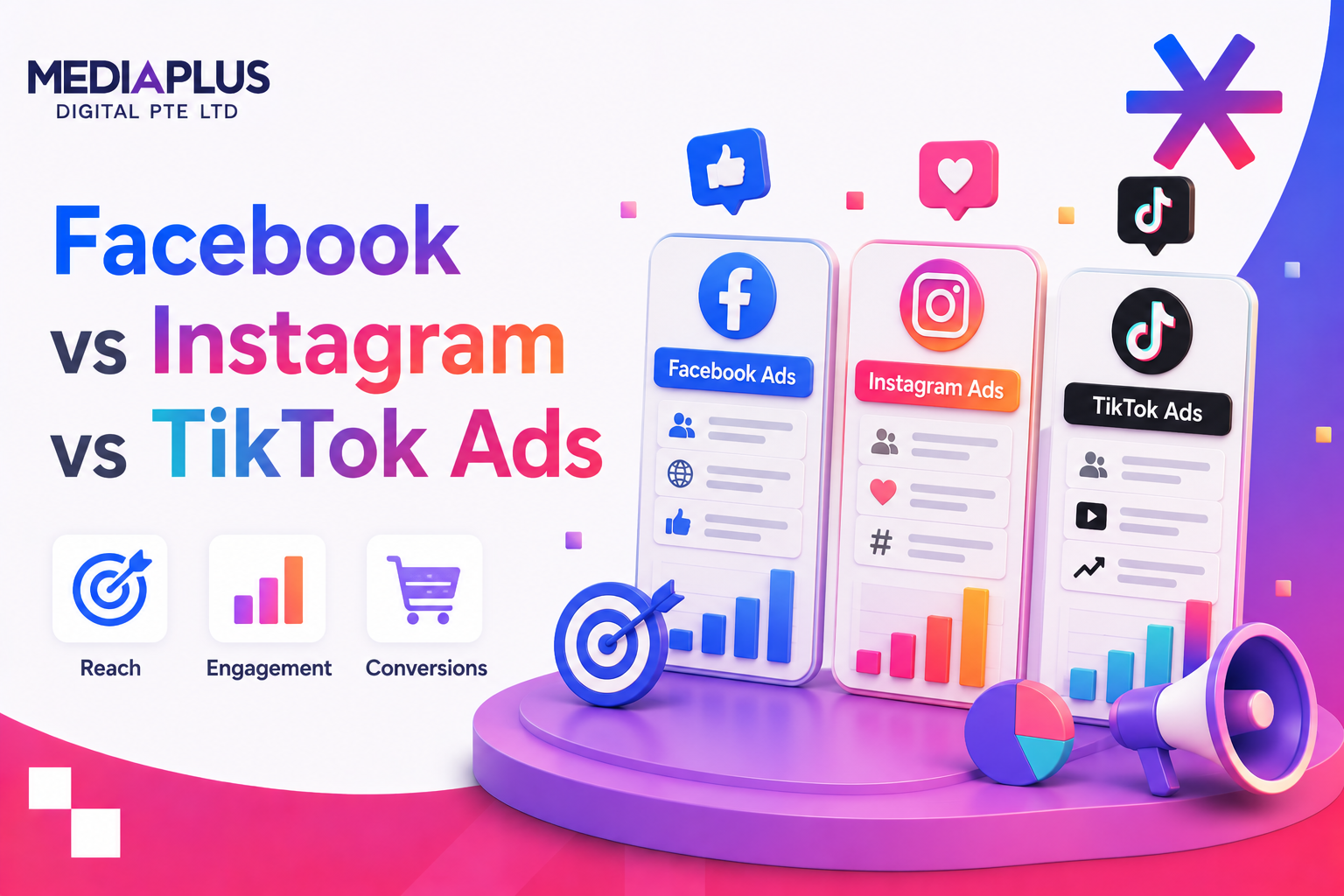
Most Singapore SME owners do not have a budget problem. They have an allocation problem. You have a fixed amount each month, three big paid-social platforms competing for it, and a lot of conflicting advice telling you that TikTok is cheaper, that Meta converts better, and that Instagram is where the buyers are. All three statements can be true at the same time, which is exactly why the decision feels hard.
This guide cuts through it. We compare Facebook, Instagram and TikTok on the things that actually move your numbers: who you reach in Singapore, what each platform costs in indicative S$ terms, the creative each one demands, and how to measure results after iOS privacy changes broke a lot of old tracking. Then we give you a decision framework by objective and industry, a budget-split model for both starter and scaling stages, and a structured 30 to 60 day test so you stop guessing.
If you would rather hand the whole thing to a team, our social media ads service runs all three platforms under one strategy. But you should understand the logic first, so let us get into it.
Facebook Ads in Singapore
Facebook still has the widest paid reach in Singapore, touching roughly four in five connected adults. The audience skews older than people assume. The core paying group sits in the 25 to 54 band, which makes Facebook the natural home for services, considered purchases, and anything that needs a form fill rather than an impulse tap.
Audience profile. Broad national reach, strongest with the 30 to 55 crowd, parents, homeowners, and decision-makers. Engagement per post is low, but intent and patience are higher.
Ad formats. News Feed image and video, Carousel, Instant (native lead) Forms, Messenger, Marketplace, and Advantage+ catalogue placements.
Indicative costs (S$). CPM in the S$6 to S$10 range, CPC around S$0.40 to S$1.50, and lead-form cost per lead commonly S$5 to S$25 depending on industry and offer quality. Finance, insurance and property run higher.
Creative style. Clear value proposition, benefit-led copy, social proof, and a hard call to action. Static images and short captioned video both perform. Facebook tolerates more text and detail than the other two platforms.
Strengths. Native lead forms with low friction, mature retargeting, granular targeting, and reliable performance for B2B and high-consideration services.
Weaknesses. Older skew limits reach to under-25s, organic engagement is poor, and creative can feel dated if you reuse the same static ad for weeks.
For a deeper cost breakdown by objective and industry, see our guide to Facebook ads cost, and our managed Facebook ads service page for done-for-you setup.
Instagram Ads in Singapore
Instagram reaches roughly two-thirds of connected Singaporeans and skews distinctly younger and more visual than Facebook, with the heart of the audience in the 18 to 35 band. Engagement runs several times higher than Facebook, which is both a strength and a cost driver: people interact more, but you pay more for the impression.
Audience profile. 18 to 35 leads, lifestyle-driven, discovery-minded, strong for female-leaning beauty, fashion, F&B, fitness and travel audiences.
Ad formats. Feed, Stories, Reels, Carousel, Explore, and Shopping tags. Reels is the placement to prioritise for reach right now.
Indicative costs (S$). CPM in the S$8 to S$15 range, CPC around S$0.80 to S$2.20, and lead-form cost per lead commonly S$8 to S$35. Costs sit above Facebook on a per-impression basis but ecommerce return can offset this.
Creative style. Polished but authentic. Vertical 9:16 video, strong first frame, clean product photography, and a lifestyle context rather than a hard sell. Shopping-tagged posts shorten the path to purchase.
Strengths. Visual product discovery, strong ecommerce ROAS, high engagement, and the best environment for brand building with younger buyers.
Weaknesses. Higher CPMs, weaker for text-heavy or B2B offers, and sending traffic to an external landing page usually costs more per lead than a Facebook native form.
If ecommerce is your focus, pair this with growing your ecommerce business on Instagram and review the full Instagram ads cost in Singapore breakdown. Our managed Instagram ads service covers creative and setup.
TikTok Ads in Singapore
TikTok is the attention engine. CPMs typically run 20 to 40 percent below Facebook and Instagram, engagement is the highest of the three, and the algorithm can put a small brand in front of a large audience fast. The catch is that cheap impressions are not the same as cheap customers. TikTok seeds intent brilliantly but often needs Meta to close the loop.
Audience profile. Youngest skew of the three, strongest with 18 to 34, fast-moving, trend-led, and increasingly used for discovery and product research, not just entertainment.
Ad formats. In-Feed video, Spark Ads (boosting organic creator or brand posts), TopView, and Collection ads. Spark Ads usually deliver the best efficiency.
Indicative costs (S$). CPM in the S$5 to S$18 range, CPC around S$0.30 to S$1.50, and cost per action commonly S$8 to S$80 depending on objective. Minimum daily spend is roughly S$27, with a practical working budget of S$50 to S$80 per day and S$1,500 to S$3,000 per month to gather useful data.
Creative style. Native-first. The ad should look like a TikTok, not a TV spot. Use trending audio, fast hooks in the first two seconds, captions, and creator-style delivery. Refresh creative every 7 to 14 days because fatigue sets in quickly.
Strengths. Low CPMs, huge top-of-funnel reach, strong for impulse and lifestyle products, and excellent for launching new brands.
Weaknesses. Less granular targeting than Meta, fast creative burnout, weaker for B2B and high-ticket considered purchases, and it demands a mobile-optimised landing experience.
See our TikTok advertising cost guide for detail, how to sell on TikTok for the commerce side, and our managed TikTok ads service for full-funnel setup.
Platform Comparison at a Glance
|
Factor |
|
|
TikTok |
|
Singapore reach |
Widest (~79%) |
Broad (~66%) |
Growing fast, youngest |
|
Core age |
25 to 54 |
18 to 35 |
18 to 34 |
|
Indicative CPM (S$) |
S$6 to S$10 |
S$8 to S$15 |
S$5 to S) |
|
Engagement |
Low |
High |
Highest |
|
Best at |
Leads, retargeting |
Ecommerce, brand |
Awareness, discovery |
|
Creative demand |
Moderate |
High polish |
High volume, native |
All figures are indicative Singapore ranges and vary by industry, season (Chinese New Year and the 11.11 to 12.12 window push costs up), audience size and creative quality. Use them to plan, not as guarantees. For wider context see our digital marketing benchmarks Singapore page.
How to Choose by Objective and Industry
Platform choice should follow your objective first, then your industry. The pattern is consistent: TikTok and Instagram earn attention at the top, while Facebook and Instagram convert and retarget further down.
|
Objective |
Primary |
Secondary |
Notes |
|
Brand awareness |
TikTok |
|
Lowest cost per reach, native video |
|
Lead generation |
|
|
Native lead forms cut friction and CPL |
|
Ecommerce sales |
|
Facebook + TikTok |
Shopping tags plus Meta retargeting |
|
App installs |
TikTok |
|
Young audience, video-led install intent |
|
Local services |
|
|
Older, intent-driven, form fills |
By industry, the rough mapping is:
- F&B, beauty, fashion, fitness, lifestyle: lead with Instagram and TikTok, retarget on Facebook.
- Professional services, B2B, real estate, education, finance: lead with Facebook, support with Instagram.
- Ecommerce and DTC: run all three, with TikTok seeding intent and Meta closing it.
- Youth and Gen Z brands: lead with TikTok. Our Gen Z marketing strategies guide goes deeper here.
If you are still weighing paid social against search, our Google Ads vs Facebook Ads comparison is a useful companion read.
A Budget-Split Model for SMEs
There is no single correct split, but there is a sensible starting structure that you then tune with data. Treat these as starting points, not rules.
Starter stage (one platform, roughly S$1,500 to S$3,000 per month). Do not spread thin across three platforms. Pick the one that matches your primary objective from the table above and give it enough budget to exit the learning phase. A typical split inside one platform: 70 percent to your proven best audience and offer, 30 percent to testing new creative and audiences.
Scaling stage (two to three platforms, roughly S$5,000 and up per month). Now you can diversify. A workable cross-platform split for a product business:
- 50 percent to your proven primary platform (often Meta for conversions)
- 30 percent to a secondary platform (often TikTok or Instagram for reach)
- 20 percent to structured testing of new creative, audiences and placements
The principle: concentrate spend where it already works, and ring-fence a fixed testing slice so you are always feeding the next winner. For a full view of what management and media add up to, see our social media marketing cost Singapore guide.
Creative Requirements per Platform
Creative is now the single biggest lever on cost, because the algorithms reward content that holds attention. Build to each platform’s native format rather than reusing one asset everywhere.
Facebook checklist: – 1:1 or 4:5 feed images, plus short captioned video – Clear headline, benefit-led primary text, single strong call to action – Native lead form for lower-friction conversions – Social proof such as reviews or results
Instagram checklist: – 9:16 vertical video for Reels and Stories as the priority – Strong first frame, polished but authentic styling – Shopping tags on product posts – Lifestyle context over hard selling
TikTok checklist: – 9:16 full-screen video, hook within the first 2 seconds – Trending audio, on-screen captions, creator-style delivery – Spark Ads boosting organic posts for better efficiency – A fresh batch every 7 to 14 days to beat fatigue
Across all three, a mobile-optimised landing page matters as much as the ad. A fast, focused landing page protects the conversion you paid to earn.
Measurement and Attribution After iOS Privacy Changes
This is where most SME campaigns quietly leak money. Since Apple’s App Tracking Transparency prompt, a meaningful share of iOS users opt out of tracking, which under-reports conversions, shrinks retargeting pools, and makes platforms guess more. Both Meta and TikTok responded with server-side tracking, and setting it up properly is no longer optional.
What to put in place:
- Meta Pixel plus the Conversions API (CAPI). The browser pixel alone misses opt-out and ad-blocked events. CAPI sends conversions server-to-server, recovering data the pixel loses. Run both together with deduplication.
- TikTok Pixel plus Events API. The same logic on TikTok’s side. The Events API restores server-side conversion signal that the client-side pixel cannot capture.
- One source of truth. Platform dashboards over-claim because each takes credit for the same sale. Reconcile against your own backend, CRM or ecommerce store, and a tool like GA4, rather than trusting any single ad account.
- Watch incremental signals. Because attribution windows shrank, lean on blended cost per acquisition and overall revenue trend, not just last-click ROAS inside each platform.
Set realistic expectations: TikTok will look weaker on last-click conversion and stronger on reach and assisted intent, while Meta will claim more direct conversions. Judge the mix on blended results, not platform-reported ROAS in isolation. If you need help wiring this up, our conversion rate optimization team handles tracking and funnel fixes.
A 30 to 60 Day Testing Plan
Stop debating platforms in theory. Run a controlled test and let spend decide. Here is a sequence that fits an SME budget.
Days 1 to 7: Set up. Install both Meta and TikTok server-side tracking, define one primary conversion event, and prepare three to four distinct creative concepts per platform. Pick a single primary objective so results are comparable.
Days 8 to 21: Learn. Launch on your two most likely platforms with broad-ish targeting. Hold the budget steady so each campaign exits the learning phase. Resist daily edits, which reset learning. Aim for enough conversions per ad set to read signal.
Days 22 to 40: Read and cut. Compare blended cost per acquisition, not platform ROAS. Pause the weakest creative and audiences. Shift budget toward the combinations producing the cheapest real conversions. Refresh TikTok creative now, since fatigue will have started.
Days 41 to 60: Scale the winner. Increase budget on the proven platform and creative in steps of 20 to 30 percent rather than all at once, to avoid resetting learning. Re-introduce a small test slice with new angles so your pipeline of winners never runs dry.
Throughout, track: cost per acquisition, cost per lead, click-through rate, and blended return against your own backend numbers.
Key Takeaways
- Match platform to objective first. TikTok and Instagram win attention, Facebook and Instagram win conversions and leads.
- TikTok is cheaper per impression, not always per customer. Low CPM seeds intent, Meta usually closes it.
- Indicative Singapore CPMs: roughly S$6 to S$10 on Facebook, S$8 to S$15 on Instagram, S$5 to S$18 on TikTok.
- Concentrate budget where it works, and ring-fence about 20 percent for testing.
- Server-side tracking is mandatory. Run Meta Pixel plus CAPI and TikTok Pixel plus Events API, and judge on blended results.
- Creative is the biggest cost lever, and it must be built native to each platform.
FAQ
Which platform is cheapest for Singapore SMEs?
TikTok usually has the lowest CPM, often 20 to 40 percent below Meta, with CPMs in the S$5 to S$18 range. But cheapest impressions do not mean cheapest customers. Measure cost per acquisition, not cost per impression.
Should I start with one platform or all three?
Start with one if your monthly budget is around S$1,500 to S$3,000. Spreading a small budget across three platforms means none of them gathers enough data to optimise. Add platforms once the first is profitable.
Is Instagram or Facebook better for ecommerce?
Instagram tends to win on product discovery and ecommerce ROAS thanks to Shopping tags and a younger, visual audience. Facebook is stronger for retargeting and lead forms. Most ecommerce SMEs run both.
Does TikTok work for B2B or high-ticket services?
Less well. TikTok shines for B2C, impulse and lifestyle products. For B2B, finance, property and high-consideration services, Facebook usually delivers better leads, with Instagram as support.
How much should I budget per month to get reliable data?
A practical working minimum is roughly S$1,500 to S$3,000 per month per platform, enough to exit the learning phase and read clear signal. Below that, results are noisy.
Why do my platform dashboards report more sales than I actually made?
Each platform claims credit for the same conversion, so totals overlap. Reconcile against your own backend, CRM or GA4, and rely on blended cost per acquisition rather than platform-reported ROAS.
Do I really need the Conversions API and Events API?
Yes. After iOS privacy changes, the browser pixel alone misses a large share of conversions. Server-side tracking through Meta CAPI and TikTok Events API recovers that data and improves optimisation and retargeting.
Ready to put your budget to work?
You do not have to choose blind. Our team builds full-funnel paid-social strategies across Facebook, Instagram and TikTok, sets up proper server-side tracking, and runs the testing that finds your cheapest real conversions. Explore our social media ads service and let us turn a fixed budget into a measurable return.