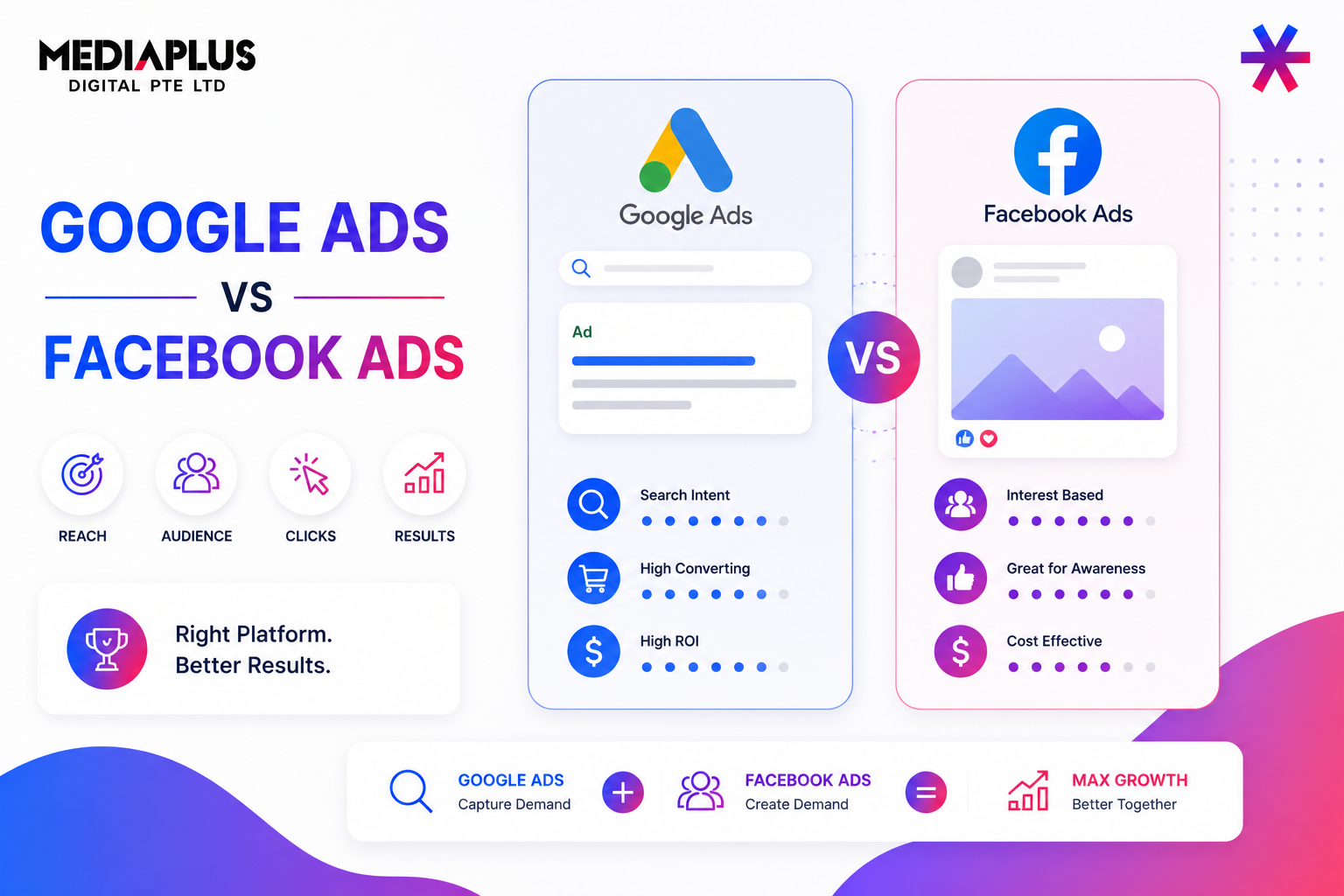
When it comes to paid advertising, two platforms dominate the digital landscape: Google Ads and Facebook Ads.
Both are powerful, but they work in very different ways. Choosing the right one can significantly impact your results, whether your goal is leads, sales, or brand awareness.
In this guide, we’ll break down the key differences between Google Ads and Facebook Ads, their strengths, and when to use each.
What Is Google Ads?
Google Ads is a search-based advertising platform that allows businesses to show ads when users actively search for specific keywords.
For example, when someone searches for “buy running shoes,” Google Ads displays relevant ads at the top of the search results.
Key features:
- Keyword-based targeting
- High intent traffic
- Pay-per-click (PPC) model
- Multiple formats including Search, Display, and Shopping
What Is Facebook Ads?
Facebook Ads, part of Meta Ads, is a social media advertising platform that targets users based on their interests, behaviour, and demographics.
Instead of responding to search intent, Facebook Ads creates demand by showing ads to users who may not be actively searching.
Key features:
- Interest and behaviour targeting
- Visual ad formats (images, videos, carousels)
- Strong audience segmentation
- Ideal for brand awareness and engagement
Key Differences Between Google Ads and Facebook Ads
1. Intent vs Discovery
The biggest difference lies in user intent.
- Google Ads targets users who are actively searching
- Facebook Ads targets users while they are browsing
This means:
- Google Ads captures demand
- Facebook Ads creates demand
2. Targeting Method
Google Ads:
- Keywords
- Search queries
- Location and device
Facebook Ads:
- Interests and behaviours
- Demographics
- Custom and lookalike audiences
Facebook offers more granular audience targeting, while Google focuses on search intent.
3. Cost Structure
Both platforms use an auction system, but costs vary.
Google Ads:
- Often higher cost per click (CPC)
- Strong ROI due to high intent
Facebook Ads:
- Lower CPC on average
- Requires strong creative to convert
The real metric to compare is cost per result, not just cost per click.
4. Ad Formats
Google Ads:
- Text ads (Search)
- Shopping ads
- Display banners
- YouTube video ads
Facebook Ads:
- Image ads
- Video ads
- Carousel ads
- Stories and Reels
Facebook is more visual, while Google is more intent-driven.
5. Funnel Position
Google Ads works best at the bottom of the funnel:
- Users ready to buy
- High conversion intent
Facebook Ads works across the funnel:
- Awareness
- Consideration
- Retargeting
When Should You Use Google Ads?
Google Ads is ideal when:
- You want immediate leads or sales
- Your product or service has existing demand
- You are targeting high-intent keywords
- You need measurable ROI quickly
Examples:
- Local services
- E-commerce with high search demand
- B2B lead generation
When Should You Use Facebook Ads?
Facebook Ads is ideal when:
- You want to build brand awareness
- Your audience is defined by interests or behaviour
- You are launching a new product
- You rely on visual storytelling
Examples:
- Lifestyle brands
- Fashion and beauty
- Fitness and coaching
- New or innovative products
Which Platform Is Better?
There is no single “better” platform.
It depends on your goals.
If your goal is:
- Immediate conversions → Google Ads
- Brand awareness and audience building → Facebook Ads
However, the most effective strategy is often to use both together.
How Google Ads and Facebook Ads Work Together
Instead of choosing one, many businesses combine both platforms.
A typical strategy:
- Use Facebook Ads to generate awareness and interest
- Use Google Ads to capture demand when users search later
Example:
A user sees your product on Facebook → becomes interested → later searches on Google → clicks your ad → converts
This full-funnel approach improves overall performance.
Common Mistakes to Avoid
Many businesses waste budget due to these mistakes:
- Choosing the wrong platform for their objective
- Ignoring audience targeting
- Using weak creatives on Facebook
- Not optimising keywords in Google Ads
- Failing to track conversions properly
Avoiding these issues can significantly improve results.
Final Thoughts
Google Ads and Facebook Ads are not competitors. They are complementary tools.
Google Ads captures existing demand, while Facebook Ads helps create it.
The best results come from understanding how each platform works and using them strategically based on your business goals.
For businesses looking to maximise performance, working with experienced teams like MediaPlus Digital Singapore can help build a full-funnel strategy across google ads agency, facebook advertising agency, and performance marketing Singapore, ensuring your campaigns are optimised for both reach and conversions.