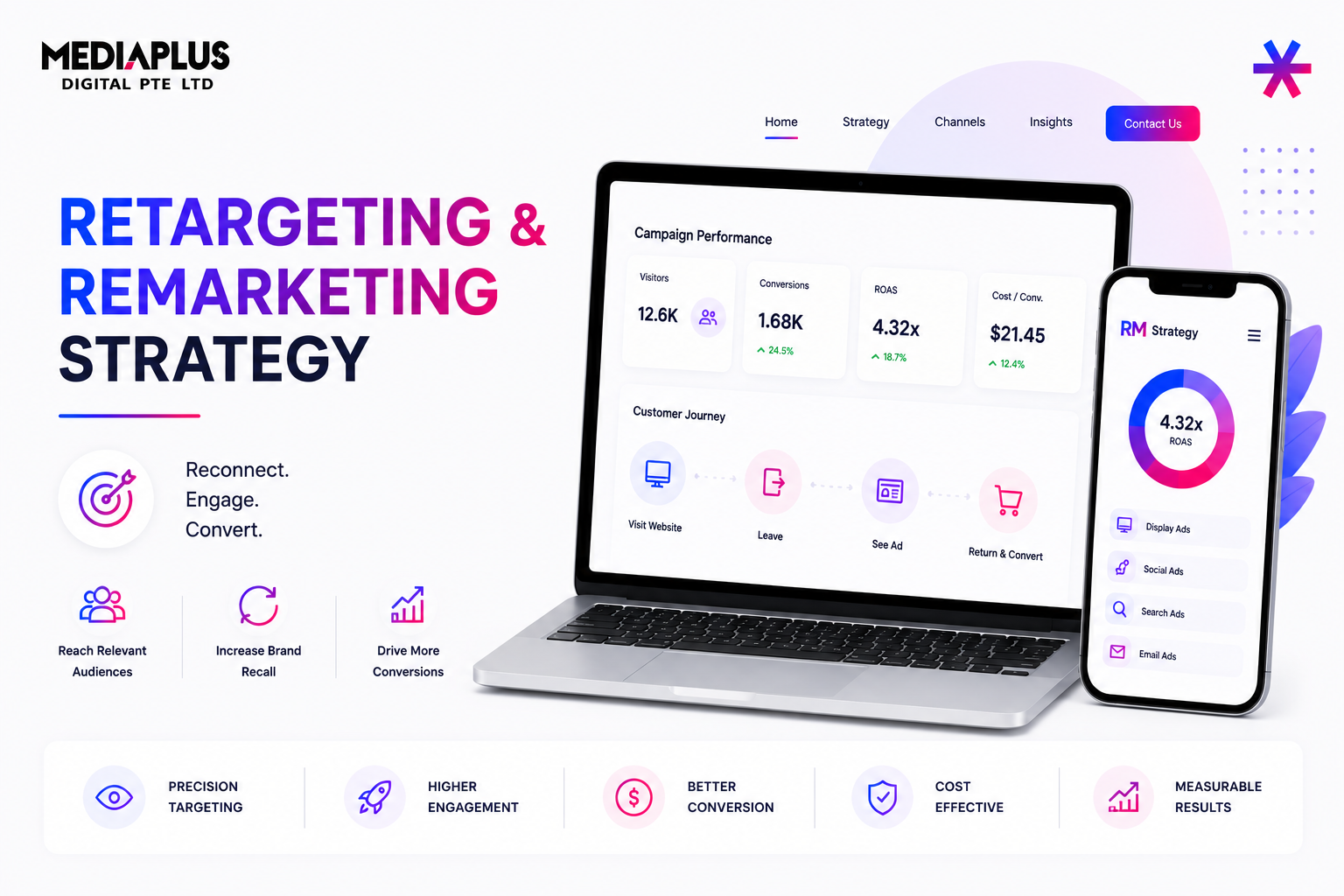
Only 2% to 4% of visitors convert on a first visit. Retargeting goes after the other 96%, and the maths is hard to argue with: retargeted users are around 70% more likely to convert, retargeting converts 3 to 5 times better than cold prospecting, and retargeted display can see roughly 10x the CTR of cold display. This is the deep playbook for building that engine across Google and Meta in 2026.
It maps to your sales funnel and customer journey.
The 2026 Shift: From Lists to Data Segments
Google renamed remarketing lists to Your data segments (Tools, Shared Library, Audience Manager). The rename matters: these segments now feed Smart Bidding, Performance Max signals, and customer acquisition, not just retargeting ads. With cookies fading, the strategy is first-party data first.
Google: The Four Data Segment Types
|
Segment |
Built from |
Note |
|
Website visitors |
Google Tag Manager or GA4 |
~70% more likely to convert, ~10x display CTR |
|
App users |
Firebase or analytics SDK |
Segment by in-app behaviour |
|
Customer Match |
Hashed first-party data (email, phone) |
Match rate 30% to 60%, min 100 users |
|
Content engagers |
YouTube and Search engagement |
Engaged audiences often match better than manual tags |
Three modes (Search, Shopping, Display): Targeting (members only), Observation (reach all, bid-adjust by segment), and Exclusion. Use Observation to learn before you target.
Customer Match Rules You Cannot Ignore
- Minimum 100 matched users to target, but aim for 1,000+ active users for the algorithm to learn. Segments under 200 usually lack data.
- Maximum membership duration is 540 days, with automatic removal of inactive users (enforced from April 2025).
- Data must be hashed and have explicit user consent before upload.
- Refresh quarterly at minimum to stay inside the 540-day window, monthly for active CRMs.
Membership windows: E-commerce 30 to 60 days, B2B and high-consideration 90 to 180 days.
Meta: Custom Audience Types
|
Audience |
Source |
Window |
|
Website visitors |
Meta Pixel or CAPI |
7 to 180 days |
|
Engagement |
On-platform activity, video views |
7 to 365 days |
|
Customer lists |
CRM or email upload |
Manual |
|
App activity |
Facebook SDK |
7 to 180 days |
|
Catalogue viewers |
Pixel plus catalogue |
7 to 90 days (dynamic ads) |
Build Segments by Funnel Stage
|
Stage |
Audience (example window) |
Message |
CTA |
|
Awareness |
All visitors (180 days) |
Brand narrative, credibility |
Learn more |
|
Consideration |
Product viewers (60 days) |
Benefits, social proof, comparisons |
See details |
|
Intent |
Add-to-cart non-purchasers (30 days) |
Reminders, incentives |
Complete purchase |
|
Conversion |
Checkout abandoners (14 days) |
Strong incentive, objection handling |
Finish checkout |
|
Retention |
Past purchasers (365 days) |
Cross-sell, loyalty |
Shop new items |
Priority: Build the high-intent lists first (cart abandoners, pricing and product viewers, lead-form starters). They consistently beat broad all-visitor lists.
Dynamic Product Ads (Setup Requirements)
- A product catalogue with accurate titles, images, and prices (from Google Merchant Center or Meta catalogue).
- Pixel or tag with e-commerce events: ViewContent, AddToCart, InitiateCheckout, Purchase.
- Content IDs matching catalogue product identifiers.
- Conversions API or server-side tracking alongside the pixel.
Pair cart-recovery ads with on-site fixes from how to reduce cart abandonment.
Exclusion Audiences (The Most Neglected Lever)
- Exclude recent converters (7 to 30 days) from acquisition campaigns.
- Exclude existing customers from PMax New Customer Acquisition mode.
- Exclude extreme bouncers (sub 5-second sessions).
- Exclude users retargeted repeatedly without engagement.
- Apply funnel hierarchy: each stage excludes the stages below it to stop overlap.
Frequency and Creative
|
Scenario |
Frequency cap |
|
Standard retargeting |
5 to 7 impressions per week |
|
Cart abandonment |
2 to 3 per day across a 3-day window |
|
Broad campaigns |
3 to 4 per week |
- Prepare multiple creative variations before launch and rotate before performance dips.
- Use sequential messaging where each ad builds on the last, not the same ad repeated.
- Fatigue signals: declining CTR week on week, frequency above 10, rising CPC, negative comments.
The Biggest Mistake: Over-Segmentation
Unless you spend roughly six figures a month, fine-grained segmentation harms performance because each tiny list lacks the data to optimise. Start broad, then split only when traffic supports statistical significance.
Measurement
- Compare conversion rate and ROAS by segment against prospecting (expect the 3 to 5x lift).
- Use Observation mode to compare members versus non-members directly.
- Interpret view-through conversions cautiously, and test attribution windows (7 vs 28 day).
- Where possible, measure incrementality so you are not paying to reach people who would convert anyway, and feed learnings into conversion rate optimisation.
Privacy-First Setup for 2026
- Implement Conversions API or server-side tracking alongside the pixel.
- Build email and phone lists aggressively as durable first-party data.
- Lean on engagement-based audiences (video viewers, page engagers).
- Use Advantage+ and Customer Match to let machine learning expand from clean signals.
Setup Checklist
- Tag and GA4 linked, key conversion events firing, remarketing tag active.
- Lists built: all visitors 30 and 90 days, product page non-converters, checkout and pricing non-converters, and converters (for exclusion).
- Customer Match uploaded and hashed, with consent and a quarterly refresh.
- PMax signals set: Customer Match primary, recent high-intent visitors secondary, past purchasers separated where volume allows.
Common Mistakes
- Retargeting all visitors with one generic ad.
- No exclusion of recent converters, so you pay to re-sell buyers.
- Running the same creative for months.
- No frequency cap, burning budget and goodwill.
- Relying only on cookie lists instead of first-party data and CAPI.
Cost Context for Singapore
Retargeting usually achieves lower CPCs than cold campaigns. For planning, see Facebook Ads cost and Google Ads cost.
Build a Retargeting Engine That Pays Back
MediaPlus runs full-funnel retargeting across Google and Meta through our social media ads and SEM services. Get in touch for a consultation.
Related Reads