Almost nobody buys the first time they hear about you. They notice you, forget you, look you up again, compare you against three competitors, hesitate over the price, then buy weeks later. A sales funnel is how you map that path and stop losing people along the way. This guide explains what a sales funnel is in digital marketing, the stages and frameworks behind it, the different funnel types you can build, and how to find the leak that is costing you sales.
Quick answer: A sales funnel is the path a person takes from first discovering your business to becoming a paying customer, and often to buying again. It is drawn as a funnel because many people enter at the top and only a fraction come out the bottom as buyers. The standard stages are awareness, interest, evaluation, decision, purchase, and retention, often shortened to top, middle, and bottom of funnel. In digital marketing, each stage needs its own content and its own metric, and improvement comes from finding the stage where the biggest drop-off happens and fixing that one first.
What is a sales funnel?
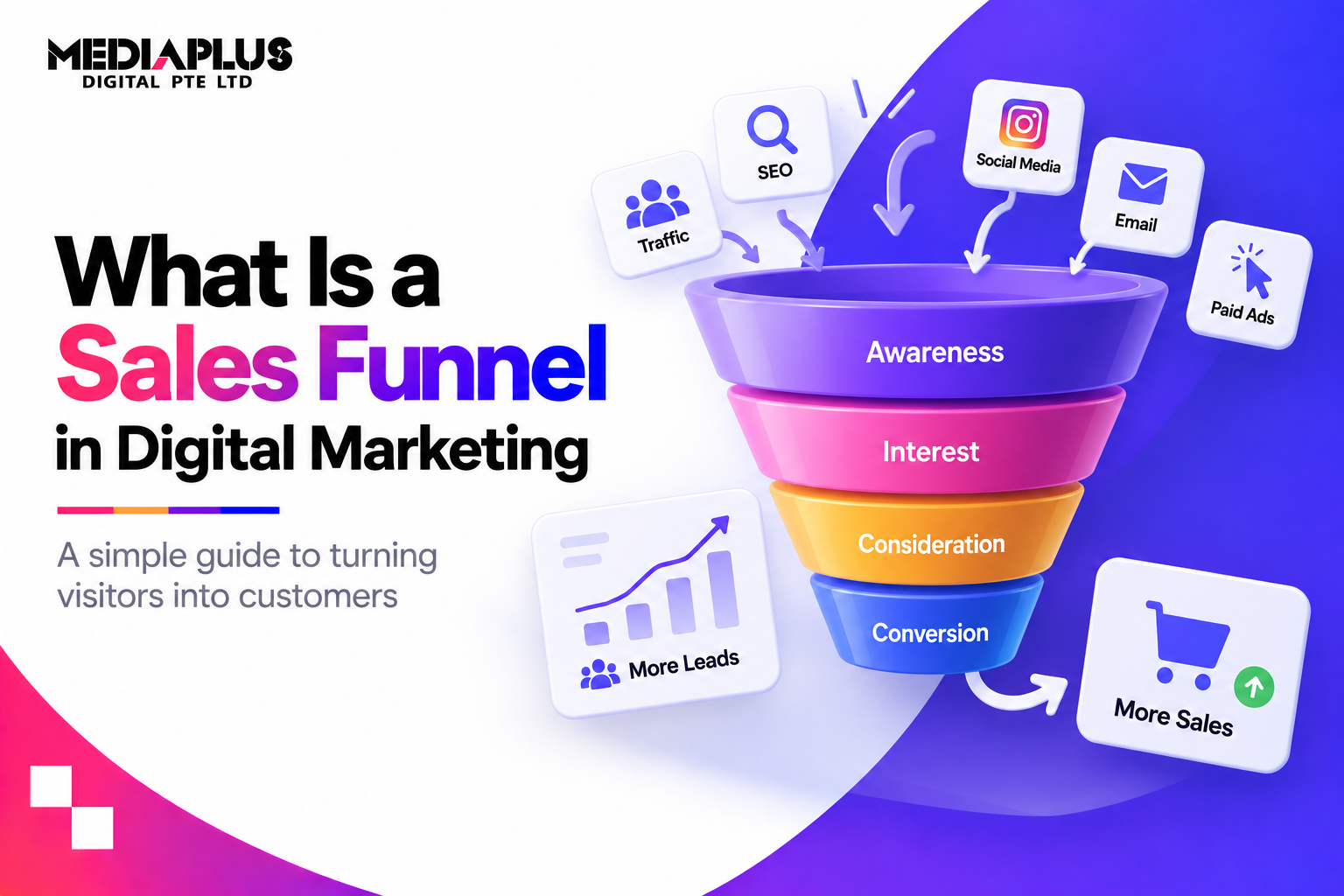
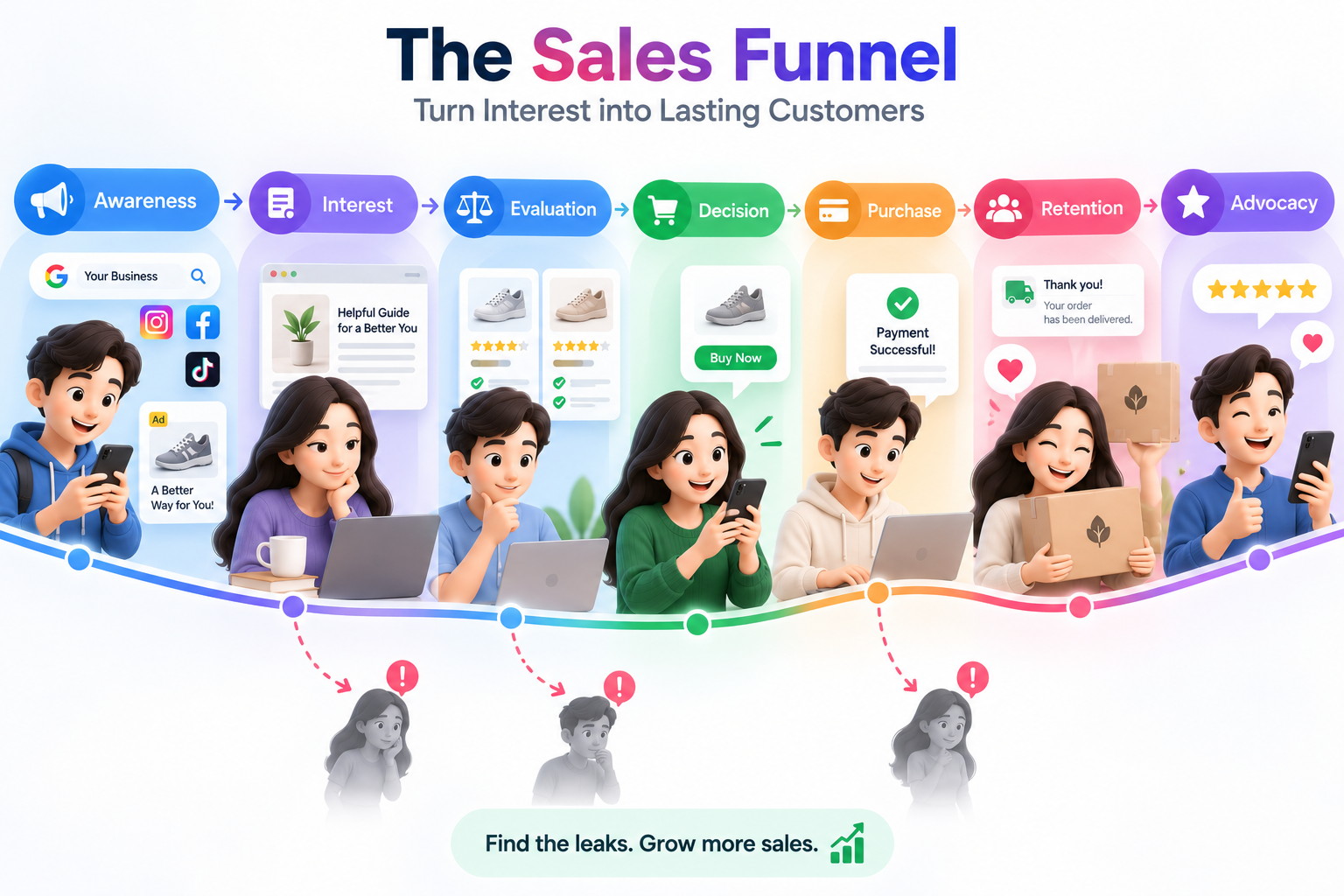
A sales funnel is a model of the customer’s journey from first contact to purchase, broken into stages so you can see where people are and what they need next. It is called a funnel because of the shape of the numbers: a large audience becomes aware of you, a smaller group shows interest, fewer still evaluate seriously, and a smaller number buy.
In digital marketing specifically, the funnel maps to real, measurable things: ad impressions and organic search at the top, blog posts and email at the middle, landing pages and checkout at the bottom. Every stage is trackable, which is what makes the funnel useful rather than theoretical. See our guide to digital marketing.
One caveat worth stating early: real buyers do not move in a tidy line. They skip stages, loop back, and disappear for a month. The funnel is a planning tool, not a description of how any individual behaves.
Why the sales funnel matters
- It shows you where you are losing people. Rather than “sales are down”, you can see that 4% of visitors add to cart but only 1% check out.
- It tells you what content to make. Someone who just discovered you needs something completely different from someone comparing your pricing.
- It stops wasted ad spend. Most businesses push cold traffic straight to a sales page and wonder why it does not convert.
- It makes marketing measurable. Each stage has its own metric, so you can prove what is working.
- It reveals the cheapest growth. Usually it is not more traffic; it is fixing the stage that leaks worst.
The stages of a sales funnel
Different sources name six stages slightly differently. Here is the practical version, with what to do and what to measure at each.
|
Stage |
What the customer is doing |
Your job |
Content that works |
Metric |
|
Awareness |
Discovering you exist |
Get found |
SEO articles, social, ads, video |
Reach, traffic, impressions |
|
Interest |
Learning about the solution |
Educate and build trust |
Guides, newsletters, webinars |
Time on page, subscribers |
|
Evaluation |
Comparing options |
Prove you are the right choice |
Case studies, reviews, comparisons, demos |
Return visits, demo requests |
|
Decision |
Ready but hesitating |
Remove the last objection |
Pricing, FAQs, guarantees, free trial |
Quote requests, add to cart |
|
Purchase |
Buying |
Make it effortless |
Checkout, clear CTA, easy forms |
Conversion rate |
|
Retention |
Using, deciding whether to return |
Deliver and stay in touch |
Onboarding, support, loyalty, email |
Repeat rate, lifetime value |
The most common mistake in Singapore SME marketing is spending the entire budget on stage one and nothing on stages two to four, then blaming the ads.
TOFU, MOFU, BOFU explained
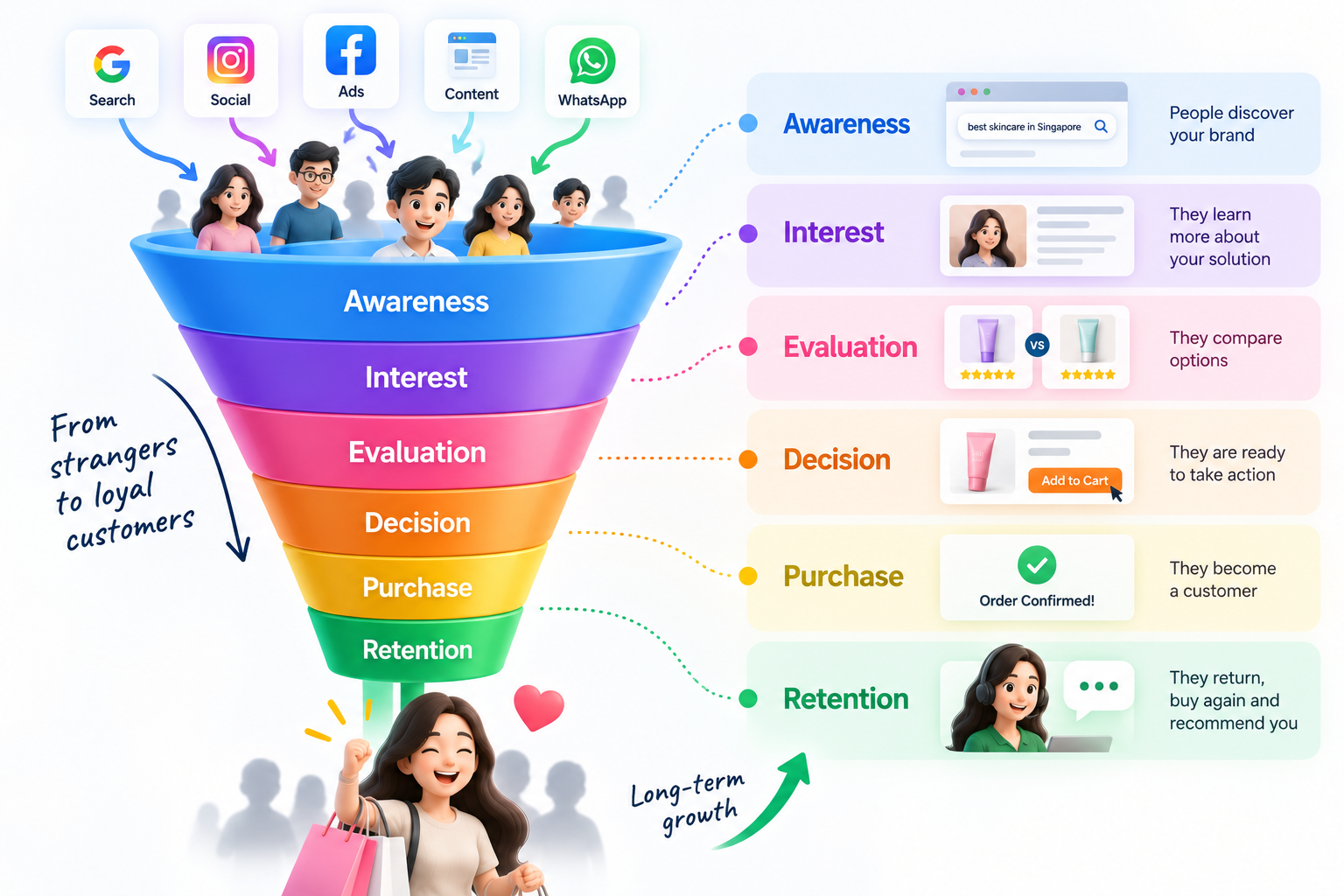
You will hear the funnel compressed into three parts:
- TOFU (top of funnel): awareness. Broad, educational content for people who do not know you yet. Judge it on reach and traffic, not sales.
- MOFU (middle of funnel): interest and evaluation. Content that helps people compare and trust you. Judge it on leads and engagement.
- BOFU (bottom of funnel): decision and purchase. Pricing pages, demos, quotes, checkout. Judge it on conversions and revenue.
This shorthand is useful because it stops you judging TOFU content by BOFU metrics, which is how good top-of-funnel content gets killed off before it has a chance to work.
The AIDA model
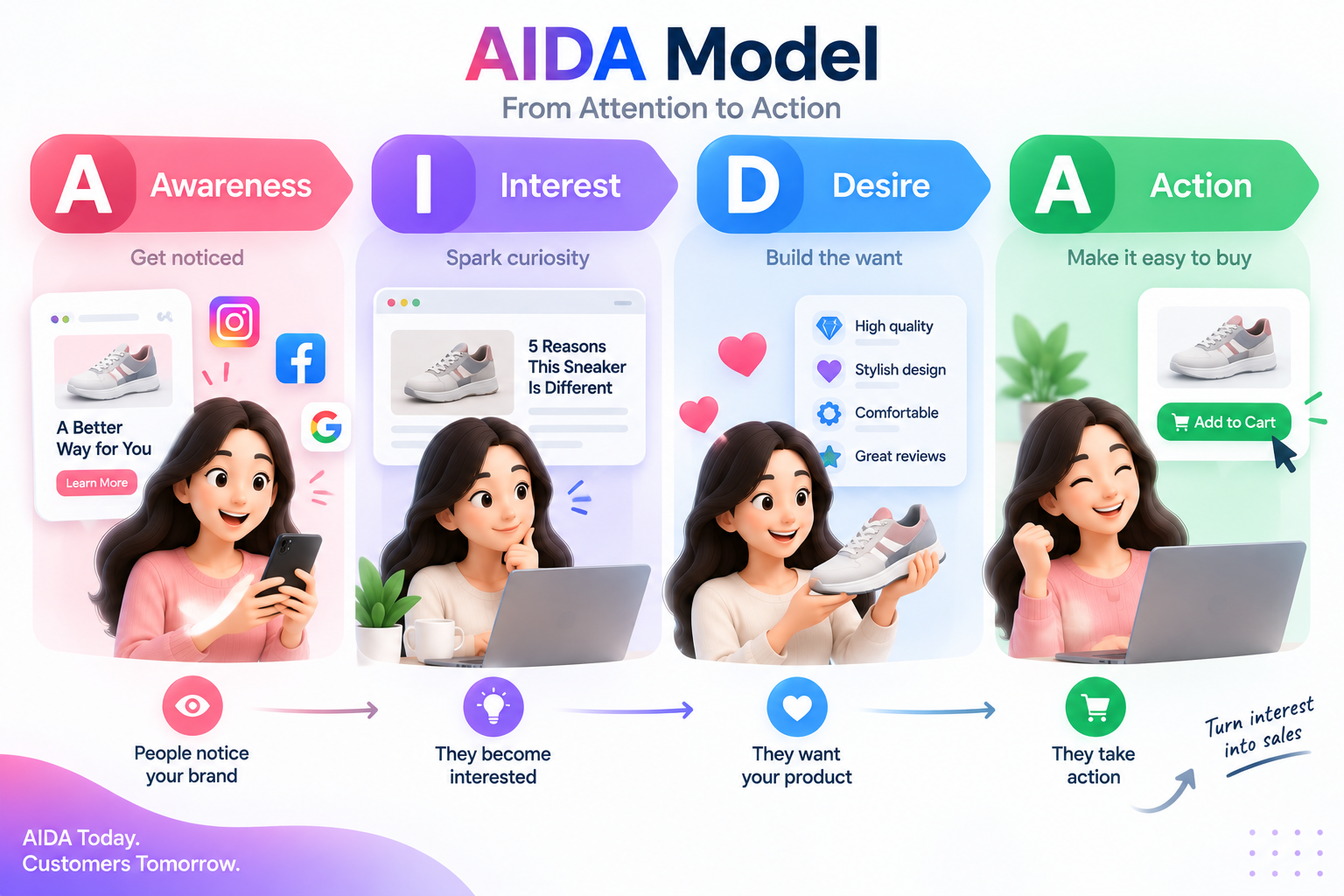
AIDA is the classic marketing framework the funnel is built on:
- Attention: get noticed
- Interest: hold their attention with something relevant
- Desire: make them want the outcome you provide
- Action: ask clearly for the next step
It is old, but it still describes what a good landing page does from top to bottom. See our guide to the call to action.
Sales funnel vs marketing funnel vs customer journey
These three overlap and get used loosely:
|
Focus |
Owned by |
|
|
Marketing funnel |
Attracting and nurturing until someone is sales-ready |
Marketing |
|
Sales funnel |
Converting interested people into customers |
Sales, or marketing in e-commerce |
|
Customer journey |
The whole experience, including after purchase, from the customer’s view |
Everyone |
In a small business or e-commerce operation, the marketing and sales funnels are effectively the same thing. The customer journey is the widest of the three, and it is mapped rather than counted. See our customer journey map guide.
B2B vs B2C funnels
B2C funnels are usually shorter and more emotional. One person decides, often quickly, and visual content and offers carry a lot of weight.
B2B funnels are longer, more rational, and involve several people. Content has to serve different roles (the user, the manager, the finance approver), and evaluation takes weeks or months. Case studies, detailed documentation, and demos matter far more than urgency tactics.
The practical implication: if you run B2B, expect a longer nurture stage and do not judge the funnel on this month’s numbers.
Types of sales funnels you can build
The “funnel” is also a concrete thing you build. The common types:
|
Funnel type |
What it does |
Best for |
|
Lead magnet funnel |
Trades useful content for an email address |
Building a list to nurture |
|
Squeeze page funnel |
A single page focused only on capturing contact details |
Fast list building |
|
Webinar funnel |
Registration, live or recorded session, then an offer |
Considered or higher-priced services |
|
Tripwire funnel |
A low-cost first offer to turn a lead into a buyer |
Turning cold audiences into customers |
|
Product launch funnel |
A content sequence building anticipation before release |
New product launches |
|
Limited-time offer funnel |
Uses a deadline to push a decision |
Promotions and seasonal pushes |
|
Video sales letter |
A long-form video that does the selling |
Higher-ticket offers |
|
Demo or consultation funnel |
Drives to a booked call or demo |
B2B and services |
|
E-commerce funnel |
Product page, cart, checkout, post-purchase upsell |
Online retail |
Most Singapore SMEs only need one or two of these done well. For services, a consultation funnel plus a lead magnet usually covers it.
How to build a sales funnel, step by step
- Define who you are targeting. Everything downstream depends on this. Base it on your actual best customers, not a guess.
- Map how they currently buy. Where do they find you, what do they read, what do they ask before committing?
- Choose your entry point. SEO, paid ads, social, or referral. Pick one or two you can do properly rather than five badly.
- Create content for each stage, using the table above. The gap is almost always in the middle.
- Build a proper landing page for the conversion point, not your homepage. See landing pages and our landing page design service.
- Set up nurturing, usually email, so people who are not ready today are not lost.
- Track every stage, so you know your drop-off rates rather than guessing.
- Fix the worst leak, then repeat. Funnels improve one bottleneck at a time.
How to find the leak
This is the part that actually makes money. Calculate the conversion rate between each stage, then look for the biggest fall.
- Lots of traffic, few leads? Your middle is missing, or your offer is unclear.
- Lots of leads, few sales? Weak follow-up, or price and trust objections you are not answering.
- High cart abandonment? Checkout friction, unexpected shipping costs, or too few payment options.
- Customers who never return? No retention effort at all, which is the most common and most expensive gap.
Fix the biggest drop first. Doubling a 1% checkout rate is usually cheaper and faster than doubling traffic. This is the core of conversion rate optimisation.
Where funnels break most often
From the pages we work on, the recurring failures:
- Ads pointing at the homepage instead of a page matched to the ad.
- Asking for the sale too early, before any trust exists.
- No middle. People discover you, get interested, and then find nothing that helps them decide.
- A checkout with too many steps, forced account creation, or missing payment methods.
- No follow-up for people who did not buy today.
- Nothing after purchase, so the cheapest sale you could make never happens.
Common sales funnel mistakes
- Judging TOFU content by BOFU metrics and killing content that was working.
- Building the funnel before defining the audience.
- Copying a funnel template that suits a different business model.
- Tracking nothing, so improvements are guesswork.
- Treating the funnel as linear and being surprised when buyers loop back.
- Optimising the funnel while ignoring the offer. No funnel saves a proposition nobody wants.
Frequently asked questions
What is a sales funnel in digital marketing?
It is the path a person takes from discovering your business online to buying, mapped in stages (awareness, interest, evaluation, decision, purchase, retention) so each stage can have its own content, channel, and metric.
What are the stages of a sales funnel?
Commonly six: awareness, interest, evaluation, decision, purchase, and retention. These are often compressed into three: top of funnel (TOFU), middle (MOFU), and bottom (BOFU).
What is the difference between a sales funnel and a marketing funnel?
The marketing funnel covers attracting and nurturing people until they are ready to buy; the sales funnel covers converting them. In small businesses and e-commerce they are effectively the same funnel.
What does TOFU, MOFU and BOFU mean?
Top, middle, and bottom of funnel. TOFU is awareness content judged on reach, MOFU is nurturing content judged on leads, BOFU is conversion content judged on sales.
How do I know where my funnel is leaking?
Measure the conversion rate between each stage and find the biggest drop. Heavy traffic with few leads points to a missing middle; many leads with few sales points to follow-up, trust, or price objections.
How long does a sales funnel take to work?
It depends on your buying cycle. B2C purchases can convert in a single session; B2B often takes weeks or months and several touchpoints, so judge B2B funnels over a longer window.
Do small businesses need a sales funnel?
Yes, and usually a simple one. Even a single lead magnet plus an email sequence and a good landing page outperforms sending all traffic to a homepage and hoping.
Fix the stage that is costing you sales
Most funnels do not need rebuilding, they need the one broken stage found and fixed. If you want help mapping your funnel and improving what converts, talk to MediaPlus Digital. Explore our conversion rate optimisation, Google Ads, and e-commerce website development services, with PSG support for eligible SMEs.