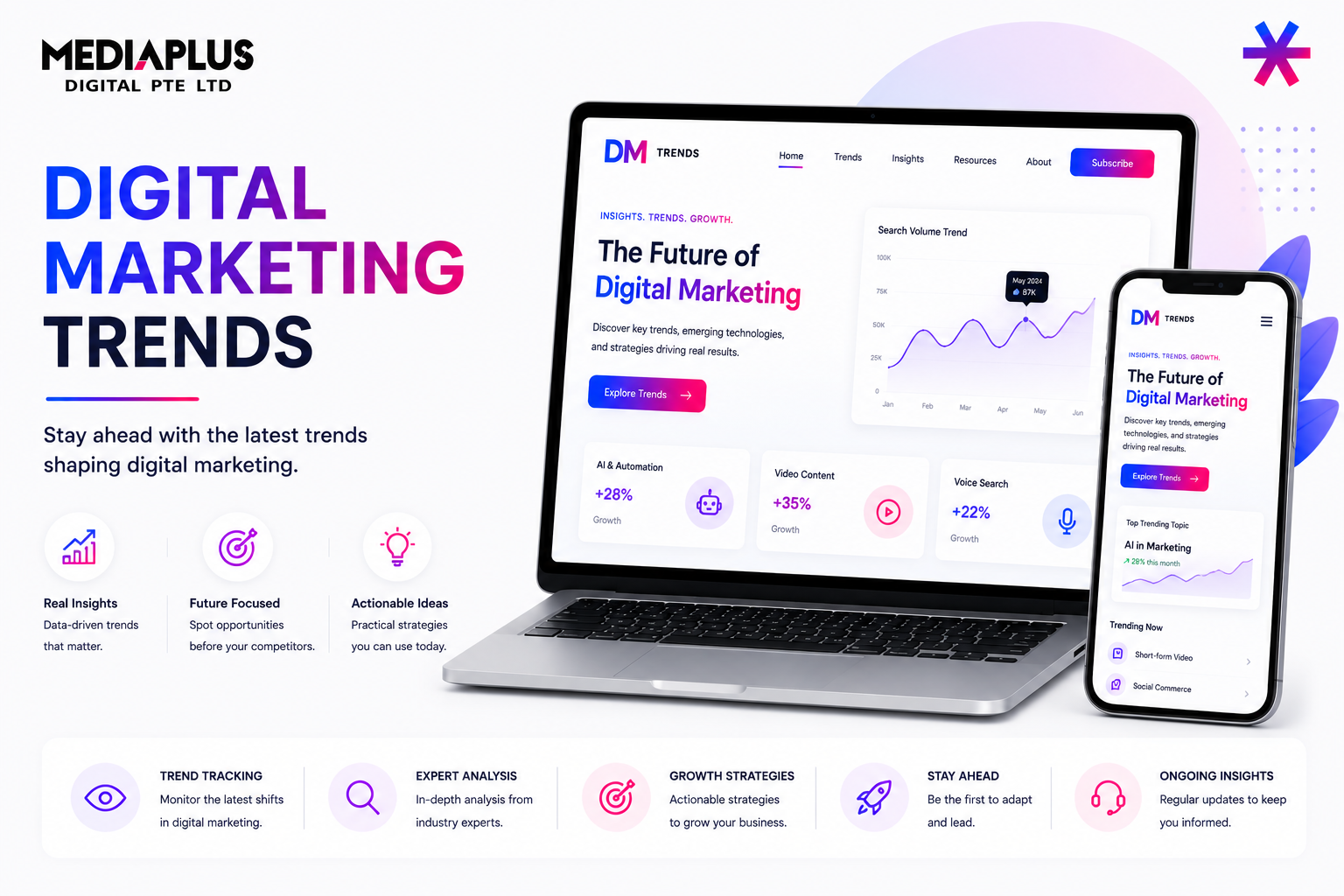
Most trend lists describe what is changing and stop there. This one is different. Each trend is ranked by how much it should move a Singapore SME’s 2026 budget, backed by a number, localised to the Singapore market, and paired with an action you can run this quarter and the tools to do it. The underlying story is simple: AI is rewiring how people discover brands, and privacy rules are rewiring how brands measure them.
If you want the foundation first, start with our digital marketing strategy guide. Otherwise, here is what is actually changing and what to do.
The 10 Trends, Ranked by Budget Impact
|
# |
Trend |
Priority for 2026 |
|
1 |
AI search and zero-click |
Critical |
|
2 |
First-party data as infrastructure |
Critical |
|
3 |
Privacy-first measurement |
Critical |
|
4 |
AEO and GEO move to budget line items |
High |
|
5 |
AI-driven ad automation |
High |
|
6 |
Short-form video everywhere |
High |
|
7 |
Micro-communities beat mass reach |
High |
|
8 |
Creator-led commerce |
Medium |
|
9 |
Retail media networks |
Medium |
|
10 |
MarTech stack consolidation |
Medium |
What Is Driving These Trends
Four forces sit underneath every trend below. Understanding them makes the actions obvious.
- AI-generated answers reduce clicks but increase brand exposure. Industry data points to roughly 60% of Google searches now ending without a click, and forecasts of a sharp drop in classic search volume by the end of 2026.
- Privacy regulation and cookie loss are breaking old tracking. PDPA enforcement in Singapore has increased, with penalties of up to SGD 1 million for serious breaches.
- Paid ad costs keep rising, so owned audiences and organic authority become cost savings, not just nice to have.
- Singapore buyers research carefully across platforms, so trust and social proof decide the sale.
Note: Statistics in this article are drawn from 2026 industry sources (Similarweb, Gartner, and agency datasets). Verify the latest figures before publishing or quoting them externally.
The 10 Trends in Detail
1. AI Search and Zero-Click Reality
ChatGPT, Perplexity, Gemini, and Google AI Overviews now answer many queries before a user ever clicks. Around 38% of Singapore search results show an AI Overview, and a large share of informational searches end with zero clicks. Transactional queries are holding up better than informational ones, so the impact is uneven across your content.
The data: Some agencies report client GA4 informational query traffic down 20% to 40% year on year as AI answers absorb the click.
Singapore angle: With a small, high-intent market, losing informational clicks hurts top-of-funnel discovery fast.
Action this quarter: Audit your top 20 informational pages. Rewrite them to be the cited source inside AI answers rather than chasing the click, with answer-first openings and clear structure.
Tools and reads: AI Overview citations, how AI is transforming digital marketing, and Google AI Overview tracking tools.
2. First-Party Data Becomes Infrastructure
Third-party cookies are functionally dead, pushed out by Apple ATT, iOS changes, the Chrome Privacy Sandbox, and PDPA enforcement. The strongest SMEs are building owned databases, often in the range of 5,000 to 50,000 contacts, that they fully control.
Build a data collection map across three points:
|
Touchpoint |
What to capture |
|
Website |
Form fills, chat, downloads, newsletter signups |
|
Checkout |
Order details, opt-ins, preferences |
|
Post-purchase |
Reviews, NPS, surveys, loyalty signups |
Action this quarter: Map your top three data collection points, add one valuable value exchange (a template, calculator, or checklist), and pipe everything into a single CRM such as HubSpot, Klaviyo, or ActiveCampaign.
Related: lead generation guide.
3. Privacy-First Measurement
As cookies fade, old last-click attribution becomes unreliable, and non-compliant tracking carries real regulatory risk under PDPA. The fix is a modern stack that is actually more accurate than the cookie era, not less.
The modern stack: GA4 plus server-side Google Tag Manager, plus Conversions API (Meta) and Enhanced Conversions (Google), feeding a first-party CRM.
Timing: Note the 15 June 2026 change to how GA4 data flows to Google Ads, where the ad_storage consent parameter becomes the deciding switch.
Action this quarter: Confirm GA4 uses server-side tagging, enable CAPI and Enhanced Conversions, and verify your consent banner and privacy notice are PDPA compliant.
Reads: how to track traffic from AI Overviews and PDPA compliance for websites.
4. AEO and GEO Move to Budget Line Items
Answer Engine Optimisation and Generative Engine Optimisation are no longer experiments. They are becoming standing budget lines. The work overlaps around 70% with classic SEO, with extra emphasis on entity-rich writing, brand mentions on Reddit, LinkedIn, and Quora, and the emerging llms.txt file.
Action this quarter: Check which sources ChatGPT and Perplexity cite for your priority topics, run a gap analysis, then add FAQs, schema, and answer-first content to close the gap. A free tool like Otterly can baseline your AI citation rate.
Reads: what is GEO, GEO vs SEO, Answer Engine Optimisation, and how to get cited inside ChatGPT.
5. AI-Driven Ad Automation
Google Performance Max, Meta Advantage+, and LinkedIn predictive audiences are now the default, and they outperform manual setups for most accounts under roughly SGD 50,000 monthly spend. They run on three fuels: creative diversity, clean conversion data, and first-party audience signals.
Typical result: Agencies report 15% to 35% CAC improvement once the data feeding loops are working.
Action this quarter: Run a 60-day A/B test between Performance Max and your legacy campaigns, feed strong audience signals, and judge on conversions and value, not clicks.
Read: Google Ads strategy.
6. Short-Form Video Everywhere
Vertical short-form video is the default discovery format across TikTok, Reels, Shorts, and now LinkedIn, and clips increasingly appear inside Google AI answers for how-to queries. Top creator pages get 50% to 70% of their views from search and discovery, not followers, which means video is now a search asset.
Cadence: Competitive brands publish around 8 to 12 short videos per month, 15 to 60 seconds each.
Action this quarter: Adopt a create-once, distribute-four-times workflow with auto-captions for sound-off viewing. Repurpose each blog post into 3 to 5 clips using tools like Descript or Opus Clip.
Reads: how to sell on TikTok and Gen Z marketing strategies.
7. Micro-Communities Beat Mass Reach
Brands are building owned communities on Telegram, Discord, Substack, paid newsletters, and WhatsApp Channels instead of chasing follower counts on platforms they do not own. Singapore’s small market is the advantage: a community of 1,000 to 5,000 engaged people is often your entire addressable audience.
|
Approach |
Cost / conversion |
Compounding |
|
Paid reach |
SGD 5 to 50 per lead, 1% to 3% conversion |
None, stops when budget stops |
|
Micro-community |
Time-heavy at first, 5% to 25% conversion |
Compounds over time |
Real Singapore examples include an F&B founder with a 4,000-member Telegram group, a fitness studio with a 1,200-person paid newsletter, and a B2B SaaS with a 500-person Slack of customers and prospects.
Action this quarter: Pick one community channel and commit to 90 days of consistent value before judging it.
8. Creator-Led Commerce
The shift is from one-off influencer posts to long-term partnerships and revenue shares, where the creator helps build and sell through their own audience. In Singapore, micro creators with 5,000 to 50,000 highly engaged followers are reported to convert at 5 to 15 times the rate of celebrity placements.
Channels: TikTok Shop, creator storefronts, newsletters, and courses.
Action this quarter: Identify 10 relevant micro creators and pitch a quarterly partnership with a revenue share rather than a single sponsored post.
Reads: social commerce in Singapore and what is Xiaohongshu.
9. Retail Media Networks
Ad inventory on marketplaces and platforms is growing fast, with first-party targeting of active shoppers that often beats Meta and Google for bottom-funnel conversions. In Singapore that means Lazada Sponsored Solutions, Shopee Ads, and Grab for Business.
Action this quarter: If you sell through marketplaces, allocate 10% to 20% of acquisition budget to a 60-day retail media test and measure incrementality, not just platform-reported sales.
Related: examples of programmatic advertising campaigns.
10. MarTech Stack Consolidation
The era of adding tools is over. The average Singapore SME pays for 6 to 12 tools and actively uses 3. Consolidating onto fewer, AI-enabled platforms can save SGD 500 to SGD 3,000 a month, since AI features are now native to the platforms you already pay for (Klaviyo predictive AI, HubSpot content assistant, Canva Magic Studio).
Action this quarter: Audit your stack, cancel any tool used by under 30% of the team or at under 50% feature utilisation, and reinvest 20% of the savings into training.
Save time with reusable prompts in AI prompts every Singapore marketing team should save.
The Hidden Problem: Visibility Without Clicks
A pattern is catching many Singapore brands out in 2026: content gets seen, but traffic and leads do not rise with it. AI answers and in-platform decisions mean visibility no longer equals visits. The fix is to capture value from the visibility you already have.
- Add a call to action above the fold (free audit, template, or consultation).
- Build one lead magnet per core topic.
- Use mid-content CTAs, not just at the end.
- Create a retargeting funnel: readers, then lead magnet, then case study, then call.
- Improve landing page conversion with fewer fields, a clearer offer, social proof, and fast load.
The maths is powerful: lifting conversion from 1% to 2.5% more than doubles leads with no extra traffic. This is pure conversion rate optimisation. See also how to increase website conversion rate.
2026 Budget Allocation Guide for Singapore SMEs
Trends only matter if the budget follows. Use these as planning ranges.
|
Business stage |
Marketing as % of revenue |
|
Established SME |
5% to 12% |
|
Growth stage |
15% to 25% |
A workable 2026 spend split:
|
Bucket |
Share |
Includes |
|
Paid media |
50% to 60% |
Meta, Google, retail media |
|
Organic and content |
20% to 30% |
SEO, AEO and GEO, video, communities |
|
Tools, data, analytics |
15% to 25% |
CRM, tracking, martech |
For monthly budget context, most Singapore SMEs run SGD 3,000 to SGD 15,000 per month. See our digital marketing pricing guide, and check the digital marketing PSG grant if you qualify as an SME.
Your 90-Day Action Plan
- Weeks 1 to 2: Fix measurement. Server-side GA4, CAPI and Enhanced Conversions, PDPA consent, and the June 2026 GA4 change.
- Weeks 2 to 4: Stand up first-party data capture and one lead magnet, piped into a single CRM.
- Weeks 4 to 6: Make your top 20 pages AI-citable with answer-first openings, FAQs, and schema.
- Weeks 6 to 8: Launch a 60-day PMax vs legacy ad experiment and a funnel-stage retargeting setup.
- Weeks 8 to 12: Start one owned community channel and a create-once, distribute-four-times video workflow.
FAQ
What is the single biggest digital marketing trend in Singapore for 2026?
Search everywhere. Buyers now find answers across Google AI Overviews, TikTok, Reddit, YouTube, and ChatGPT, so being citable across surfaces matters more than ranking one page.
Is SEO still relevant in 2026?
Yes, but evolved. Structured content, FAQs, schema, and authority now drive both classic rankings and AI citations. See GEO vs SEO.
How much should a Singapore SME spend on digital marketing?
Roughly 5% to 12% of revenue for established SMEs and 15% to 25% for growth-stage businesses, often SGD 3,000 to SGD 15,000 per month.
How do I measure success when clicks are falling?
Track leads, lead quality (MQL to SQL), and revenue attribution, not traffic or impressions. Conversion rate and cost per acquisition matter more than ever.
How often should we publish short-form video?
Around 8 to 12 clips per month, 15 to 60 seconds each, repurposed across TikTok, Reels, Shorts, and LinkedIn.
Act on These Trends With a Partner
MediaPlus helps Singapore brands turn these trends into results through our digital marketing agency and AI marketing services, spanning SEM, social media ads, and AEO and GEO. Get in touch for a strategy session and a free measurement audit.
Related Reads