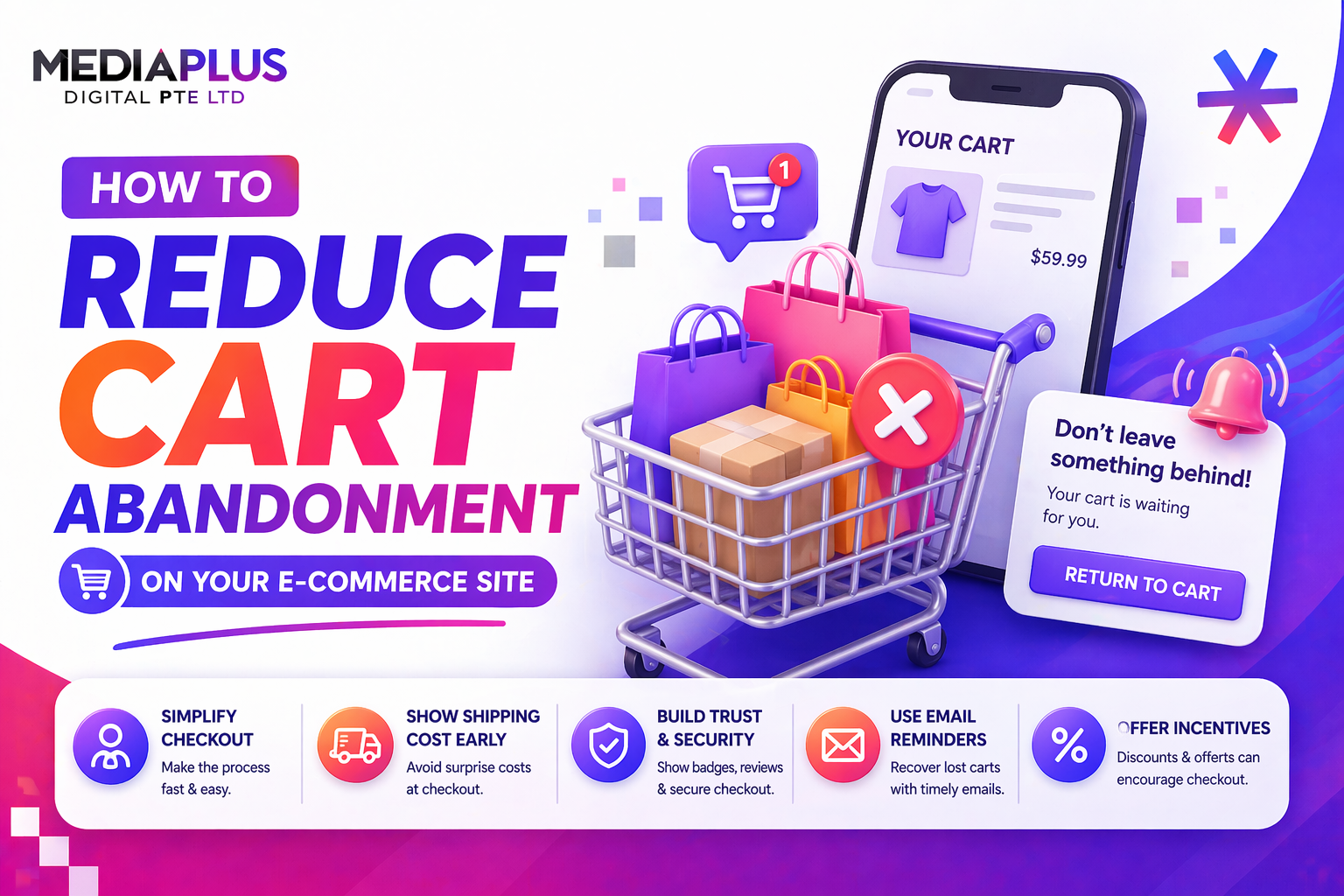
The average cart abandonment rate across ecommerce is 70.19% (Baymard Institute, 2024). That means 7 out of every 10 shoppers who add items to their cart leave without completing a purchase. For a store generating S$100,000 in monthly revenue, that represents roughly S$235,000 in lost sales sitting in abandoned carts.
The good news: cart abandonment is fixable. Most abandonment stems from a small number of predictable problems, and targeted strategies can recover a meaningful percentage of those lost sales. This guide covers 15 strategies organised by impact, with implementation guidance and Singapore-specific considerations.
Why Shoppers Abandon Carts: The 8 Root Causes
Understanding why shoppers leave is the first step to bringing them back. Research consistently points to the same core reasons:
|
Cause |
% of Abandoners |
Fix Category |
|
Extra costs too high (shipping, tax, fees) |
48% |
Pricing transparency |
|
Forced to create an account |
26% |
Checkout simplification |
|
Checkout too long or complicated |
22% |
Checkout optimisation |
|
Could not see total cost upfront |
21% |
Pricing transparency |
|
Did not trust site with card info |
18% |
Trust and security |
|
Delivery too slow |
17% |
Shipping and logistics |
|
Return policy not satisfactory |
12% |
Trust and transparency |
|
Not enough payment methods |
11% |
Payment options |
Source: Baymard Institute, cart abandonment statistics (aggregated from 49 studies).
15 Strategies to Reduce Cart Abandonment
1. Streamline Checkout to 3 Steps or Fewer
Every additional step in checkout increases drop-off. The ideal flow: Cart Review > Shipping + Payment > Confirmation. Compress address, shipping, and payment into a single page where possible. One-page checkouts consistently outperform multi-step flows.
- Remove unnecessary fields. Do you really need company name, fax number, or title?
- Use address auto-complete (Google Places API) to reduce typing.
- Show a progress indicator so users know how close they are to finishing.
2. Offer Guest Checkout
26% of shoppers abandon because they are forced to create an account. Always offer guest checkout, then invite users to create an account after purchase (“Save your details for faster checkout next time”). This converts better than gating checkout behind registration.
3. Show All Costs Upfront from the Product Page
48% of abandoners leave because of unexpected costs. The fix is simple: show shipping costs, taxes, and fees before the cart page. Use a shipping calculator on the product page. If you offer free shipping above a threshold, display it prominently (“Free shipping on orders over S$80”).
4. Optimise for Mobile Checkout
Mobile accounts for over 70% of ecommerce traffic but has the highest abandonment rate (85.65%). Mobile checkout must be thumb-friendly:
- Large buttons (minimum 44x44px) for CTAs and form inputs.
- Auto-fill for addresses and payment details.
- Mobile-appropriate input types (numeric keyboard for phone, email keyboard for email).
- Persistent cart summary that does not scroll away.
Our guide on responsive web design best practices covers mobile optimisation in depth.
5. Add Singapore-Preferred Payment Methods
11% abandon because of limited payment options. In Singapore, this means supporting:
- Credit/debit cards (Visa, Mastercard, AMEX)
- PayNow (bank transfer via QR)
- GrabPay
- Buy Now Pay Later: Atome, Pace, ShopBack PayLater
- Apple Pay and Google Pay for mobile
Each additional relevant payment method removes friction for a segment of your audience that would otherwise leave.
6. Display Trust Signals Where Doubt Lives
Place security badges, payment provider logos, and SSL indicators near the payment form, not just in the footer. Add a money-back guarantee badge near the checkout button. Research shows that trust badges near the CTA can increase conversions by 42%.
7. Make Your Return Policy a Conversion Tool
A generous, clearly visible return policy reduces purchase anxiety. Display “Free Returns Within 14 Days” or “Hassle-Free Returns” on the product page and in the cart. Shoppers who see a clear return policy are 67% more likely to complete their purchase.
8. Use Social Proof at the Point of Decision
Show reviews, ratings, and purchase counts near the Add to Cart and Checkout buttons. “4.8/5 from 2,340 reviews” or “1,247 sold this month” provides reassurance at the exact moment shoppers hesitate.
Learn more about how conversion rate optimisation uses social proof and trust signals to increase sales.
9. Build a 3-Email Abandoned Cart Sequence
Abandoned cart emails recover 5-10% of lost sales on average. Here is a proven 3-email sequence:
|
|
Timing |
Content |
Subject Line Example |
|
Email 1: Reminder |
1 hour after abandonment |
Cart contents + product images + direct link back to cart |
“You left something behind” |
|
Email 2: Urgency |
24 hours after |
Low stock warning or limited-time offer + reviews/social proof |
“Your items are selling fast” |
|
Email 3: Incentive |
48-72 hours after |
Small discount (5-10%) or free shipping offer |
“Here is 10% off to complete your order” |
Do not lead with the discount. Most shoppers will convert from the reminder alone, saving you margin.
10. Add SMS and WhatsApp Recovery
In Singapore and Southeast Asia, WhatsApp has 80%+ penetration. SMS and WhatsApp cart recovery messages have 98% open rates (compared to 20-25% for email). Send a friendly reminder with a direct cart link 2-4 hours after abandonment. Keep it conversational, not promotional.
11. Deploy Exit-Intent Popups with Smart Offers
When a user moves their cursor toward the browser’s close button (desktop) or shows exit behaviour (mobile), trigger a popup with a relevant offer: free shipping, a small discount, or a reminder of what they are leaving behind. Exit-intent popups convert 10-15% of abandoning visitors when the offer is compelling.
- Keep the popup clean: one message, one CTA.
- Do not show the same popup to returning visitors. Escalate or vary the offer.
- Never interrupt users who are actively filling in forms.
12. Retarget Abandoners Across Channels
Use Meta Ads, Google Display, and TikTok retargeting to show dynamic product ads to users who abandoned their carts. Retargeting ads are 76% more likely to be clicked than standard display ads because they show products the user already expressed interest in.
13. Use AI to Predict and Prevent Abandonment in Real Time
AI-powered tools can now analyse user behaviour in real time and trigger interventions before abandonment happens. If a user pauses on the shipping page, an AI chatbot can proactively offer help. If scroll depth and mouse patterns indicate exit intent, a personalised offer can appear dynamically.
14. Trigger Live Chat at Cart Page Drop-Off
Users who reach the cart page but stall for 30+ seconds are prime candidates for a proactive chat message: “Need help completing your order? I am here to assist.” Live chat at checkout has been shown to increase conversion rates by up to 20%.
15. Test Micro-Incentives Before Discounting
Before offering a 10% discount, test smaller incentives that protect your margins:
- Free shipping (often perceived as more valuable than an equivalent discount)
- A free sample or gift with purchase
- Priority shipping upgrade
- Loyalty points or store credit for future use
Micro-incentives can be just as effective as discounts at a fraction of the margin impact.
How to Prioritise: Cost vs Impact Framework
|
Strategy |
Implementation Cost |
Impact |
Priority |
|
Show all costs upfront |
Low (content change) |
Very High |
Do first |
|
Guest checkout |
Low (settings change) |
High |
Do first |
|
3-email recovery sequence |
Low (email platform) |
High |
Do first |
|
Mobile checkout optimisation |
Medium (dev work) |
Very High |
Quick win |
|
Add payment methods |
Medium (integration) |
High |
Quick win |
|
Trust signals placement |
Low (design change) |
Medium |
Quick win |
|
Exit-intent popups |
Low (tool subscription) |
Medium |
Test and learn |
|
SMS/WhatsApp recovery |
Medium (platform + opt-in) |
High |
Test and learn |
|
Retargeting ads |
Medium (ad budget) |
Medium-High |
Scale |
|
AI-powered interventions |
High (tools + setup) |
High |
Long-term |
Cart Abandonment Benchmarks by Industry
|
Industry |
Avg. Abandonment Rate |
Key Cause |
|
Fashion and Apparel |
68-72% |
Sizing uncertainty, comparison shopping |
|
Electronics |
74-78% |
High prices, comparison shopping |
|
Travel and Hospitality |
81-85% |
Research phase, complex booking flows |
|
Food and Grocery |
50-55% |
Lowest rate due to immediate need |
|
Health and Beauty |
65-70% |
Trust concerns, ingredient research |
|
Furniture and Home |
72-76% |
High AOV, delivery concerns |
Measuring Success: KPIs to Track
- Cart abandonment rate: (Carts Created – Completed Purchases) / Carts Created x 100
- Cart recovery rate: Recovered Sales / Total Abandoned Carts x 100
- Revenue recovered: Total revenue from recovery emails, SMS, and retargeting
- Checkout completion rate: Completed Purchases / Checkout Initiated x 100
- Average order value of recovered carts vs. standard orders
Track these in Google Analytics 4 or your ecommerce platform’s analytics. For a broader conversion strategy, see our guide on how to increase website conversion rate.
Frequently Asked Questions
What is a good cart abandonment rate?
The global average is 70.19%. Getting below 60% is considered good. Below 50% is excellent. The achievable rate depends on your industry, average order value, and target audience.
How do I calculate my cart abandonment rate?
Cart Abandonment Rate = (Number of Carts Created – Number of Completed Purchases) / Number of Carts Created x 100. Most ecommerce platforms (Shopify, WooCommerce) calculate this automatically in their analytics dashboard.
What is the best abandoned cart email subject line?
Keep it simple and personal. Top performers include: “You left something behind”, “Your cart is waiting for you”, “Did you forget something?”, and “[Name], your items are still available.” Avoid aggressive urgency or all-caps.
How many abandoned cart emails should I send?
Three emails is the sweet spot. Email 1 at 1 hour (reminder), Email 2 at 24 hours (urgency/social proof), Email 3 at 48-72 hours (incentive). More than 3 risks annoying customers.
Does free shipping reduce cart abandonment?
Yes, significantly. Unexpected shipping costs are the #1 cause of cart abandonment (48% of abandoners). Offering free shipping above a threshold (e.g., “Free shipping over S$80”) can reduce abandonment by 15-20%.
Are exit-intent popups annoying?
When done well, no. The key is relevance and restraint. Show one popup per session, make the offer genuinely useful, and never interrupt users who are actively completing a form. Poorly timed or irrelevant popups will increase bounce rate.
Key Takeaways
- The average cart abandonment rate is 70%. Most abandonment comes from hidden costs, forced registration, and complicated checkout.
- Start with high-impact, low-cost fixes: show all costs upfront, offer guest checkout, set up a 3-email recovery sequence.
- For Singapore ecommerce, add PayNow, GrabPay, and BNPL (Atome, Pace) to reduce payment friction.
- Use a 3-email recovery sequence: reminder (1hr), urgency (24hr), incentive (48-72hr). Do not lead with discounts.
- SMS and WhatsApp recovery have 98% open rates in Singapore, far exceeding email.
- Prioritise strategies using a cost-vs-impact framework rather than implementing everything at once.
Need Help Optimising Your Ecommerce Store?
At MediaPlus Digital, we build and optimise ecommerce websites that convert. From checkout optimisation to email recovery flows, our team helps Singapore businesses recover lost revenue. Explore our ecommerce website development services or read our guide on improving ecommerce user experience.