Quick answer
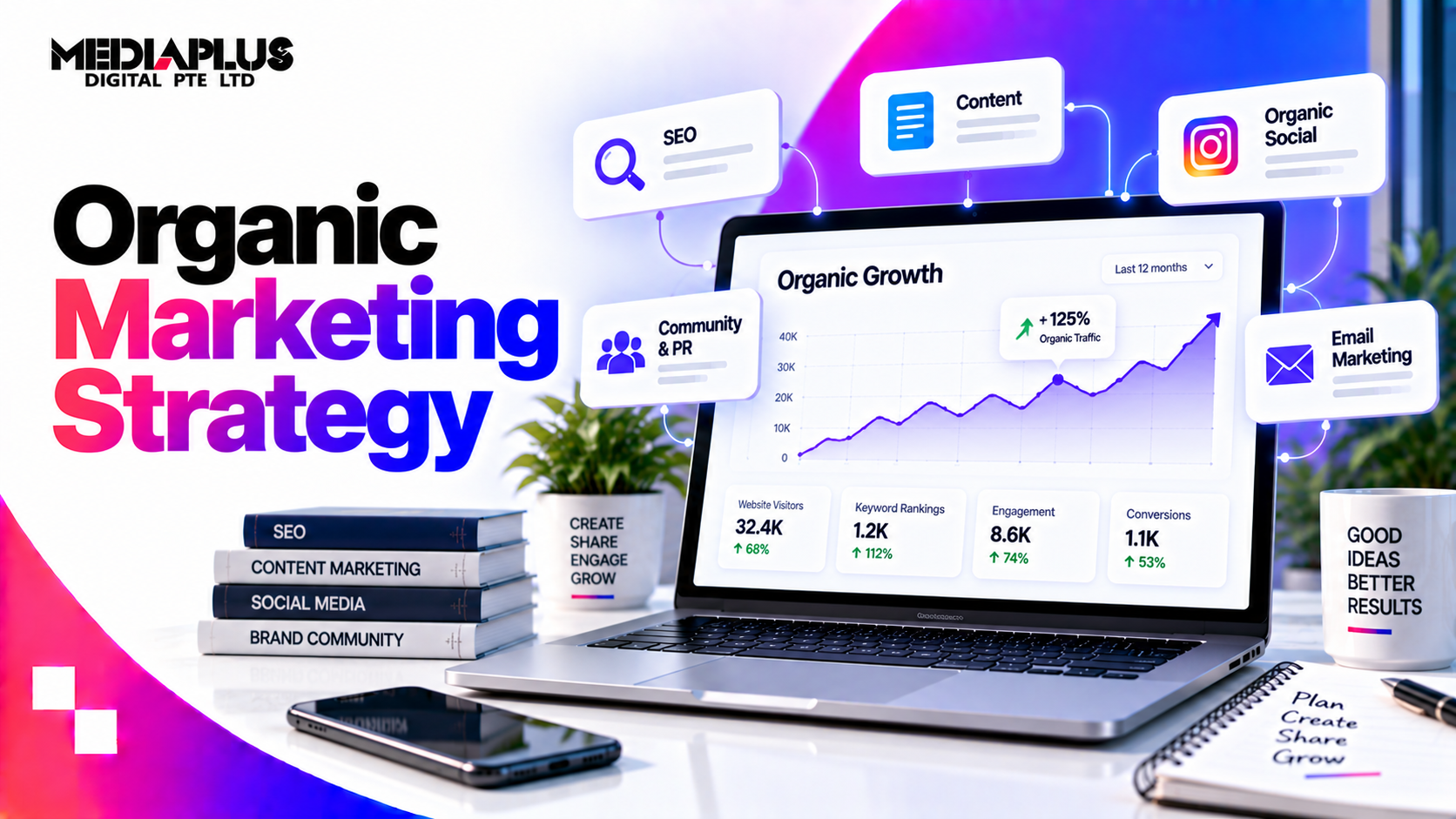
Organic marketing is everything that brings customers without paying per click: search, content, your own website, email, social posts, reviews, referrals and word of mouth.
The trade is simple. Paid marketing rents attention and stops the day the budget stops. Organic marketing builds assets you keep, and costs time before it costs anything else.
Most businesses need both. The mistake is treating organic as the free option, because it is not free, it is deferred. You pay in months of work before the returns arrive, and the businesses that win are the ones that started 18 months ago.
What counts as organic marketing
|
Channel |
What it builds |
Time to meaningful return |
|
SEO and content |
Pages that earn search traffic every month |
3 to 9 months |
|
Google Business Profile |
Visibility in map results and local searches |
Weeks |
|
Email list |
An audience you own outright |
Months, then compounding |
|
Organic social |
Credibility, community, customer service |
Months |
|
Reviews and ratings |
Conversion on every other channel |
Weeks to months |
|
Referrals and partnerships |
Warm leads at near-zero cost |
Immediate once asked for |
|
PR and expert commentary |
Authority, links, brand searches |
Months |
|
Community and events |
Relationships that compound |
Months |
The asset test: if you stopped all marketing tomorrow, what would still bring enquiries next month? That is your organic base. For most businesses it is smaller than they think.
Why organic is harder than it used to be, and still worth doing
Three honest headwinds:
- AI answers absorb clicks. Pew Research, tracking 68,879 Google searches from 900 US adults in March 2025, found users clicked a traditional result in 8% of visits where an AI summary appeared, versus 15% without. Ahrefs, comparing 300,000 keywords in Search Console data, reported a 58% lower average click-through rate for the top-ranking page when an AI Overview is present.
- Organic social reach keeps falling, because platforms have more content than attention to give.
- Everyone publishes now, so thin content ranks for nothing.
The reasons it still works:
- Cost per lead falls over time rather than rising with competition
- The assets keep producing while you sleep, and during months when budget is tight
- Being cited in AI answers requires content, and content is organic work
- It supports every paid channel: branded search, retargeting pools, landing page quality
Build the base in this order
Doing these out of order is the most common reason organic programmes stall.
1. Fix the conversion path first
There is no point sending hard-won organic traffic to a page that does not convert. Before creating anything: clear offer, visible pricing logic, short forms, fast mobile pages, obvious contact options.
2. Claim and complete what already exists
Google Business Profile, industry directories, LinkedIn company page, review platforms. This is a week of work with a faster return than anything else on the list.
3. Build the money pages
Service, product and comparison pages that match what people actually search when they are ready to buy. Not blog posts. See keyword mapping for assigning searches to pages.
4. Get reviews systematically
A steady flow of real reviews improves conversion everywhere, including paid. Ask at the moment of delivery, reply to every one.
5. Then publish content, in clusters
Choose one subject you want to own and build a connected set of pages, not scattered articles. See topical authority.
6. Start collecting emails
A list you own is the only channel no algorithm can take away. Offer something worth an address: a template, a checklist, a price guide.
7. Ask for the links you have earned
Suppliers, clients, associations, partners. Most businesses have ten uncollected links sitting in their existing relationships. Our guide to what makes a good backlink covers how to judge them.
A 12-month organic plan
|
Months |
Focus |
What to expect |
|
1 |
Foundations: tracking, profiles, technical fixes |
Little visible change |
|
2 to 3 |
Money pages rewritten, reviews process live |
First ranking movement on long-tail searches |
|
3 to 5 |
Content cluster one, internal linking, email capture |
Impressions rising, some clicks |
|
5 to 8 |
Cluster two, first PR or data piece, link outreach |
Traffic growth becomes visible |
|
8 to 10 |
Refresh what is stuck on page two |
The biggest single traffic jump usually lands here |
|
10 to 12 |
Cluster three, review and reallocate |
Compounding, with a base you own |
A realistic expectation to set with management: months one to three look like nothing is happening. If nobody has agreed that in advance, the programme gets cancelled in month four, just before it starts working.
How much does organic cost
It is not free. Budget for:
- Strategy and SEO work, in-house or agency
- Content production: writing, design, photography, video
- Tools: SEO software, email platform, analytics
- Technical work on the site
- Time from your own team, which is the most underestimated line
The comparison that matters: cost per enquiry from organic in month 12 versus cost per enquiry from paid. For most Singapore SMEs, paid is cheaper in month one and more expensive by month twelve. Run both and let the numbers decide the split. Our guide to SEO costs for small businesses has the ranges.
Measuring organic properly
|
Metric |
Why |
Where |
|
Organic enquiries by landing page |
The only number that matters |
GA4 |
|
Impressions and clicks by page |
Early signals before clicks arrive |
Search Console |
|
Branded search volume |
Whether awareness work is landing |
Search Console |
|
Number of queries per page |
Whether content is understood broadly |
Search Console |
|
Google Business Profile actions |
Calls, directions, messages |
Business Profile |
|
Email list growth and engagement |
The asset you own |
Email platform |
|
Review count and rating |
Conversion support |
Google and industry platforms |
|
Generative AI impressions |
Visibility in AI Overviews and AI Mode |
Search Console generative AI report |
Rising impressions with flat clicks is the pattern to watch for. It usually means AI answers are taking the click, and the response is more specific content plus stronger titles, not more articles.
When organic is the wrong priority
Be honest about these cases:
- You need revenue this quarter. Paid search will get there first.
- Nobody searches for what you sell. A genuinely new category has no search demand yet. Build awareness with paid social and PR.
- Your site cannot convert. Fix that first.
- You cannot commit for six months. Stopping at month three wastes everything spent.
- Your margins are thin and volumes are low. The maths may not justify a content programme.
Common mistakes
- Publishing blog posts before the service pages are right
- Treating organic as free because there is no media spend
- Chasing high-volume keywords with no commercial intent
- Measuring traffic rather than enquiries
- Stopping in month four
- Ignoring the assets you already have: customers, partners, reviews
- Repurposing the same post across channels without adapting it
Frequently asked questions
What is organic marketing?
Growth that does not come from paying per click or impression: search, content, email, reviews, referrals, organic social and PR.
Is organic marketing free?
No. It costs time, content production and tools. What it avoids is paying for each click, which is why cost per lead tends to fall over time.
How long does organic marketing take to work?
Local profile and review work can show in weeks. Search and content usually take three to nine months, with the biggest gains after six.
Is organic still worth it with AI search?
Yes, though the measurement has changed. AI answers reduce clicks on informational searches, so commercial pages and specific, citable content matter more than volume publishing.
What should a small business start with?
Google Business Profile, reviews, and three excellent service pages. Those three produce more than a year of blogging for most SMEs.
How do I balance organic and paid?
Use paid to buy leads now and to learn which messages convert, then build organic pages around what worked. Review the split every quarter on cost per qualified lead.
Can I do organic marketing myself?
The foundations yes: profiles, reviews, clear service pages, consistent posting. Technical SEO, content strategy and links usually need help.
What is the single highest-return organic activity in Singapore?
For most local service businesses, a complete Google Business Profile with a steady flow of reviews. See local SEO.
Building marketing you own
MediaPlus Digital builds organic programmes that start with the pages and profiles that convert, then add content once the foundations hold. Thirteen years in the Singapore market, a team of 60 and more than 1,800 projects delivered.
See our SEO services in Singapore, or read digital marketing strategy for how organic fits with everything else.