Quick answer
A digital marketing plan answers four questions in order:
- What number are we trying to hit, expressed in customers, not impressions?
- Who buys, and how do they currently decide?
- Which channels reach them, and what does each realistically cost?
- Who does what, in which month?
If a plan does not end with a named owner and a month against every line, it is a document, not a plan.
This guide covers the execution half. For definitions and the strategic framework, read digital marketing strategy first. For the document you fill in, use our marketing plan template.
What is a digital marketing plan?
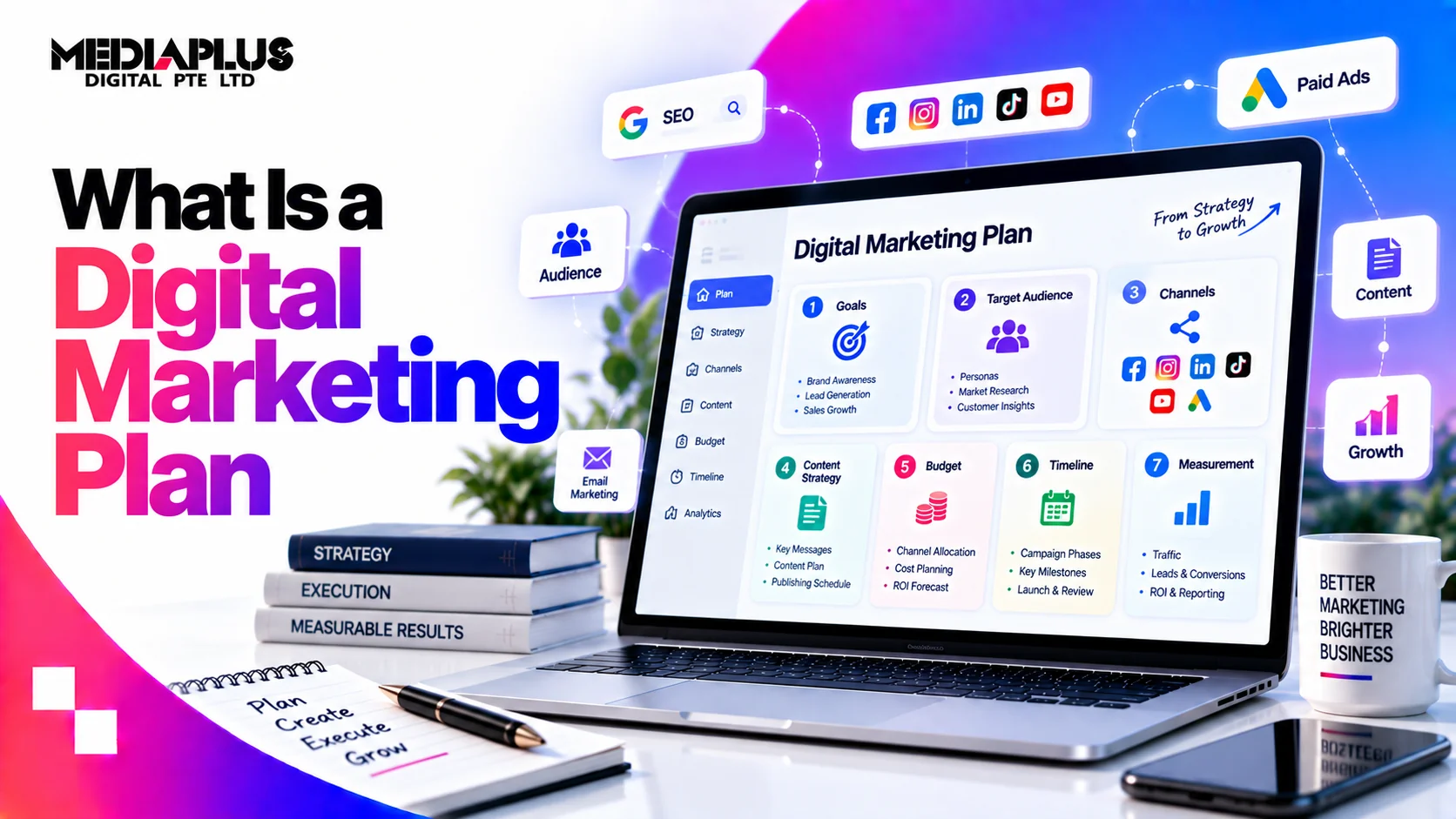
A digital marketing plan is a written document that sets out which digital channels you will use over the next six to twelve months, what each is meant to produce, what it costs, who runs it and how you will measure it.
It differs from the two documents it gets confused with:
|
Digital marketing plan |
Marketing strategy |
Campaign brief |
|
|
Scope |
All digital channels over 6 to 12 months |
Positioning, audience and competitive choice |
One campaign |
|
Time horizon |
6 to 12 months |
1 to 3 years |
Weeks |
|
Contains |
Channels, budgets, owners, calendar, targets |
Who we serve and why us |
Offer, audience, creative, dates |
|
Changes |
Quarterly |
Annually |
Per campaign |
What it must contain, at minimum:
- An objective expressed in customers or enquiries, not impressions
- A description of how your customers currently decide
- The channels you have chosen, with the reason for each
- A budget split across media, content, tools and testing
- A month-by-month calendar with a named owner per line
- The report you will produce, and how often
If your plan is missing the last two, it will not survive February. For the wider framework, see digital marketing strategy; for a definition-led view of marketing plans in general, see what is a marketing plan.
Step 1: Work backwards from revenue, not forwards from budget
Most plans start with “we have S$5,000 a month, what should we do”. That produces activity, not outcomes. Start here instead.
|
Input |
Where it comes from |
Example |
|
Revenue target for the year |
Management |
S$1,200,000 |
|
Average order or contract value |
Your accounts |
S$8,000 |
|
Customers needed |
Revenue ÷ order value |
150 |
|
Close rate from qualified lead |
Your sales records |
25% |
|
Qualified leads needed |
Customers ÷ close rate |
600 |
|
Enquiry to qualified rate |
Your CRM |
40% |
|
Total enquiries needed |
600 ÷ 0.4 |
1,500 |
|
Enquiries per month |
Divide by 12 |
125 |
Now you have a monthly number to plan against. If your website currently produces 20 enquiries a month, you know the plan has to find another 105, and you can test whether that is plausible before committing budget.
The sanity check most plans skip: what can you afford to pay for a customer? If your gross margin on an S$8,000 contract is S$3,000 and you want a 3:1 return, your ceiling is about S$1,000 per customer, or S$250 per qualified lead at a 25% close rate. Any channel that cannot deliver within that is out, regardless of how popular it is.
Step 2: Describe how your customers actually decide
Two paragraphs beat a persona template with stock photos.
Answer these from your sales team’s real experience:
- What triggers someone to start looking? A breakdown, an audit, a new regulation, growth, a competitor’s move?
- What do they search or ask first, in their words?
- Who else is involved before a decision, and what do they each worry about?
- What do they compare you against, including doing nothing?
- What is the objection that kills most deals?
- How long does it take from first contact to signature?
Everything downstream depends on this. A two-week consumer purchase and a six-month B2B purchase need different plans, even with the same budget. Our comparison of B2B vs B2C digital marketing covers the split.
Step 3: Choose channels by behaviour, not by popularity
|
If your customers… |
Start with |
Why |
|
Search when they have the problem |
SEO and Google Ads |
Demand already exists, you just have to be there |
|
Discover things while scrolling |
Meta and TikTok ads |
You create the demand |
|
Choose by distance |
Local SEO and Google Business Profile |
The map pack decides |
|
Compare vendors for weeks |
SEO, comparison content, email nurture |
Long consideration needs owned assets |
|
Are on a shortlist you cannot reach |
LinkedIn ads and digital PR |
Awareness before the search happens |
|
Already bought from you |
Email and WhatsApp |
Cheapest revenue you will find |
|
Buy physical products online |
Google Shopping, Meta catalogue ads, marketplaces |
Product feeds do the work |
Singapore context worth planning around:
- Google holds about 92.61% of Singapore search, per Statcounter in August 2026. Search budget means Google first.
- DataReportal’s Digital 2026 Singapore report counts 5.78 million internet users and 5.33 million social media identities, with people averaging 17 hours a week on social platforms and using 7.4 platforms a month.
- WhatsApp is the most-used app here, with around four in five people using it monthly, which makes it a real channel for follow-up rather than an afterthought.
- Social ads are now the third most common source of brand discovery in Singapore, after search engines and word of mouth.
- Online sales were 15.4% of total retail sales value in July 2026 according to SingStat, and 62.9% for computer and telecommunications equipment.
Pick two channels to do properly rather than five badly. A business spending S$3,000 a month across five channels is buying noise in all of them.
Step 4: Split the budget
There is no universal percentage, but there are two splits worth using as a starting point.
Brand versus activation. Analysis by Les Binet and Peter Field for the LinkedIn B2B Institute, using IPA data, suggests efficiency peaks at roughly 60% brand and 40% activation for B2C, and roughly 46% brand and 54% activation for B2B. The authors caution that the B2B sample was fewer than 50 cases and call the ratio “a rough estimate”, so treat it as a direction, not a formula.
Practically, that means not spending everything on lead generation for the small group ready to buy this month.
Working budget versus making budget. Split your total into:
|
Bucket |
Typical share |
What it covers |
|
Media spend |
40 to 60% |
Google Ads, Meta, LinkedIn, TikTok |
|
Content and creative production |
20 to 30% |
Pages, video, photography, design |
|
Tools and platforms |
5 to 10% |
CRM, email, analytics, SEO tools |
|
Agency or in-house time |
20 to 30% |
Strategy, execution, reporting |
|
Test budget |
10% |
New channels, new formats |
Keep the test budget ring-fenced. Plans without one repeat last year until the year it stops working.
Grants. The Productivity Solutions Grant closes to new applications on 29 September 2026, together with EDG and MRA. From 30 September 2026, Enterprise Singapore’s EDGE Grant applies, offering up to 70% for SMEs and up to 50% for non-SMEs depending on the activity, capped at S$100,000 per company per year. Media spend itself is generally not funded, so plan the grant around solutions and projects rather than ad budget.
Step 5: Set targets per channel before you spend
For each channel, write down four numbers. If you cannot, you are not ready to spend on it.
|
Channel |
Monthly budget |
Expected cost per enquiry |
Enquiries expected |
Review date |
|
Google Ads |
||||
|
SEO |
Not per enquiry, per month invested |
|||
|
Meta ads |
||||
|
|
||||
|
|
Use your own historic numbers where you have them. Where you do not, run a small test first and fill the table with real figures after 30 days. Industry benchmark tables are averages of businesses unlike yours.
Step 6: Build the 12-month rollout
This is the part clients actually use. Adjust the months to your seasonality.
|
Months |
Focus |
Deliverables |
|
1 |
Foundations |
Tracking verified, CRM connected to forms, baseline recorded, quick technical fixes |
|
1 to 2 |
Money pages |
Service pages rewritten, pricing logic published, enquiry forms shortened |
|
2 to 3 |
Demand capture live |
Google Ads on high-intent terms, local SEO or Shopping feed set up |
|
3 to 5 |
Content engine |
Comparison and question content, case studies with numbers, email nurture built |
|
5 to 7 |
Reach |
Paid social prospecting, digital PR, first original data piece |
|
7 to 9 |
Conversion work |
CRO on the top landing pages, retargeting, review generation |
|
9 to 11 |
Scale what works |
Increase spend on proven channels, kill the rest |
|
12 |
Plan the next year |
Full review against the revenue maths in step 1 |
Seasonal markers to plan around in Singapore: Chinese New Year, Great Singapore Sale, 9.9, 11.11, 12.12, Christmas, plus your own industry’s budget cycle. Map these against your own sales data before assuming a retail calendar applies to you.
Step 7: Decide how you will report
Agree the report format before month one, because it shapes what gets optimised.
Monthly, one page:
- Enquiries and qualified leads, against target
- Cost per qualified lead, by channel
- Revenue or pipeline attributed, by channel
- What we did, what we learned, what changes next month
Quarterly, deeper:
- Channel performance against the plan’s assumptions
- Content and page performance
- Competitive movemen
- Budget reallocation decisions
Anything reporting impressions and followers without a line connecting them to enquiries is a status update, not a marketing report.
The one-page plan summary
When the plan is done, it should compress to this. If it cannot, it is too vague to execute.
|
Field |
Your answer |
|
Revenue target |
|
|
Enquiries needed per month |
|
|
Maximum cost per customer |
|
|
Primary audience, in one sentence |
|
|
Channel 1 and its monthly budget |
|
|
Channel 2 and its monthly budget |
|
|
Main asset to build this quarter |
|
|
Owner for each channel |
|
|
Review date |
|
|
What we will stop doing |
That last row is the one most plans omit. A plan that only adds work never survives contact with a real team’s capacity.
Common mistakes
- Starting from the budget instead of the revenue target
- Five channels on a budget that supports two
- No number for what a customer is allowed to cost
- Plans with no owner and no month against each line
- Tracking set up after the campaigns launch
- Reporting impressions and reach to people who think in revenue
- No test budget, so nothing new is ever tried
- Copying a competitor’s channel mix without knowing their margins
Frequently asked questions
What is a digital marketing plan?
A document setting out which digital channels you will use over six to twelve months, what each should produce, the budget, the owner of each activity and how results will be measured.
What should a digital marketing plan include?
A revenue-based goal, a description of how customers decide, chosen channels with budgets and targets, a 12-month rollout with owners, and an agreed reporting format.
How is a digital marketing plan different from a strategy?
The strategy decides who you serve, what you promise and where you compete. The plan decides what happens in which month, with what budget. See digital marketing strategy.
How much should a Singapore SME budget for digital marketing?
Work it out from your own maths: what a customer is worth, what you can afford to pay to acquire one, and how many you need. Percentage-of-revenue rules of thumb ignore your margins and sales cycle.
Which channel should I start with?
Whichever matches how your customers already behave. If they search when the problem appears, start with search. If they discover while scrolling, start with paid social.
How long before a plan shows results?
Paid channels can show within weeks. SEO and content usually take three to nine months. Build the plan so the paid side funds the wait.
How often should the plan be reviewed?
Monthly against the numbers, quarterly against the assumptions, annually against the revenue maths.
Do I need a template?
It helps. Ours is at marketing plan template, with the structure to fill in.
What if the plan is not working?
Check in this order: is tracking correct, is the offer competitive, is the landing page matched to the ad or search, and only then whether the channel is wrong. Most plans fail at the second and third checks.
Turning the plan into results
MediaPlus Digital builds and runs digital marketing plans for Singapore businesses across SEO, Google Ads, social advertising and web, with 13 years in the market, a team of 60 and more than 1,800 projects delivered. We will tell you when a channel in the plan is not worth your budget.
See our digital marketing services, or start with the numbers in digital marketing pricing.