Most Singapore brands shopping for a Shopify agency in 2026 are not really shopping for a Shopify agency. They are shopping for an integration architect who happens to know Shopify. The store itself is the easy part. The data plumbing between the store, the warehouse, the accounting system, the CRM, the marketing platforms, the marketplaces, and the finance team is where Shopify projects actually succeed or fail. If you are still early in evaluating platforms, our e-commerce website services in Singapore overview covers when Shopify, WooCommerce, or a headless build is the right starting point.
This guide does not list the best Shopify agencies in Singapore. Plenty of other articles do that, with varying honesty. Instead, it walks through what makes a Shopify integration actually complex, where most builds quietly break, and the questions to ask before signing a contract.
What Actually Makes a Shopify Integration Complex
Most Shopify builds look identical from the outside: theme, products, checkout, ship. The complexity hides in the data flows behind the storefront. Five categories of complexity cover almost every real-world enterprise Shopify project:
1. ERP and inventory complexity
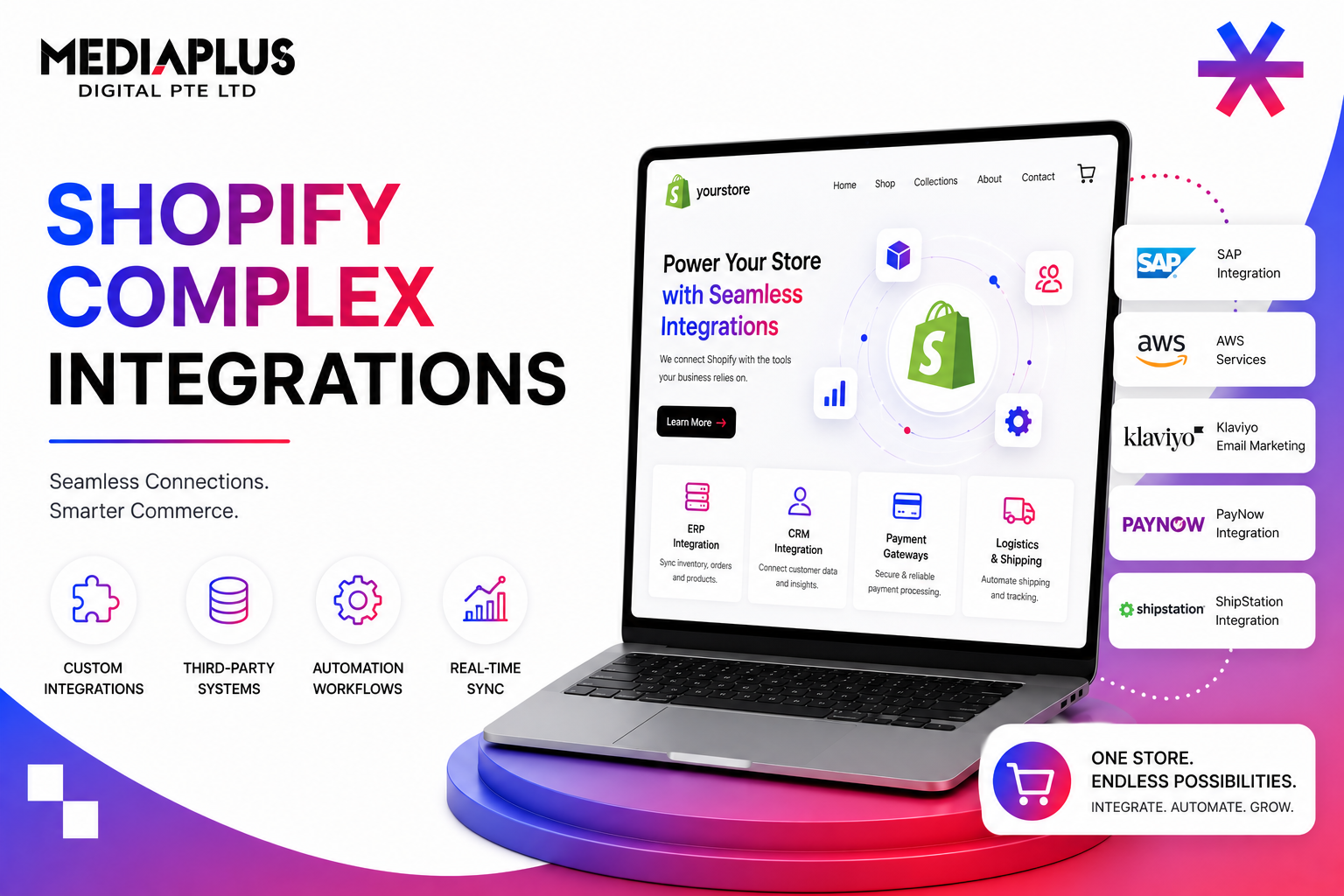
When Shopify is not the system of record for inventory, every product update, stock level, and SKU change must reconcile with an ERP (NetSuite, SAP Business One, Microsoft Dynamics 365 Business Central, Odoo). The integration must handle: bidirectional sync, partial sync failures, currency conversion, multi-warehouse fulfilment routing, and the edge case where the ERP and Shopify disagree about the current quantity. Most off-the-shelf connectors handle the happy path. The edge cases are where bespoke middleware earns its fees.
2. POS and unified commerce complexity
A Singapore retailer with physical stores plus a Shopify storefront needs unified inventory, unified customer profiles, unified loyalty, and unified order history across channels. Shopify POS solves about 70% of this natively. The rest needs custom work: integrating with non-Shopify POS systems (Vend, Lightspeed, Square), syncing with local payment systems (PayNow, NETS, GrabPay) that Shopify Payments does not handle natively, and routing fulfilment based on store proximity.
3. Marketing and CRM complexity
Customer data has to flow into a marketing automation platform (Klaviyo, Mailchimp, Bloomreach) and a CRM (HubSpot, Salesforce). The right event taxonomy at the start saves months of rework later. Common failures: order events firing twice, customer profiles duplicating, subscription status not syncing, and product taxonomies that do not align between Shopify, Klaviyo, and the recommendation engine. Pair the build with paid social media advertising and a clear conversion API setup so that ad spend on Facebook Ads and TikTok Ads attributes to the right orders.
4. Finance and accounting complexity
Singapore brands eventually need orders, refunds, taxes (especially GST), and payouts flowing into accounting (Xero, QuickBooks, NetSuite). GST treatment for cross-border sales after January 2023 changes is its own rabbit hole; B2B versus B2C tax handling requires explicit logic. Failures here trigger audit problems months after launch.
5. Marketplace and channel complexity
Most Singapore D2C brands sell on Shopify plus Lazada plus Shopee plus TikTok Shop plus Amazon SG. Each is a separate inventory and pricing channel. Multichannel platforms (Channable, Sellbrite, Anchanto) help but introduce their own sync logic. Discount pricing per channel, exclusive SKUs per channel, and reconciling returns across channels are all sources of leak.
The Eight Failure Patterns Most Singapore Shopify Builds Hit
- Off-the-shelf connectors used for cases they were never designed for (e.g. a generic Shopify-Xero connector handling GST for B2B exports).
- Webhook reliability assumed but not engineered. Shopify webhooks can drop; idempotency and replay logic are required.
- Theme code and Shopify Functions confused. Custom checkout logic written into a theme breaks on every theme update.
- No staging environment. Brands run integrations on production because Shopify’s development workflow is awkward, then break live orders.
- Inventory race conditions during flash sales. Two customers buy the last unit; one gets a fulfilment notice, one gets a refund 48 hours later.
- Customer PII flowing to overseas vendors without PDPA-compliant DPAs. A real risk if the brand is audited.
- Marketing automation that fires order confirmations twice because two systems both think they own the trigger.
- No observability. When an order does not appear in NetSuite, no one knows whether the webhook fired, the middleware processed it, or the ERP rejected it.
How to Tell a Real Shopify Plus Agency from a Theme Shop
Most Singapore “Shopify agencies” are theme customisation shops with a Liquid developer and a designer. That is enough for a SGD 5,000 storefront. It is not enough for an integration-heavy build. For comparison, our Shopify design and development services and WooCommerce development services page outline the kind of work that distinguishes a real engineering partner. Look for these signals:
- Named experience integrating Shopify with at least one ERP and one CRM. Ask for case studies with specific systems.
- Familiarity with Shopify Functions, Shopify Flow, and Shopify’s GraphQL Admin API beyond basic Liquid templating.
- A documented approach to webhook reliability: retries, idempotency, dead-letter queues.
- A staging-to-production deployment workflow using tools like Theme Kit, Shopify CLI, or Hydrogen for headless builds.
- Engineers who can describe the trade-offs between Shopify Plus Scripts, Functions, and external middleware.
- A PDPA-aware data handling approach when customer PII flows through middleware.
- A QA process that includes inventory race conditions, refund flows, and tax edge cases, not just visual UI testing.
- Post-launch monitoring and observability. A vendor who only quotes “build cost” and not “operate cost” has not yet thought about year two.
What Complex Shopify Work Actually Costs in Singapore (2026)
A theme-only Shopify store from a Singapore agency costs SGD 5,000 to SGD 15,000. Add real integrations and the price climbs sharply. A realistic 2026 scope:
|
Scope |
Typical Singapore range (SGD) |
Timeline |
|
Theme-based Shopify store, light customisation |
5,000 to 15,000 |
4 to 6 weeks |
|
Shopify Plus with custom checkout, B2B portal |
25,000 to 60,000 |
8 to 14 weeks |
|
Plus integration with one ERP (NetSuite, SAP B1) |
+20,000 to 60,000 |
+6 to 10 weeks |
|
Plus marketplace sync (Lazada, Shopee, TikTok Shop) |
+10,000 to 30,000 |
+4 to 6 weeks |
|
Plus headless rebuild (Hydrogen / Remix) |
+40,000 to 120,000 |
+12 to 20 weeks |
|
Annual maintenance, integrations, and feature work |
24,000 to 96,000 |
Ongoing |
The most common cost overrun is not in the initial build. It is in year one operations when the marketing team wants a new flow that needs an integration nobody scoped for. Budget 20 to 30% of build cost annually for ongoing engineering.
Twelve Scoping Questions to Ask Before Signing
A scoping conversation that does not surface these gets you a price that does not survive contact with reality. Walk an agency through each one before you sign.
- Which exact systems must Shopify integrate with on day one? (ERP, POS, CRM, marketing automation, accounting, marketplaces.)
- For each, does the agency propose an off-the-shelf connector, native Shopify app, or custom middleware? Why?
- How will the agency handle GST on cross-border orders and B2B exports?
- What is the plan for inventory race conditions during a flash sale?
- How are webhooks made reliable? Retry policy, idempotency, dead-letter queues.
- What is the staging environment? Theme-only or full data?
- How is customer PII handled, and which DPAs need to be signed?
- Who owns post-launch observability and what is the SLA?
- How are theme code, Shopify Functions, and middleware kept in sync during a Shopify version upgrade?
- What is the rollback plan if a launch breaks orders?
- How is the project priced (fixed, time-and-materials, hybrid)? What triggers a change order?
- What does year-two cost look like? Maintenance, integrations, security patches, feature work.
When “Complex Shopify” Is Actually the Wrong Frame
A surprising number of Singapore brands scope a complex Shopify Plus project when their real need is something simpler or stranger:
- A brand doing under SGD 200K monthly revenue rarely needs ERP integration. The “complex” project is usually a feature wishlist, not a constraint.
- A brand selling on Shopee at twice the volume of its own Shopify store probably needs marketplace optimisation, not a Shopify rebuild.
- A brand whose conversion rate is stuck at 1% needs CRO and content, not a new integration layer.
- A brand whose checkout abandonment is 80% needs PayNow integration, not a custom NetSuite connector.
- A brand whose problem is “the website is slow” needs performance work, not a headless migration.
An honest agency will tell you when “complex Shopify” is the wrong answer to your actual problem, even at the cost of a smaller contract. If conversion is the real bottleneck, invest in conversion rate optimisation before any rebuild. If pipeline is the real bottleneck, SEO and lead generation will move the number faster than any integration project.
For a Shopify or Shopify Plus build that scopes the integration work properly before the first sprint, talk to MediaPlus Shopify design and development in Singapore. For full e-commerce architecture, see our e-commerce website services, and browse more on the MediaPlus blog.