B2C digital marketing is what makes Shopee flash sales sell out in seconds, what fuels TikTok beauty trends, and what turns Grab promotions into recurring orders. In Singapore, it is no longer optional. There are 5.78 million internet users (98.4% penetration), 9.79 million mobile connections (166% of population), and the country sits in the most digitally engaged region on earth. Singapore consumers spend 7 hours and 12 minutes online every day and an average of 34 hours per month on TikTok alone (DataReportal 2026).
This guide answers the question “What is B2C digital marketing?” with a clear definition, the 10 channels that matter most in Singapore, real ROAS and CAC benchmarks, a B2B vs B2C comparison, working examples (Shopee, Charles & Keith, Love Bonito, Foodpanda), and a 90-day growth plan. If you are looking for a partner, our digital marketing agency in Singapore specialises in performance-led B2C campaigns across e-commerce, F&B, beauty, fashion, lifestyle, and travel.
Singapore B2C Digital Snapshot (2026)
|
Metric |
Value |
Source |
|
Internet users |
5.78 million (98.4%) |
DataReportal 2026 |
|
Mobile connections |
9.79 million (166%) |
DataReportal 2026 |
|
Smartphone penetration |
95%+ |
IMDA / DataReportal |
|
Avg time online per day |
7 hours 12 minutes |
DataReportal 2026 |
|
Avg monthly time on TikTok |
34 hours |
DataReportal 2026 |
|
E-commerce market 2026 |
USD 6.17 billion |
Mordor Intelligence |
|
E-commerce CAGR 2026 to 2031 |
10.84% |
Mordor Intelligence |
|
Mobile share of e-commerce |
77.58% |
Statista 2025 |
|
Shopee SEA GMV (Q1 2026) |
USD 66.8B (52% share) |
Digital in Asia |
|
TikTok Shop SEA GMV |
USD 22.6B (18% share) |
Digital in Asia |
|
Total advertising market |
USD 2.79B |
Statista 2025 |
|
Largest digital category |
Search advertising (USD 815.6M) |
Statista 2025 |
1. What Is B2C Digital Marketing?
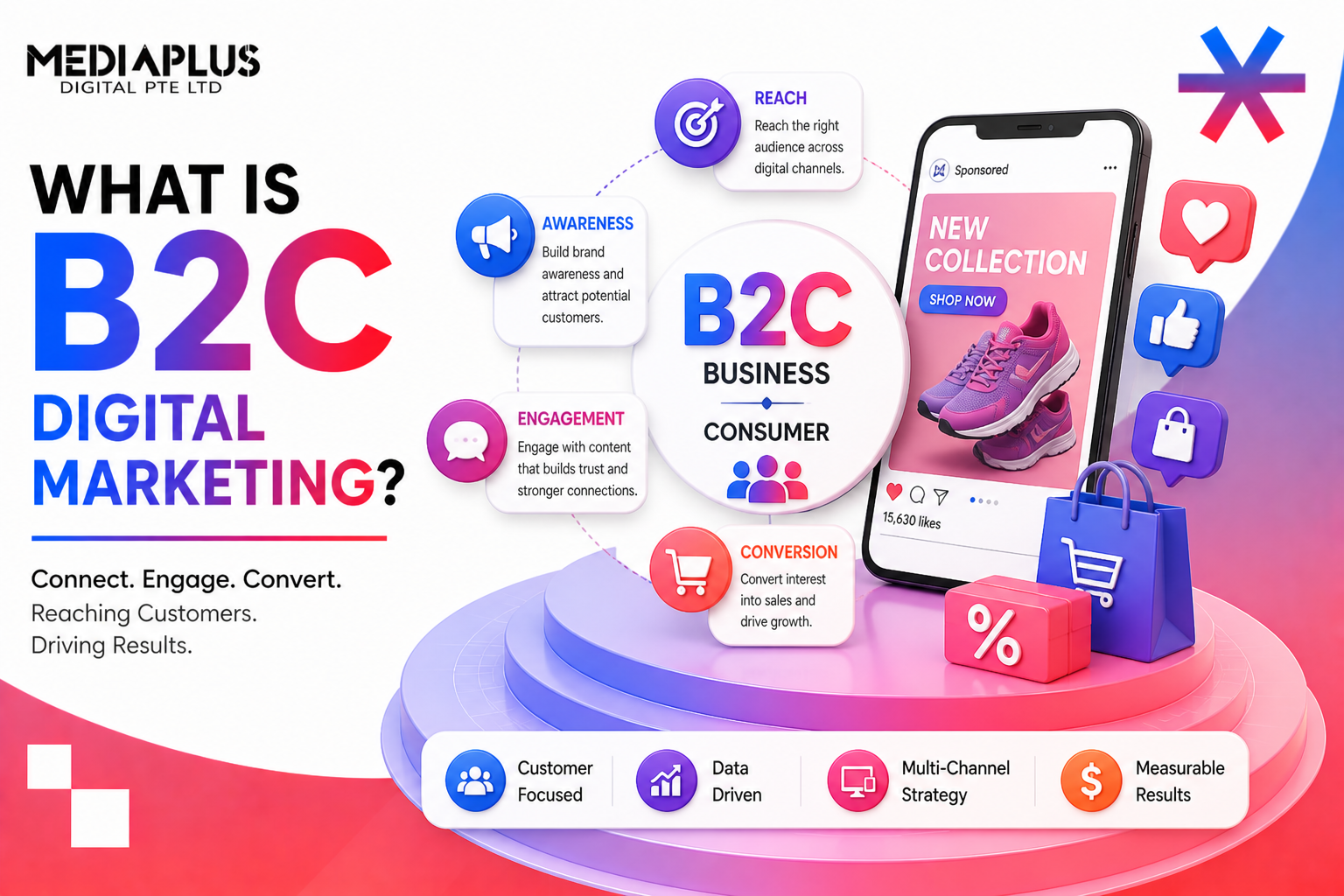
B2C digital marketing, short for business-to-consumer digital marketing, is the use of online channels to promote products or services directly to individual consumers. The buyer is one person making a fast, often emotional decision. Average decision time in Singapore B2C is minutes to days, so B2C strategies prioritise reach, emotion, convenience, and instant conversion. Common B2C industries include e-commerce, fashion, beauty, F&B, travel, entertainment, fitness, and consumer fintech.
1.1 Defining Characteristics
- Audience: mass or segmented consumers, targeted by lifestyle, age, location, language, and interests.
- Decision driver: emotion, brand image, social proof, price, convenience.
- Funnel: short and direct, often discover-to-buy in a single session.
- Average order value: smaller (SGD 30 to SGD 500), but higher volume.
- Tone: friendly, visual, entertaining, often informal and creator-led.
- Critical channels: TikTok, Instagram, Google Shopping, marketplaces, email, SMS.
2. How B2C Differs from B2B Digital Marketing
|
Dimension |
B2C Digital |
B2B Digital |
|
Buyer |
1 individual |
11.2 stakeholders |
|
Decision time |
Minutes to days |
3 to 12 months |
|
Decision driver |
Emotion, price, convenience |
ROI, evidence, risk reduction |
|
Top channels |
TikTok, Instagram, Google Shopping, email/SMS |
LinkedIn, SEO, SEM, ABM |
|
Content style |
Short video, UGC, influencer, livestream |
Whitepapers, case studies, webinars |
|
Funnel |
Short, conversion-focused |
Long, nurture-focused |
|
Primary KPI |
ROAS, AOV, repeat purchase |
Pipeline, CAC vs LTV |
|
Average deal size |
SGD 30 to SGD 500 |
SGD 10K to SGD 1M+ |
See the full breakdown in our blog on B2B vs B2C digital marketing.
3. The 10 Core Channels of B2C Digital Marketing
3.1 Social Media Marketing (TikTok, Instagram, Facebook, YouTube)
Social media is the discovery engine of Singapore B2C. TikTok alone consumes 34 hours per Singapore user per month (DataReportal 2026), and 71% of consumers say they love social commerce for its convenience. Short-form video, livestream shopping, and creator partnerships drive most of the discovery and conversion.
Run high-impact paid campaigns through Facebook Ads, Instagram Ads, and TikTok Ads. Singapore B2C ROAS benchmarks: TikTok Ads 1.8x to 4.5x; Meta (Facebook + Instagram) 2.5x to 6x; YouTube Shorts 1.5x to 3.5x.
3.2 Search Engine Marketing (Google Ads, Shopping, Performance Max)
Singapore search advertising is a USD 815.6M market in 2025 (Statista), the largest single digital category. Google Shopping Ads and Performance Max capture buyers ready to purchase, with average ROAS of 3x to 8x for healthy e-commerce stores. Add YouTube Ads for upper-funnel reach through our SEM agency in Singapore.
3.3 SEO and Local SEO
Organic search delivers the lowest CAC of any B2C channel once you rank. Optimise for product, category, comparison, and review keywords; for retailers, F&B, and clinics, local SEO and Google Business Profile are essential. Build long-term traffic with our SEO services in Singapore and consistent blogging for SEO.
3.4 Influencer and Creator Marketing
Singapore creators drive measurable revenue, especially in beauty, fashion, F&B, and lifestyle. Typical rate cards: nano (under 10K followers) SGD 100 to SGD 500 per post; micro (10K to 100K) SGD 500 to SGD 3,000; macro (100K to 1M) SGD 3,000 to SGD 15,000. Live commerce sessions on TikTok or Shopee Live often drive higher conversion than static posts.
3.5 Email and SMS Marketing
Email and SMS deliver some of the highest ROI in B2C: USD 36 to USD 42 per dollar on email (Litmus 2024), and 90%+ open rates on SMS. Singapore-friendly platforms include Klaviyo, Mailchimp, Omnisend, and Postscript. Core flows: welcome series (5 to 7 emails), abandoned cart, post-purchase upsell, win-back, and loyalty triggers. Average e-commerce stores generate 25 to 40% of revenue from email and SMS once flows are mature.
3.6 E-commerce and Marketplace Marketing
In SEA, Shopee dominates with USD 66.8 billion GMV in Q1 2026 (52% market share), TikTok Shop has surged to USD 22.6 billion (18% share, 40 to 55% YoY growth), and Lazada remains strong in groceries and fashion. Singapore brands win by combining: optimised SKU listings, strong reviews, sponsored ads on platform, livestream commerce, and seller-funded campaigns aligned to platform mega-sales (9.9, 11.11, 12.12).
3.7 Affiliate Marketing
Performance-based partnerships through ShopBack, Involve Asia, Rakuten Advertising, and direct creator deals. Brands typically pay 5 to 15% commission on confirmed sales. Affiliate is powerful because brands pay only for results, with attribution validated by tracking platforms like Trackonomics or Impact.
3.8 Display, Video, and Connected TV
YouTube ads, programmatic display, and connected TV reach mass audiences for awareness. Pair with retargeting on the Google Display Network to bring window-shoppers back. Singapore CTV and OTT inventory (meWATCH, Netflix Ads, Disney+) is growing 20 to 35% YoY.
3.9 Loyalty, Apps, and Retention Marketing
Bain & Company famously found that a 5% lift in retention drives a 25 to 95% lift in profit. In Singapore, 77.58% of e-commerce transactions now happen on smartphone apps (Statista 2025), so apps with push notifications, points, and exclusive offers are central. Examples: GrabRewards, FairPrice Link, Sephora Beauty Pass.
3.10 Conversion Rate Optimisation and UX
Mobile-first design, fast load times, one-click checkout, social proof widgets, and exit-intent popups boost ROAS without raising ad spend. Our CRO services typically lift Singapore B2C conversion rates 15 to 60% within 90 days.
4. ROAS and CAC Benchmarks for Singapore B2C (2026)
|
Channel |
Typical ROAS |
CAC (consumer) |
Best For |
|
Meta Ads (FB + IG) |
2.5x to 6x |
SGD 8 to SGD 35 |
Awareness + conversion |
|
TikTok Ads |
1.8x to 4.5x |
SGD 6 to SGD 25 |
Discovery, Gen Z, virality |
|
Google Search |
4x to 10x |
SGD 3 to SGD 20 |
High-intent buyers |
|
Google Shopping / Pmax |
3x to 8x |
SGD 4 to SGD 25 |
E-commerce SKU sales |
|
YouTube Ads |
1.5x to 3.5x |
SGD 8 to SGD 30 |
Awareness, video storytelling |
|
Influencer (micro) |
2x to 5x |
SGD 5 to SGD 25 |
Trust + UGC creation |
|
Email + SMS |
15x to 40x |
Near zero (owned) |
Retention, repeat purchase |
|
Affiliate |
4x to 12x |
SGD 5 to SGD 20 |
Performance-only growth |
|
Marketplace ads (Shopee, Lazada) |
3x to 9x |
SGD 4 to SGD 20 |
Marketplace conversion |
5. The Singapore B2C Customer Journey
- Discover: TikTok For You, Instagram Reels, YouTube Shorts, Google search, influencer content.
- Consider: Reviews, comparison content, retargeting ads, email signup offers, livestream demos.
- Buy: Google Shopping, Performance Max, marketplace listings, fast mobile checkout, instalment options (Atome, Grab PayLater).
- Repeat: Email and SMS flows, loyalty programmes, app push notifications, subscription bundles.
- Advocate: UGC campaigns, referral programmes, reviews, social shares, ambassador tiers.
6. Real Examples: How Singapore Brands Win Online
- Charles & Keith: Combines TikTok virality (the viral USD 80 lunchbox bag moment), influencer collaborations, and global SEO to grow internationally from a Singapore base.
- Love, Bonito: Built a content-led brand using SEO, email automation, and community storytelling, expanding from Singapore to the US, the UK, and Indonesia.
- Shopee Live: Leverages live commerce, gamification (Shopee Coins, daily check-ins), and seller-led content to dominate SEA e-commerce with USD 66.8B GMV.
- Foodpanda and Grab: Use Performance Max, app push notifications, and gamified loyalty (GrabRewards) to drive repeat orders multiple times per week.
- Sephora Singapore: Operates Beauty Pass loyalty, in-app exclusives, and beauty-creator partnerships to dominate the local beauty category.
7. Key KPIs for B2C Digital Marketing
|
KPI |
Why It Matters |
|
ROAS |
Direct measure of ad efficiency. |
|
Conversion Rate |
Funnel quality from click to purchase. |
|
Average Order Value (AOV) |
Profit per transaction; tied to bundles, upsells. |
|
Customer Acquisition Cost (CAC) |
Cost to win one new customer. |
|
Lifetime Value (LTV) |
Total revenue per customer over time. |
|
LTV : CAC ratio |
Long-term unit economics; healthy >3:1. |
|
Repeat Purchase Rate |
Loyalty and retention strength. |
|
Cart Abandonment Rate |
Highlights checkout friction (target under 70%). |
|
Engagement (views, saves, shares) |
Top-of-funnel signal for social-led growth. |
8. Common Mistakes That Burn Budget
- Driving traffic to slow, non-mobile-optimised sites (every 1 second of delay costs 7% of conversions, Akamai).
- Chasing top-of-funnel reach without retargeting or email capture, leaking 90%+ of attention.
- Treating TikTok as Instagram, recycling polished ads instead of creator-style native content.
- Ignoring email and SMS, leaving 25 to 40% of potential revenue on the table.
- Running marketplace ads without optimising SKU title, images, and reviews first.
- Discount-only promotions that train customers to buy on sale, eroding LTV.
- No attribution, so unprofitable channels keep eating budget while profitable ones starve.
9. A 90-Day B2C Growth Plan
|
Phase |
Weeks |
Activities |
|
Foundation |
1 to 4 |
Audit site speed, mobile UX, GA4, Meta + TikTok Pixel; refine hero offer; build core email + SMS flows; set up Google Shopping feed. |
|
Launch |
5 to 8 |
Run Meta + TikTok Ads on hero offer; activate Google Shopping and Performance Max; partner with 3 to 5 micro-influencers; turn on retargeting. |
|
Scale |
9 to 12 |
Layer livestream commerce (Shopee Live, TikTok Live); expand to YouTube Shorts; open marketplace ads; launch loyalty or app retention; reallocate budget to top-ROAS creatives. |
10. Frequently Asked Questions
What is B2C digital marketing in simple terms?
It is the use of online channels (social media, search ads, SEO, email, influencer marketing, marketplaces) to sell products or services directly to individual consumers.
Which channels work best for B2C in Singapore?
For most consumer brands, the top five are TikTok and Instagram Ads, Google Search and Shopping, SEO, influencer marketing, and email or SMS automation. Marketplace ads (Shopee, Lazada, TikTok Shop) are essential for e-commerce.
How is B2C different from B2B digital marketing?
B2C targets individuals making fast, emotional decisions in minutes to days. B2B targets buying committees of 11+ stakeholders making slow, evidence-based decisions over 3 to 12 months.
How much should a Singapore B2C brand spend on digital marketing?
Most growth-stage B2C brands invest 15 to 30% of revenue, with 70 to 90% allocated to digital and creator channels. Starter budgets begin at SGD 3,000 to SGD 8,000 per month; scale-stage brands run SGD 50,000+.
What ROAS should I aim for?
Healthy Singapore e-commerce ROAS targets: 2.5x to 6x for Meta, 3x to 8x for Google Shopping, and 1.8x to 4.5x for TikTok Ads. Email and SMS often deliver 15x to 40x ROAS.
Is TikTok Shop worth it for Singapore brands?
Yes, especially for fashion, beauty, F&B, and lifestyle. TikTok Shop has surged to USD 22.6B GMV in SEA (Q1 2026) with 40 to 55% YoY growth. Combine livestream commerce with creator collaborations for best results.
11. Conclusion and Next Steps
B2C digital marketing in Singapore is fast, visual, and data-driven. The brands that grow fastest in 2026 master TikTok and Instagram, run efficient Google Shopping campaigns, build owned email and SMS audiences, dominate marketplace placements, and turn loyal customers into advocates. They invest in mobile-first UX, measure ROAS by creative not just channel, and reinvest into the few campaigns that compound.
Ready to grow your consumer brand? Talk to MediaPlus Digital. From SEO and SEM to social media advertising and CRO, we help Singapore B2C brands turn marketing into measurable revenue. Browse our latest blog insights for more.