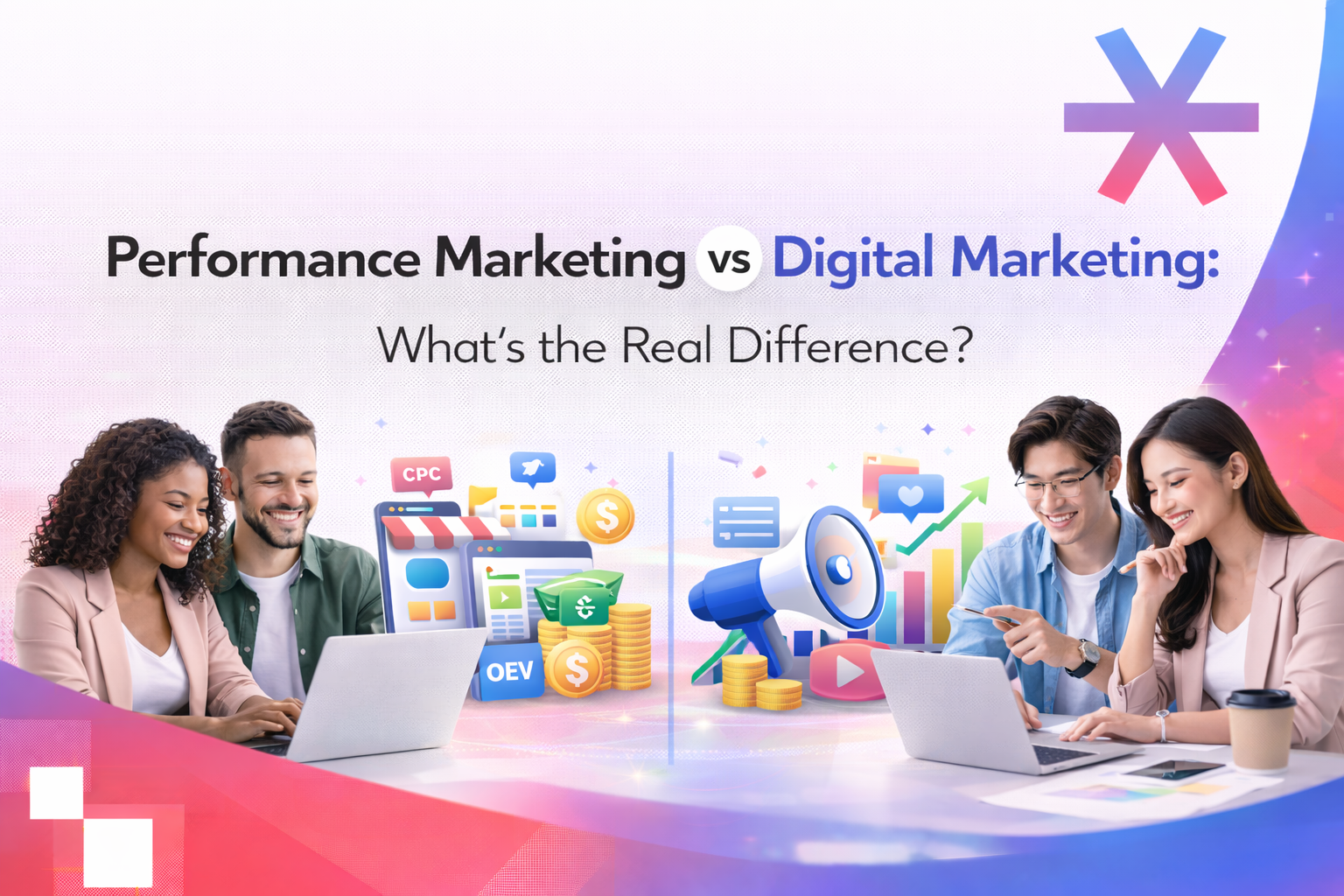
Want the TL;DR on performance marketing vs. digital marketing? Here it is: Digital marketing builds your brand and audience over time. Performance marketing drives immediate, measurable actions and only charges you for results. The real magic happens when you combine them strategically.
But that’s just scratching the surface. Let’s dive deeper.
Key Takeaways
-
Digital marketing focuses on building brand awareness, engagement, and long-term customer relationships through multiple online channels
-
Performance marketing is results-driven, with payment based on specific user actions like purchases, leads, or clicks
-
Digital marketing excels at creating brand visibility and trust; performance marketing delivers measurable ROI and conversion-focused outcomes
-
Most successful businesses combine both approaches – using digital marketing to build audience interest and performance marketing to convert that interest into revenue
-
Your specific business goals, audience, and budget should determine the ideal mix of these complementary strategies
-
Testing and optimizing both approaches with proper analytics is crucial for maximizing your marketing investment

What Exactly Is Digital Marketing?
Digital marketing encompasses all your online efforts to increase brand visibility and drive sustainable growth. Think of it as the foundation of your online presence – the infrastructure that supports all your marketing activities.
Unlike traditional marketing, digital marketing allows you to reach people where they already spend 6+ hours daily: online.
Digital marketing includes:
- Search engine optimization (SEO)
- Content marketing (blogs, videos, podcasts)
- Social media marketing
- Email marketing
- Online PR
- Web design and user experience
The primary objectives? Building brand awareness, driving qualified traffic to your website, and nurturing relationships with potential customers over time.

Why Digital Marketing Works
Digital marketing gives you unprecedented reach compared to traditional approaches. Instead of broadcasting your message to everyone and hoping it sticks, you can precisely target the specific audiences most likely to become customers.
The data shows why this matters: According to recent research, targeted digital campaigns achieve 5-10× higher engagement rates than non-targeted efforts.
With digital marketing, you can:
- Target specific demographics, interests, and behaviors
- Track performance in real-time and make immediate adjustments
- Build meaningful relationships through valuable content
- Establish thought leadership in your industry
- Create multiple touchpoints throughout the customer journey
For brands looking to build lasting connections with their audience, digital marketing provides the framework and foundation necessary for sustainable growth.
What is Performance Marketing?
Performance marketing is a results-driven digital strategy where advertisers pay only when a specific action is completed. These actions can include making a purchase, submitting a lead form, clicking through to a website, or installing an app. Unlike traditional marketing that charges for impressions or general brand exposure, performance marketing ensures your budget is spent on measurable outcomes.
How Performance Marketing Works
The core idea is simple: you pay only for results, not for potential reach. This pay-for-performance approach commonly uses models such as:
-
Cost per Acquisition (CPA) – paying for each customer acquired
-
Cost per Lead (CPL) – paying for each qualified lead
-
Cost per Click (CPC) – paying for each click to your site
-
Cost per Install (CPI) – paying when an app is installed
-
Cost per Engagement (CPE) – paying for user interactions
By tying costs directly to results, performance marketing removes much of the guesswork from digital campaigns, making it highly effective for businesses in Singapore and beyond that want to focus on measurable returns.
Key Channels in Performance Marketing
Performance marketing often involves collaborations with publishers, affiliates, or influencers who promote products or services in exchange for commissions based on results. The main channels include:
-
Affiliate Marketing: Influencers or content creators promote products on blogs, social media, or websites, earning a commission for each lead or sale generated.
-
Pay-Per-Click (PPC) Advertising: Platforms like Google Ads charge advertisers only when users click, ensuring the budget goes toward real engagement.
-
Social Media Advertising: Platforms like Facebook, Instagram, and TikTok offer performance-based campaigns with real-time tracking and optimization.

The Advantages of Performance Marketing
-
Transparent ROI – Every dollar spent is tied to a measurable action, so marketers know exactly how much they’re investing to acquire customers.
-
Real-Time Optimization – Campaigns produce immediate data, allowing continuous refinement and better results over time.
-
Scalable Growth with Lower Risk – Once winning campaigns are identified, budgets can be increased confidently, as costs remain linked to performance.
In short, performance marketing provides accountability, cost efficiency, and measurable growth that traditional advertising cannot match. For businesses aiming to maximize ROI and track every marketing dollar, it’s a highly effective strategy.
10 Key Differences Between Digital Marketing and Performance Marketing
| Aspect | Digital Marketing | Performance Marketing |
|---|---|---|
| Objectives | Long-term brand awareness, engagement, and loyalty | Short-term, measurable outcomes: clicks, leads, sales |
| Measurement | Impressions, reach, engagement | Cost per click (CPC), cost per acquisition (CPA), ROAS |
| Channels | SEO, email, social media, content marketing, online/offline ads | PPC, affiliate marketing, social ads, influencer campaigns |
| Cost Structure | Upfront investment, ROI over months | Pay-for-performance, pay only for completed actions |
| Time Frame | Gradual growth, long-term results | Fast results, real-time optimization |
| Content Strategy | Informative, engaging, relationship-building | Action-oriented, with clear calls-to-action |
| Audience Targeting | Broad audience for brand reach | Precise targeting based on data and behavior |
| Optimization | Slower adjustments, long-term planning | Continuous testing and real-time refinement |
| ROI | Indirect, tied to brand value and engagement | Direct, tied to measurable results and revenue |
| Industries | Fashion, lifestyle, entertainment | E-commerce, tech, subscription services, fast-growing sectors |
1. Objectives
Digital marketing is primarily focused on building a strong brand presence over time. It seeks to engage audiences, increase awareness, and nurture loyalty across multiple touchpoints. Campaigns are designed for long-term impact, such as maintaining consistent messaging across social media, blogs, email, and websites.
Performance marketing, on the other hand, is outcome-driven. Every campaign is built to generate a specific action, whether it’s a click, lead submission, purchase, or app install. Its main goal is measurable, immediate results that directly influence revenue.
2. Measurement and Tracking
Digital marketing often relies on broader metrics like impressions, reach, and engagement, which provide signals of audience interest but don’t always translate directly into revenue.
Performance marketing is tied to specific key performance indicators (KPIs), such as CPA, CPC, CPL, or ROAS. This allows businesses to track exactly how much each campaign contributes to their bottom line, providing more actionable insights.
3. Channels and Platforms
Digital marketing spans a wide array of platforms and tools:
-
SEO to improve search visibility
-
Content marketing through blogs and articles
-
Email campaigns for nurturing leads
-
Social media engagement (both paid and organic)
-
Offline digital channels such as digital billboards
Performance marketing focuses on trackable, high-impact channels like:
-
PPC campaigns (Google Ads, Bing Ads)
-
Affiliate marketing networks
-
Paid social campaigns on Facebook, Instagram, TikTok, LinkedIn
Over 90% of marketers agree that social media marketing can positively influence ROI (Hootsuite, 2024).
4. Cost Structure
Digital marketing requires upfront investment in strategy, content creation, and platform management, with ROI typically measured over months.
Performance marketing uses a pay-for-performance model, meaning advertisers pay only when a desired action occurs, offering more predictable costs and higher accountability.
5. Time Frame for Results
Digital marketing is built for gradual growth and long-term brand equity. Measurable results often take months to appear, as trust and authority are built over time.
Performance marketing focuses on short-term wins, with campaigns designed for rapid scaling. Real-time data allows marketers to adjust campaigns immediately for optimal outcomes.
6. Content and Creative Strategy
Digital marketing content aims to inform, entertain, and engage audiences. Examples include blog posts, videos, newsletters, and social media content designed to nurture relationships over time.
Performance marketing content is action-oriented, with a strong focus on conversions. Every ad, landing page, or post is crafted with clear calls-to-action to encourage clicks, sign-ups, or purchases.
7. Audience Targeting
Digital marketing often targets broad audiences to maximize brand visibility and awareness, particularly effective in search campaigns or social media for top-of-funnel engagement.
Performance marketing leverages precise targeting, using data on demographics, interests, and user behavior to personalize campaigns. This improves ROI and maximizes efficiency.
89% of marketers report ROI increases when campaigns are personalized (Exploding Topics, 2023).
Check more: Digital Marketing Funnel Explained: TOF, MOF, BOF
8. Adaptability and Optimization
Digital marketing strategies, especially SEO and brand-building campaigns, require longer periods to show impact, making frequent adjustments more challenging.
Performance marketing enables continuous optimization. Advertisers can test and refine targeting, messaging, creative, and bidding in real time to improve results instantly.
9. Return on Investment (ROI)
ROI from digital marketing is often indirect, tied to brand recognition, customer engagement, and long-term loyalty rather than immediate revenue.
In performance marketing, ROI is direct and transparent, as every dollar is linked to measurable actions. This allows businesses to assess the financial impact of each campaign accurately.
10. Application Across Industries
Digital marketing suits industries where brand identity and long-term presence are essential, such as fashion, lifestyle, entertainment, and luxury goods.
Performance marketing is ideal for fast-moving sectors like e-commerce, technology, subscription services, and startups that rely on rapid, measurable growth.
Digital Marketing vs Performance Marketing Examples
| Aspect | Digital Marketing Example | Performance Marketing Example |
|---|---|---|
| Social Media | Posting regular Instagram stories, running brand awareness campaigns, or sharing TikTok content to grow followers and engagement | Running a Facebook Lead Ads campaign where you pay only for each completed lead form |
| Search Engine | SEO blog articles to improve organic traffic over time | Google Ads PPC campaign charging only when a user clicks on your ad (CPC) |
| Content Marketing | Publishing educational guides, newsletters, or videos to build trust and authority | Sponsored content or affiliate articles where the publisher earns a commission for each sale or signup |
| Email Marketing | Sending weekly newsletters to nurture subscribers and increase engagement | Sending promotional emails with tracked conversions, paying only for clicks or sign-ups |
| Affiliate Marketing | N/A (typically not used in traditional digital marketing) | Influencers promoting products on Instagram, YouTube, or blogs and earning a commission for each purchase or lead |
| Display Advertising | Banner ads shown to a wide audience to increase brand visibility | Retargeting ads that charge only when a user clicks and completes a purchase (CPC or CPA model) |
| Mobile Apps | Regular push notifications to engage users | Cost-per-install (CPI) campaigns where you pay only when the app is installed |
| Video Marketing | Posting brand videos on YouTube for awareness and engagement | YouTube TrueView for Action ads where you pay only when viewers click through to your site or convert |
IKEA – Holiday Meatball Campaign (Performance Marketing)
Campaign Overview:
During the holiday season, IKEA launched a highly creative performance marketing campaign centered around its iconic meatballs. The campaign leveraged the universal appeal and emotional connection of IKEA’s food offerings to drive both online and offline engagement.
Objective:
The main goal of the campaign was to generate measurable user actions, rather than simply increase brand awareness. IKEA aimed to:
-
Create a “buzz” around the holiday season and their food offerings
-
Encourage website visits for online promotions and menu details
-
Drive foot traffic to IKEA stores across key markets
Implementation:
The campaign utilized a multi-channel performance marketing approach, combining digital ads, social media promotions, and email marketing. Each ad and promotion included clear calls-to-action, such as “Order Online,” “Visit Your Local IKEA,” or “Try Our Holiday Meatballs.” The creative content was designed to be engaging, fun, and shareable, capitalizing on the emotional and festive aspects of the holiday season.
Results and Value:
-
IKEA successfully generated high engagement rates, with measurable increases in website traffic and in-store visits.
-
The campaign demonstrated the core principle of performance marketing: every action taken by users—whether clicking an ad, visiting the website, or making a purchase—was trackable and tied to ROI.
-
Beyond boosting sales, the campaign also reinforced IKEA’s brand positioning as a fun, family-friendly destination during the holidays, showing that performance marketing can still deliver creative and engaging experiences.
Key Takeaway: This campaign exemplifies how performance marketing can combine measurable results with creative storytelling, proving that brands can drive both actions and engagement effectively.
Dove – “Real Beauty Sketches” (Digital / Brand Marketing)
Campaign Overview:
Dove’s “Real Beauty Sketches” campaign is a celebrated example of digital marketing focused on brand building rather than immediate conversions. The campaign explored perceptions of female beauty by commissioning forensic artists to draw portraits of women based on their own descriptions versus descriptions from strangers.
Objective:
The campaign’s goals were long-term and brand-centric:
-
Challenge societal beauty stereotypes
-
Strengthen Dove’s positioning as a champion of real beauty
-
Build emotional connections with the audience through storytelling
Implementation:
-
Video Content: Short documentaries of the sketches were produced and optimized for online sharing.
-
Distribution Channels: The campaign ran primarily on YouTube using TrueView in-stream and search ads, supplemented by Dove’s global YouTube channels.
-
Content Strategy: The focus was on emotional resonance rather than hard conversions. Each video told a compelling story, encouraging viewers to reflect and share.
Results and Value:
-
The campaign went viral globally, with millions of views within days, widespread social sharing, and significant media coverage.
-
While the campaign did not directly focus on immediate sales or conversions, it achieved a dramatic increase in brand equity, trust, and consumer engagement.
-
The success of “Real Beauty Sketches” demonstrates that digital marketing can build deep, emotional connections with audiences, which is critical for long-term brand loyalty.
Key Takeaway: Dove’s campaign shows that digital marketing is more than clicks and conversions. By prioritizing storytelling, emotional engagement, and consistent brand messaging, brands can strengthen identity and influence audience perception over time.
Comparison of the Two Approaches:
| Feature | IKEA Holiday Meatball | Dove Real Beauty Sketches |
|---|---|---|
| Marketing Type | Performance Marketing | Digital / Brand Marketing |
| Primary Goal | Measurable actions (website visits, in-store visits, purchases) | Brand awareness, emotional engagement, long-term loyalty |
| Metrics | Clicks, visits, purchases, ROI | Views, shares, social engagement, sentiment |
| Creative Approach | Festive, fun, action-oriented | Emotional storytelling, thought-provoking content |
| Outcome | Directly tied to ROI and conversions | Indirect impact through brand perception and long-term engagement |
Conclusion: The Future Is Integrated Marketing
The most successful businesses don’t treat digital marketing and performance marketing as separate or competing efforts—they see them as complementary strategies that work best together.
Digital marketing services at MediaPlus Digital focus on building your brand’s online presence, creating awareness, trust, and meaningful engagement with your audience. This includes SEO, social media management, content marketing, GEO (Generative Engine Optimisation), and more everything you need to establish a strong foundation for your digital ecosystem.
Performance marketing services, on the other hand, are designed to drive measurable results. From Google Ads and social media advertising to conversion optimization and lead generation, these campaigns provide clear ROI and actionable insights that help scale your business efficiently.
By combining these two approaches strategically, you get the best of both worlds: a strong, recognizable brand presence that fuels high-performing campaigns. This integrated approach ensures both immediate wins and long-term growth.
Ready to elevate your marketing? The experts at MediaPlus Digital can craft a tailored strategy that blends digital marketing and performance marketing services, helping your Singapore business achieve measurable success online. As a Google Partner and PSG pre-approved vendor, MediaPlus Digital has guided over 1,000 local businesses to stronger results and sustainable growth.
Ready to Transform Your Marketing Approach?
Contact MediaPlus Digital today to discuss how a blended marketing strategy can drive results for your business:
- Email: wow@mediaplus.com.sg
- Phone: +65 6816 3168
- Address: 60 Paya Lebar Road, #09-03 Paya Lebar Square, Singapore 409051
Check more: Top 10 Digital Marketing Agencies in Singapore