
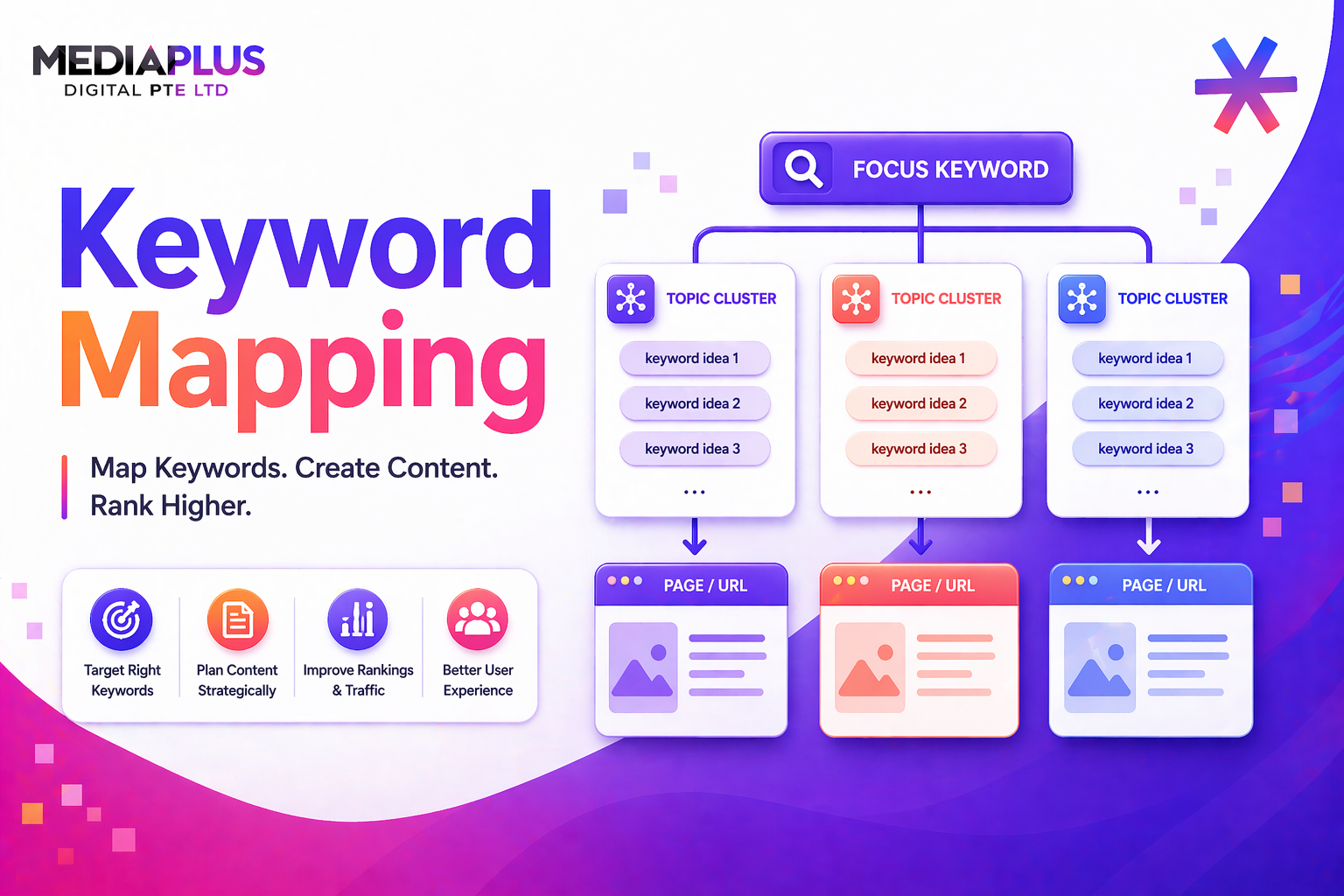
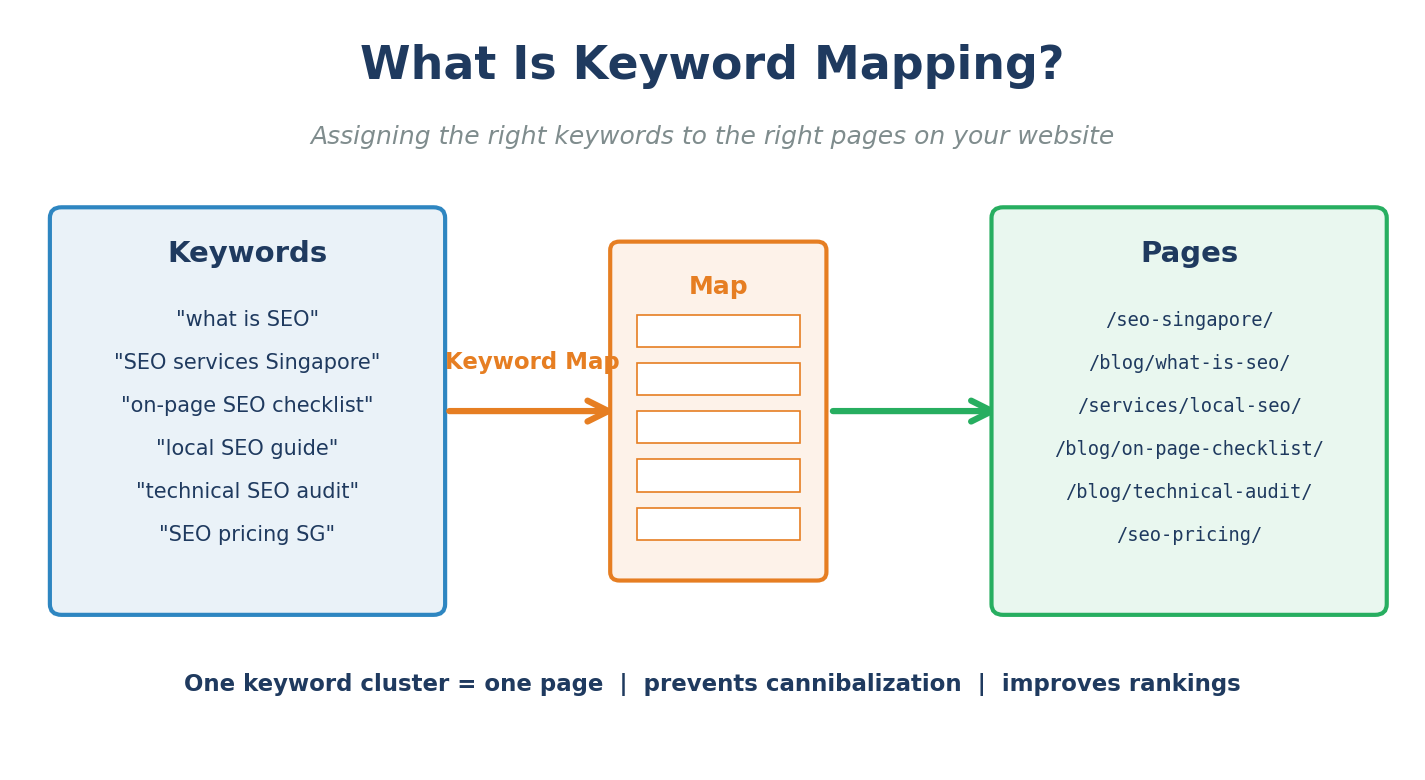
Keyword mapping is the SEO process of assigning specific target keywords to specific pages on a website, so each page has one clear primary keyword and one defined search intent. It is documented in a keyword map (usually a spreadsheet) and is used to prevent keyword cannibalization, plan new content, and improve rankings on Google Singapore.
Free download: Get our ready-to-use MediaPlus Keyword Mapping Template (Excel) to apply everything in this guide on your own website.
1. What Is Keyword Mapping in SEO?
Keyword mapping is the SEO practice of assigning specific keywords to specific URLs on your website. Every page is paired with one primary keyword and a small group of secondary keywords that share the same search intent. The result is a keyword map: a spreadsheet where each row connects a keyword cluster to a single page, page type, and content status.
Without keyword mapping, you guess. You publish a blog about “SEO services” while another page already targets “SEO agency Singapore”, and Google has to choose between them. With a keyword map, every page has a job, every keyword has a home, and your site structure becomes a strategic asset rather than a pile of articles.
2. Why Keyword Mapping Matters (with Data)
Keyword mapping is one of the highest-leverage activities in modern SEO. It directly affects rankings, click-through rate, internal linking, and content production speed. Here is why Singapore brands cannot skip it in 2026:
|
Benefit |
Impact |
|
Prevents keyword cannibalization |
Up to 30% of websites have at least 2 pages competing for the same keyword (Ahrefs). |
|
Improves topical authority |
Sites with structured topic clusters earn 2 to 4x more organic traffic (HubSpot). |
|
Higher CTR from better titles |
Aligning the H1, title, and intent can lift CTR 20 to 60% (Backlinko). |
|
Faster content production |
Mapped sites produce 2 to 3x more publishable content per quarter (Moz benchmarks). |
|
Cleaner internal linking |
Each page has a clear topic, so contextual links boost rankings rather than dilute them. |
|
Better AI search visibility |
Generative engines (ChatGPT, Perplexity, AI Overviews) cite pages with clear topical focus. |
In Singapore, where SEO is a USD 815.6 million market in 2025 (Statista) and competition for commercial keywords is fierce, a keyword map is the single best way to stretch every SEO dollar further. For full-service support, see our SEO services in Singapore.
3. Keyword Mapping vs Keyword Research vs Content Mapping
|
Concept |
What It Is |
When You Use It |
|
Keyword research |
Discovering what people search for, with volume and difficulty data. |
Step 1 of any SEO project. |
|
Keyword mapping |
Assigning those keywords to specific pages and intents on your site. |
After research, before publishing or rewriting. |
|
Content mapping |
Mapping content (formats, ideas, calls to action) to buyer journey stages. |
Once keyword map is done, to plan editorial calendar. |
4. Map Keywords to the 4 Search Intent Types
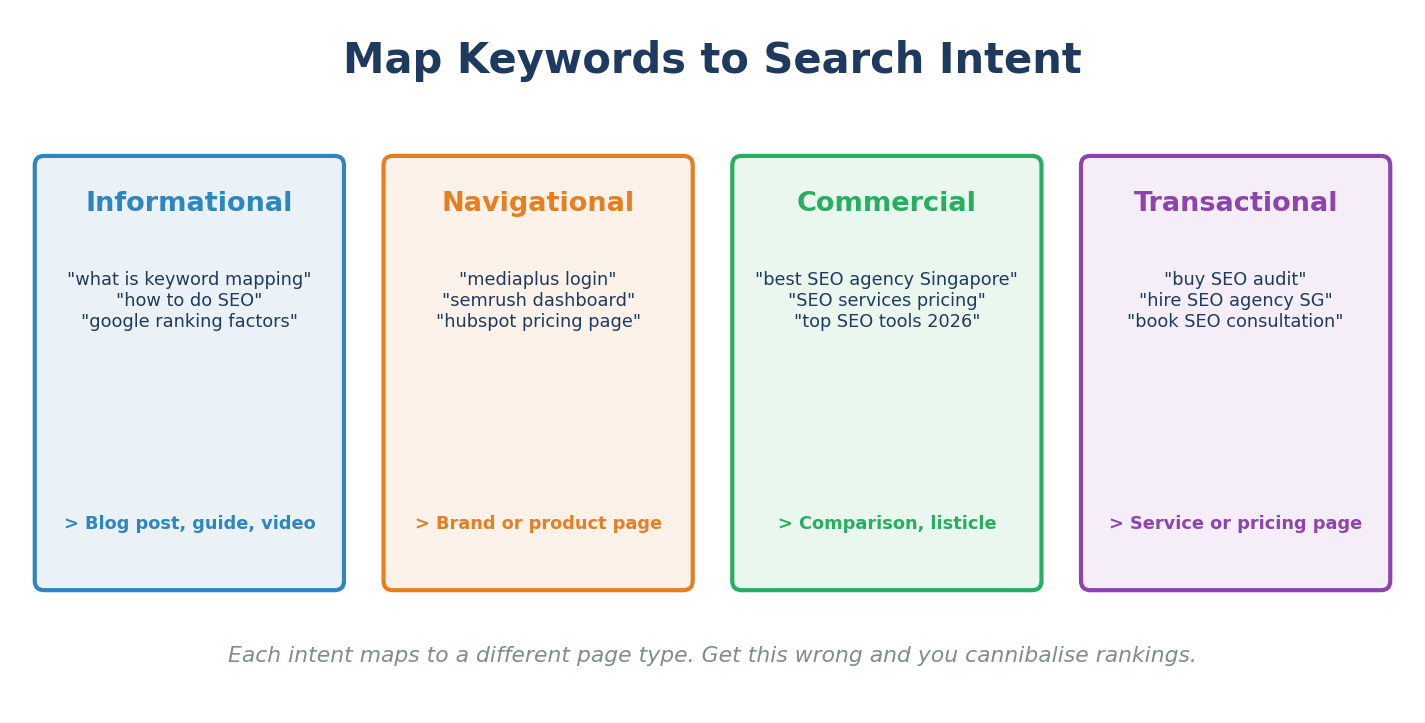
Search intent is the reason behind a query. Google ranks pages that match intent and ignores pages that do not, no matter how strong the backlinks. The four intent types are:
- Informational: the user wants to learn (“what is keyword mapping”, “how to do SEO”). Map to a blog post or guide.
- Navigational: the user wants a specific brand or page (“hubspot login”). Map to brand or product page.
- Commercial Investigation: the user is comparing options (“best SEO agency Singapore”). Map to comparison or listicle.
- Transactional: the user is ready to act (“buy SEO audit”, “book SEO consultation”). Map to service or pricing page.
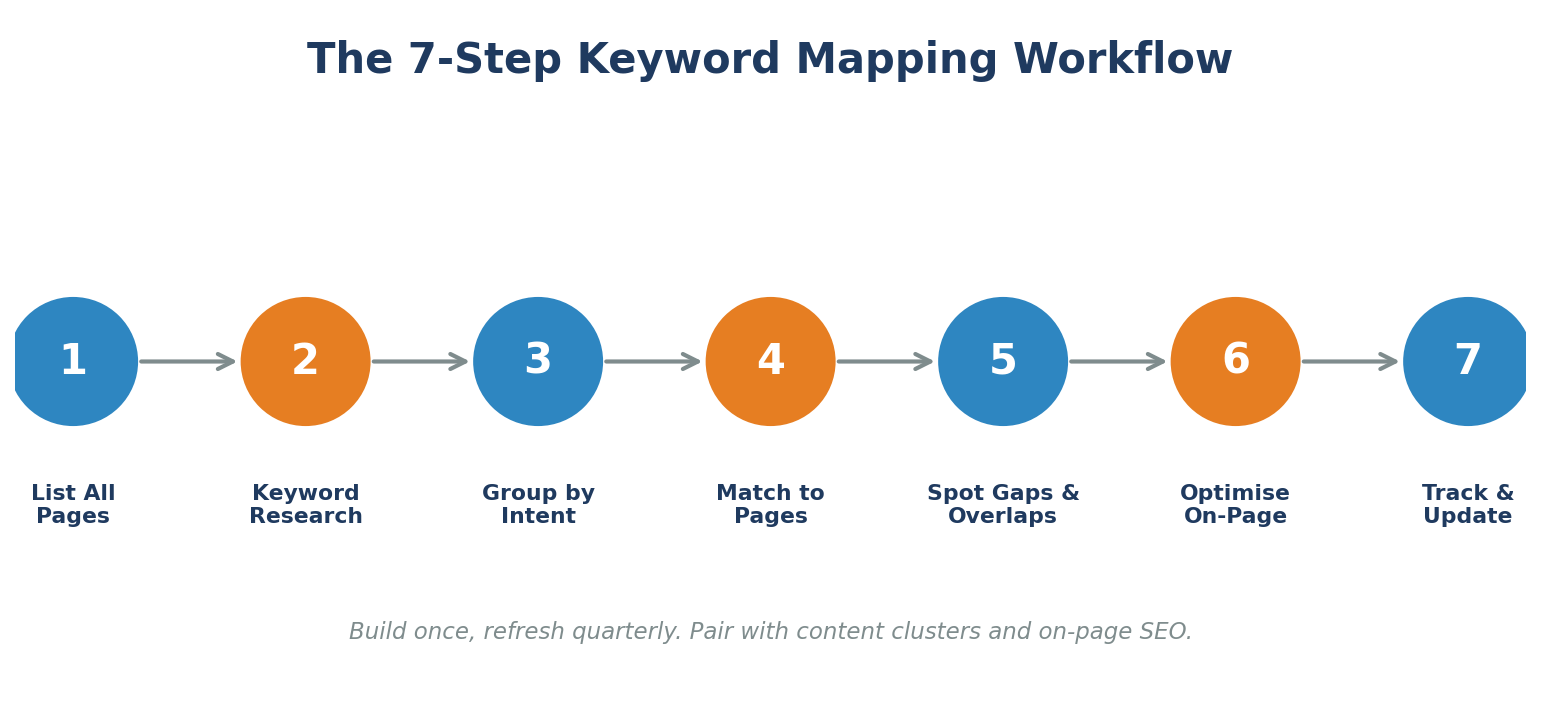
5. The 7-Step Keyword Mapping Workflow
Step 1: List Every Important Page on Your Site
Export your full URL list from Google Search Console, Screaming Frog, or your CMS. Add columns for page type (Service, Blog Pillar, Blog Cluster, Landing, Category) and current status. This is your starting inventory.
Step 2: Run Keyword Research (Singapore-Filtered)
Use Semrush, Ahrefs, or Google Keyword Planner. Always filter for Singapore as the country. Pull search volume, keyword difficulty, and intent. For commercial topics, also pull SERP features (Featured Snippet, AI Overview, People Also Ask). For deeper guidance, see blogging for SEO and our E-E-A-T and topical authority guide.
Step 3: Group Keywords by Topic and Intent
Cluster keywords that mean the same thing. “SEO services Singapore”, “SEO agency Singapore”, and “SEO company Singapore” should sit in the same cluster because Google ranks the same pages for all three. Each cluster will become one page, never several. Use a clustering tool such as Keyword Insights, Surfer, or the SERP overlap method (manually checking if 3 to 5 URLs rank for both keywords).
Step 4: Match Each Cluster to a Page
For every cluster, pick or create a target URL. Existing page that matches intent? Assign it. No page exists yet? Mark it as “To Build”. Two pages competing? Mark one as canonical and merge or 301 redirect the other. The output is a one-to-one keyword cluster to URL relationship.
Step 5: Spot Gaps and Overlaps
Filter the map for clusters with no URL (gaps) and URLs with multiple primary keywords (overlaps). Gaps become your editorial calendar. Overlaps usually require merging or rewriting to focus each page on a single primary keyword.
Step 6: Optimise On-Page Elements
For every “Live” or “Optimise” row, update Title Tag (50 to 60 characters), H1 (one per page), meta description (140 to 160 characters), URL slug, intro paragraph, image alt text, and internal links. The primary keyword should appear in the title, the H1, the URL, and within the first 100 words.
Step 7: Track Rankings and Update Quarterly
Add columns for current rank, target rank, last updated, and review date. Most Singapore SEO teams refresh the keyword map every 90 days. New competitors, new SERP features (especially AI Overviews), and new business priorities all force updates.
6. The Pillar + Cluster Model
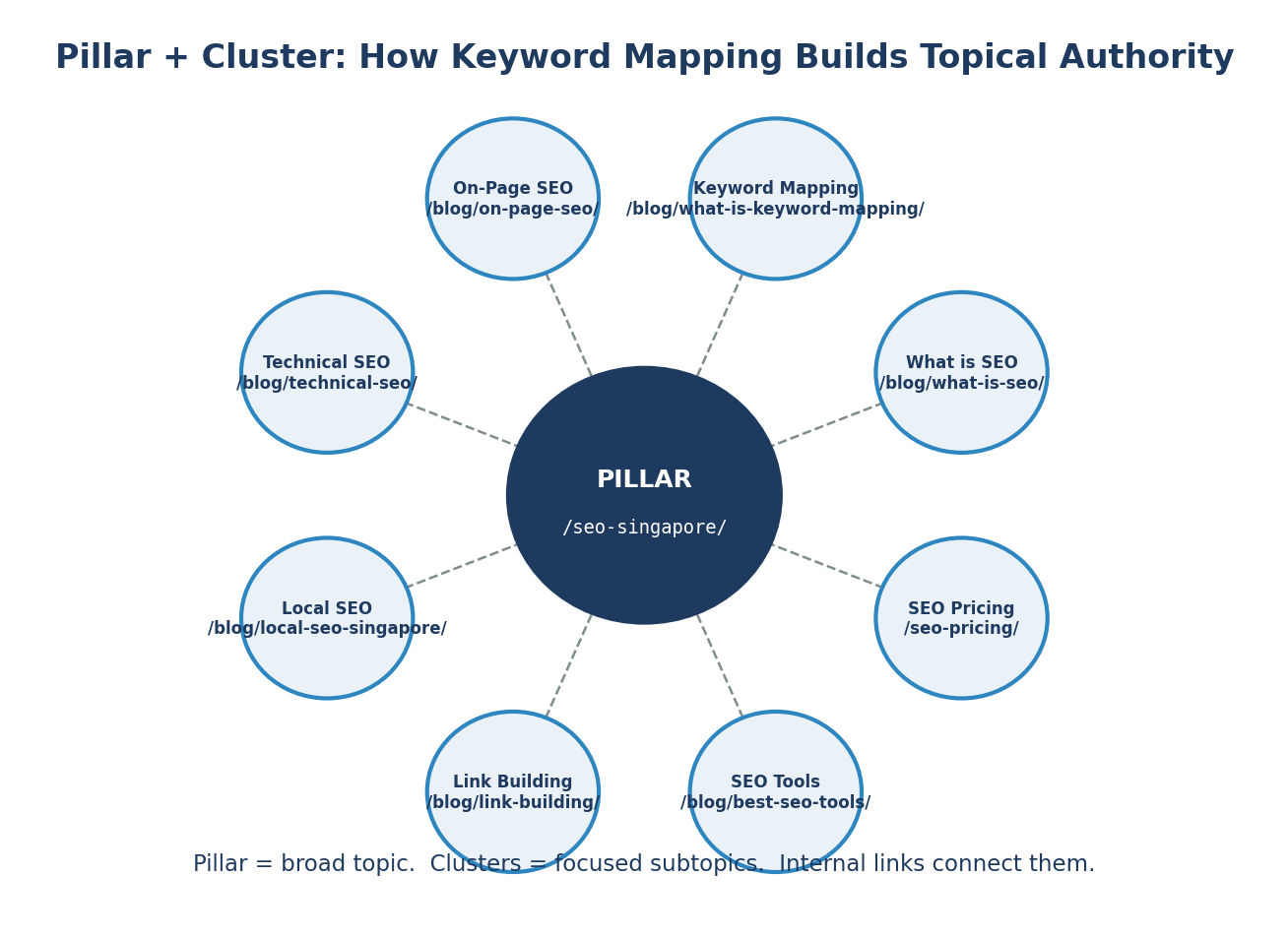
The most effective keyword maps are organised as a hub-and-spoke (also known as pillar and cluster). The pillar page targets the broad topic (“SEO Singapore”). Cluster posts target focused subtopics (“what is keyword mapping”, “on-page SEO checklist”, “technical SEO audit”). Every cluster post links back to the pillar with a relevant anchor, and the pillar links out to clusters. Google reads this structure as topical authority and rewards it. Read our content cluster strategy guide for the full implementation.
7. Best Tools for Keyword Mapping in 2026
7.1 Free Tools
- Google Keyword Planner: free, decent for Singapore-specific volume data.
- Google Search Console: shows the keywords your site already ranks for, ideal for mapping existing pages.
- Google Sheets: free, flexible, works perfectly for any keyword map up to 5,000 rows.
- AnswerThePublic: free for a few searches per day, great for People Also Ask ideas.
7.2 Paid Tools
- Semrush: industry standard for keyword research, clustering, and SERP analysis.
- Ahrefs: best for keyword difficulty and backlink intelligence.
- Keyword Insights: AI clustering of thousands of keywords in minutes.
- Surfer SEO: keyword clustering plus on-page content scoring.
- ChatGPT or Claude: useful for grouping long-tail keywords by intent and drafting briefs.
AI is changing how SEO teams build and maintain maps. See how AI is transforming digital marketing and our AI SEO and Generative Engine Optimization services in Singapore for the latest workflows.
8. Free Keyword Mapping Template (Download)
Skip the spreadsheet setup. Download the ready-to-use MediaPlus Keyword Mapping Template (Excel) built by our SEO team in Singapore. It includes:
- 11 pre-defined columns: Cluster, Primary Keyword, Secondary Keywords, Search Volume (SG), Keyword Difficulty, Search Intent, Target URL, Page Type, Title Tag, Status, Notes.
- Color-coded Status (Live, Optimise, To Build) for quick scanning.
- A pre-filled Singapore SEO example you can adapt to your business.
- A separate Instructions sheet with our 7-step workflow.
9. Common Keyword Mapping Mistakes to Avoid
- Mapping multiple pages to the same primary keyword. This causes cannibalization and Google picks the wrong winner.
- Ignoring search intent. Targeting “best SEO agency Singapore” with a how-to article will never rank, no matter how strong your domain authority.
- Mapping based on volume alone. A 5,000-volume keyword you cannot rank for is worth less than a 200-volume keyword you can win.
- Treating the map as a one-time exercise. SERPs change, AI Overviews appear, and new competitors emerge. Refresh quarterly.
- Forgetting internal linking. A keyword map without contextual links between pillar and cluster pages leaves topical authority on the table.
- Skipping commercial pages. Most teams only map blogs, but service and pricing pages drive revenue and need maps too.
- No status tracking. Without Live, Optimise, To Build labels, the map gets ignored after week one.
10. Real Singapore SEO Example
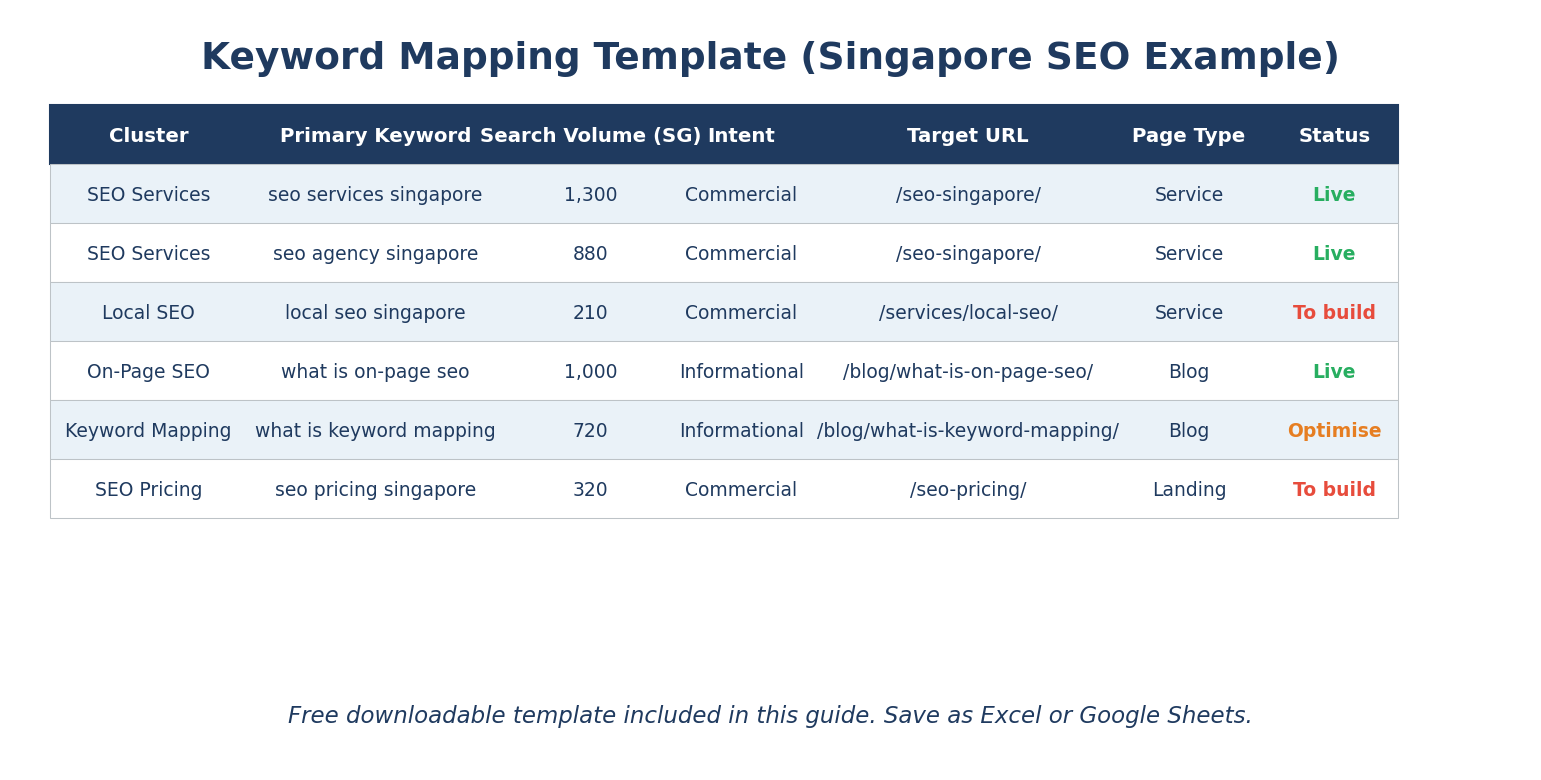
Here is a simplified slice of how a Singapore SEO agency could map its own site. Each row shows one cluster, the assigned page, and the next action.
|
Cluster |
Primary Keyword |
Volume (SG) |
Intent |
Target URL |
Page Type |
Status |
|
SEO Services |
seo services singapore |
1,300 |
Commercial |
/seo-singapore/ |
Service |
Live |
|
Local SEO |
local seo singapore |
210 |
Commercial |
/services/local-seo-singapore/ |
Service |
To Build |
|
Keyword Mapping |
what is keyword mapping |
720 |
Informational |
/blog/what-is-keyword-mapping/ |
Blog Pillar |
Optimise |
|
On-Page SEO |
on page seo checklist |
880 |
Informational |
/blog/on-page-seo-checklist/ |
Blog Cluster |
Live |
|
SEO Pricing |
seo pricing singapore |
320 |
Commercial |
/seo-pricing-singapore/ |
Landing |
To Build |
In this example, the team would prioritize: (1) optimizing /blog/what-is-keyword-mapping/ to capture the 720-volume informational keyword (this very article), (2) building two new commercial pages for local SEO and pricing, and (3) maintaining the live pages with quarterly refreshes.
11. Frequently Asked Questions
What is keyword mapping in simple terms?
Keyword mapping is the process of assigning each target keyword on your site to one specific page, so each page has a clear primary keyword and search intent. It is documented in a spreadsheet called a keyword map.
Why is keyword mapping important for SEO?
It prevents keyword cannibalization (multiple pages competing for the same term), clarifies site structure, improves rankings, increases CTR, and speeds up content production by 2 to 3 times.
How often should I update my keyword map?
Most Singapore SEO teams review the map every 90 days. SERPs, AI Overviews, and competitor moves all force updates. A complete rebuild is recommended once per year.
What is the difference between keyword mapping and keyword clustering?
Keyword clustering groups related keywords by intent or SERP overlap. Keyword mapping takes those clusters and assigns each one to a specific page on your site. Clustering feeds mapping.
Do I need an SEO tool to do keyword mapping?
No. You can map keywords with Google Sheets, Google Search Console, and Google Keyword Planner alone. Tools like Semrush, Ahrefs, and Keyword Insights speed it up but are not mandatory.
Is keyword mapping still relevant with AI search?
Yes, more than ever. ChatGPT, Perplexity, and Google AI Overviews cite pages with clear topical focus. A clean keyword map directly improves AI search visibility (Generative Engine Optimization).
How long does keyword mapping take?
For a small business site (under 50 pages), 1 to 2 days. For a mid-size B2B site (200 to 500 pages), 1 to 2 weeks. Enterprise sites with thousands of URLs typically run a 4 to 6 week mapping project.
12. Conclusion and Next Steps
Keyword mapping turns SEO from guesswork into strategy. Every page gets a job, every keyword has a home, and your site structure becomes a long-term competitive asset. In Singapore, where Google search ads alone are a USD 815.6 million market and AI Overviews are reshaping the SERP, a clean keyword map is the difference between ranking on page one and disappearing entirely.
Start with the free MediaPlus keyword mapping template. If you want a complete map built and executed for you, talk to MediaPlus SEO Singapore. We also help with B2B SEO rankings, content clusters, and AI SEO and GEO. Browse more on the MediaPlus blog.
Ready to fix your keyword map and rank on Google Singapore?
Get a free SEO audit and a customised keyword map. Visit mediaplus.com.sg/seo-singapore or download the free Excel template to start mapping today.