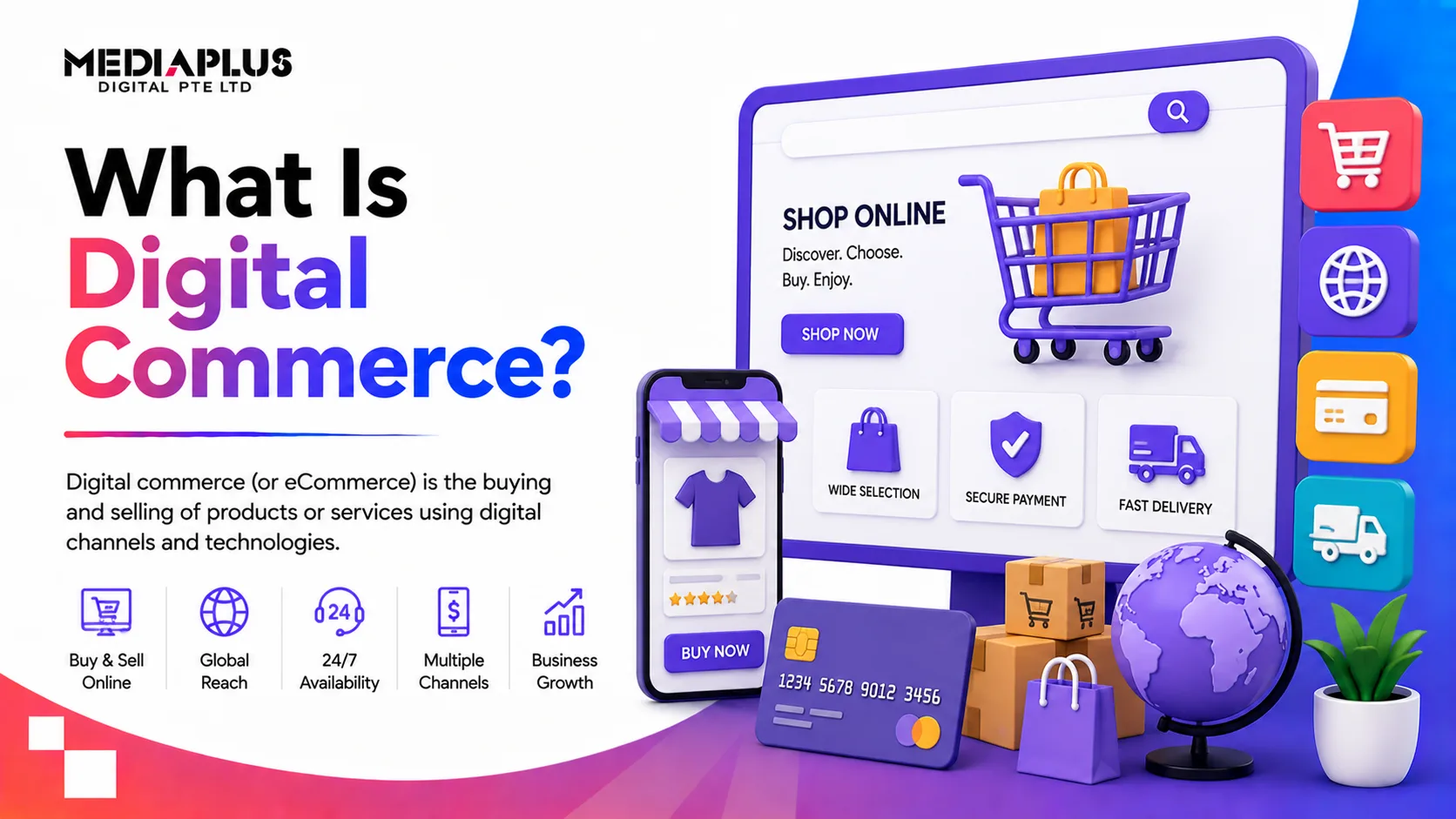
A customer sees your product in a TikTok video, checks reviews on Google, asks a question on WhatsApp, pays with PayNow on your website and collects the order at your shop. Each step is part of the same purchase. That full, connected buying journey is what “digital commerce” describes, and it is why the term has replaced plain “e-commerce” in many boardrooms. This guide explains what digital commerce means, how it differs from e-commerce, what it looks like in Singapore, and how to build a strategy around it.
Quick answer: Digital commerce is the buying and selling of goods and services through digital channels across the whole customer journey, not just the online checkout. It covers your website, marketplaces, social commerce, messaging apps, mobile apps and B2B portals, plus the data, content, payments and systems that connect them. E-commerce is the online transaction itself; digital commerce is the wider system that attracts customers, sells to them wherever they are and keeps them coming back.
What is digital commerce?
Digital commerce is the use of digital technology to sell products and services across every online touchpoint a customer uses, supported by connected data, content and operations. Research firm Gartner describes digital commerce as the technology that enables customers to purchase goods and services through an interactive, self-service or assisted experience, supported by customer data, product content and order functionality connected through APIs.
In plain terms, digital commerce includes:
- Where people buy: your website, apps, marketplaces, social platforms and messaging
- How they discover and decide: search, content, reviews, ads and recommendations
- How the sale is completed: cart, checkout, payments, invoicing and fulfilment
- What happens after: delivery updates, support, returns, loyalty and repeat purchases
- The systems behind it: product data, customer data, inventory, order management and analytics

Digital commerce vs e-commerce
The two terms overlap, and many people use them interchangeably. The useful difference is scope.
|
E-commerce |
Digital commerce |
|
|
Focus |
The online transaction |
The full customer journey |
|
Channels |
Mainly an online store or marketplace |
Website, marketplaces, social, messaging, apps, B2B portals and in-store digital touchpoints |
|
Starts and ends |
Add to cart, checkout, delivery |
Discovery, research, purchase, service and repeat buying |
|
Data |
Orders and sales reports |
Unified customer, product and behaviour data used for personalisation |
|
Content |
Product listings and prices |
Product content, reviews, videos, guides and recommendations across channels |
|
Technology |
A store platform and payment gateway |
Store platform plus CRM, product information, order management, marketing and analytics tools, often connected by APIs |
|
Goal |
Complete the sale |
Win, convert and retain customers profitably |
Put simply, every e-commerce store is part of digital commerce, but digital commerce also includes the channels and systems around the store. See our guide to what e-commerce is for the basics.
Examples of digital commerce in Singapore
|
Channel |
What it looks like |
|
Your own website |
A Shopify or WooCommerce store with PayNow, cards and wallets at checkout |
|
Marketplaces |
Selling on Shopee, Lazada or Amazon Singapore alongside your own store |
|
Social commerce |
Product tags on Instagram, TikTok Shop listings and livestream selling |
|
Messaging commerce |
Customers enquire, receive a quote and pay through WhatsApp |
|
Apps and super apps |
Ordering food or services through a brand app or delivery platform |
|
B2B portals |
Trade customers log in to see their own pricing, reorder and download invoices |
|
Online to offline |
Buy online and collect in store, or scan a QR code in store to order online |
|
Digital products and subscriptions |
Online courses, software, memberships and recurring deliveries |
Singapore’s digital economy is still growing from an already high base. The e-Conomy SEA 2025 report by Google, Temasek and Bain & Company projected Singapore’s digital economy gross merchandise value at about US$29 billion in 2025, up 7% on 2024. For businesses, the more practical point is that customers move easily between channels, so selling well in only one of them leaves sales on the table.
For channel-specific guidance, see social commerce in Singapore, how to sell on TikTok and WhatsApp Business marketing.

Digital commerce business models
|
Model |
Who sells to whom |
Example |
|
B2C |
Business to consumer |
A skincare brand selling online to shoppers |
|
D2C |
Brand directly to consumer, skipping retailers |
A food brand running its own store and subscriptions |
|
B2B |
Business to business |
A supplier’s trade portal with account pricing and reordering |
|
B2B2C |
Business through a partner to consumers |
A brand selling through a marketplace or retailer’s site |
|
C2C |
Consumer to consumer |
Second-hand selling on Carousell |
|
Subscription |
Recurring purchases |
Monthly coffee, pet food or software plans |
|
Marketplace |
A platform connecting many sellers and buyers |
Shopee, Lazada |
B2B is often overlooked. Many Singapore distributors and manufacturers still take orders by email and phone, and a self-service ordering portal is one of the most practical digital commerce upgrades they can make.
The building blocks of a digital commerce system
|
Building block |
What it does |
Common tools |
|
Storefront |
Where customers browse and buy |
Shopify, WooCommerce, Magento, headless front ends |
|
Product information |
Keeps product data, images and specs consistent across channels |
Store admin, PIM systems |
|
Cart, checkout and payments |
Completes the purchase securely |
Payment gateways supporting cards, PayNow and wallets |
|
Order and inventory management |
Syncs stock and orders across website, marketplaces and store |
OMS, inventory apps, ERP |
|
Customer data |
Records who customers are and what they buy |
CRM, customer data platforms |
|
Marketing and search |
Brings in traffic and repeat buyers |
SEO, paid ads, email, social, marketplace ads |
|
Service and fulfilment |
Delivery, returns and support |
Courier integrations, helpdesk, messaging |
|
Analytics |
Measures what works |
GA4, platform reports, dashboards |
|
Integrations |
Connects everything |
APIs, connectors, headless architecture |
Smaller businesses rarely need all of these as separate systems. The point is that they must work together. Stock that does not sync between your website and Shopee, or a CRM that does not know what a customer bought, is where digital commerce breaks down. See our guide to choosing an e-commerce CMS and headless CMS options for e-commerce.
Benefits of digital commerce
For businesses
- Reach customers where they already are, instead of waiting for them to find one store
- Sell around the clock, across channels, with less manual work
- Use data to personalise offers and improve marketing return
- Grow repeat revenue through accounts, subscriptions and loyalty
- Reduce order-handling costs, especially in B2B
For customers
- Convenience: buy on the channel they prefer
- Better information: reviews, videos and detailed product content before buying
- Flexible payment and delivery options
- Consistent service whether they buy online, in an app or in store
Challenges and how to handle them
|
Challenge |
What goes wrong |
How to handle it |
|
Disconnected channels |
Stock, prices and promotions differ between website, marketplaces and store |
Use one source of truth for product and inventory data, synced to every channel |
|
Rising acquisition costs |
Paying more for every new customer on ads and marketplaces |
Build owned channels: SEO, email, WhatsApp lists and loyalty |
|
Checkout friction |
Customers abandon at payment or delivery |
Offer local payment methods, show delivery costs early, simplify checkout. See reducing cart abandonment |
|
Data spread across tools |
No single view of the customer |
Connect store, marketplace and CRM data; start with the few metrics that matter |
|
Personal data compliance |
Collecting customer data without proper consent |
Follow the PDPA: collect only what you need, get consent and secure the data |
|
Choosing the wrong platform |
Replatforming within two years |
Match the platform to your catalogue, integrations and growth plans. See Shopify vs WooCommerce vs Magento |
|
Fulfilment strain |
Orders from several channels overwhelm operations |
Integrate courier and order management before scaling marketing |
How to build a digital commerce strategy
- Map how your customers buy today. List where they discover you, where they ask questions and where they pay.
- Choose your core channels. Most SMEs do best with one owned store plus one or two marketplaces or social channels, rather than everything at once.
- Fix the foundation. A fast, mobile-friendly store with local payment options and clear delivery information comes before expansion.
- Unify product and inventory data so every channel shows the same stock, prices and details.
- Connect customer data from your store, marketplaces and messaging into one CRM or customer list.
- Build owned demand. Invest in SEO, content and email or WhatsApp lists so you are not fully dependent on paid ads and marketplace fees. See what e-commerce SEO is.
- Automate the repetitive work: order confirmations, abandoned cart reminders, restock alerts and review requests.
- Measure and improve every month using the metrics below.

Metrics that matter
|
Metric |
What it tells you |
|
Revenue by channel |
Which channels actually make money |
|
Conversion rate |
How well each channel turns visitors into buyers |
|
Average order value |
Whether bundles and upsells are working |
|
Customer acquisition cost |
What you pay to win each customer |
|
Repeat purchase rate |
Whether customers come back |
|
Customer lifetime value |
Long-term value per customer |
|
Cart abandonment rate |
Where checkout is losing sales |
|
Fulfilment time and return rate |
Whether operations support growth |
Judge channels on profit after fees, ad spend and fulfilment, not on revenue alone. A marketplace with high sales and high commissions may be less valuable than a smaller owned channel.
Trends shaping digital commerce
- AI shopping assistants and product search. Customers increasingly ask AI tools for product recommendations, so clear, structured product information and reviews help your products get surfaced.
- AI search visibility. Being cited in Google AI Overviews and assistants such as ChatGPT is becoming part of how brands are discovered, alongside traditional search rankings.
- Social and livestream commerce. Short video and live selling continue to shorten the path from discovery to purchase.
- Composable and headless commerce. Larger businesses separate the storefront from back-end systems so they can add channels without rebuilding everything.
- B2B self-service. Trade buyers expect to reorder, check pricing and track orders online, like consumers do.
- Retail media. Marketplaces and retailers sell advertising on their platforms, making marketplace ads a channel in their own right.
Frequently asked questions
What is digital commerce in simple terms?
It is selling products and services through all the digital channels a customer uses, such as your website, marketplaces, social media, messaging apps and mobile apps, supported by connected data, payments and operations.
What is the difference between digital commerce and e-commerce?
E-commerce focuses on the online transaction. Digital commerce covers the entire customer journey across every digital channel, including discovery, purchase, service and repeat buying, and the systems that connect them.
What are examples of digital commerce?
An online store, selling on Shopee or Lazada, TikTok Shop and Instagram shopping, taking orders and payments through WhatsApp, B2B ordering portals, mobile app purchases and online subscriptions.
Is digital commerce only for large companies?
No. A small business selling through its own website, one marketplace and WhatsApp is already practising digital commerce. The priority for smaller businesses is keeping those channels connected rather than adding more of them.
What platform do I need for digital commerce?
Most SMEs start with an e-commerce platform such as Shopify or WooCommerce, connected to marketplaces, payment gateways and a CRM. Larger businesses with complex requirements may use headless or composable commerce platforms.
Can I get a grant for digital commerce in Singapore?
Eligible SMEs can claim up to 50% of qualifying costs for pre-approved e-commerce solutions from pre-approved vendors under the Productivity Solutions Grant. See our PSG e-commerce grant guide.
Build a digital commerce setup that connects
Digital commerce works when your store, marketplaces, social channels and customer data work together instead of in separate silos. If you want an e-commerce website built to sit at the centre of that system, talk to MediaPlus Digital. Explore our e-commerce website development and e-commerce SEO services, with PSG support of up to 50% for eligible SMEs.