Quick answer
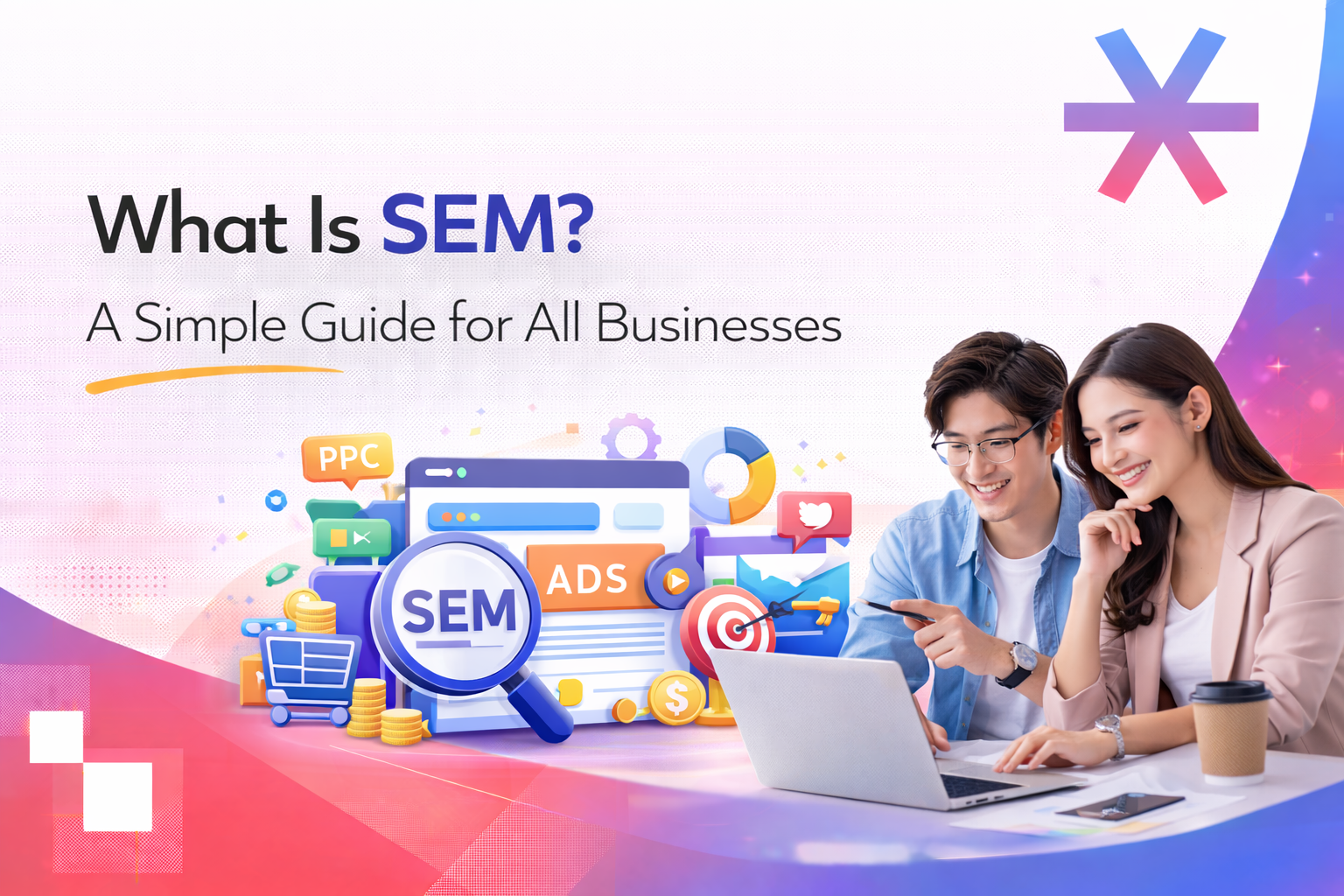
SEM (search engine marketing) is paying to appear on a search results page when someone searches for what you sell. In practice, in Singapore, that means Google Ads, with Microsoft Advertising as a smaller secondary channel.
You choose the searches you want to show up for, you bid, and you pay when someone clicks. Unlike SEO, it starts producing traffic the day the campaign is approved, and it stops the day you pause it.
What is SEM in digital marketing?
Search engine marketing is the paid half of search. Someone types a query, the search engine runs an auction in the time it takes the page to load, and the winning ads appear above and below the organic results.
Three things make SEM different from most other channels:
- The intent is already there. Nobody searches “emergency aircon repair singapore” out of curiosity. You are not creating demand, you are catching it.
- It is bought by the click, not by the impression. You pay when someone acts, which makes the maths easy to check.
- It is measurable to the dollar. With conversion tracking set up properly, you can trace a sale back to a keyword.
The older textbook definition of SEM covered both paid and organic search. Nobody uses it that way now. In everyday usage, SEM means paid search, and SEO means organic.

SEM, SEO and PPC: how the three relate
|
SEM |
SEO |
PPC |
|
|
What it is |
Paid placement on search engines |
Earning organic rankings |
A pricing model: pay per click |
|
Where it runs |
Google Ads, Microsoft Advertising |
Google, Bing and AI search surfaces |
Search, social, display, marketplaces |
|
Time to first result |
Same day to a few days |
Weeks to months |
Same day |
|
Cost behaviour |
Stops when budget stops |
Compounds, costs staff or agency time |
Stops when budget stops |
|
Best for |
Launches, promotions, competitive commercial keywords |
Long-term acquisition, lower cost per lead over time |
Any channel priced per click |
So: all search ads are PPC, but not all PPC is SEM. Facebook ads are PPC, not SEM. Our side-by-side breakdowns are here: SEO vs SEM and SEO vs PPC.
Why Google dominates the SG plan. Statcounter puts Google at 92.61% of Singapore search engine market share in August 2026, with Bing at 3.61%. Start with Google Ads, then test Microsoft Advertising if your audience skews desktop and corporate.
How the auction actually works
This is the part most guides skip, and it is the part that explains why your competitor with a smaller bid still outranks you.
Google does not simply sell the top spot to the highest bidder. It calculates Ad Rank for every eligible ad. In Google’s own words, Ad Rank is “a set of values that are used to determine whether your ads are eligible to show and if eligible, where on the page your ads are shown.” The factors Google lists:
- Your bid
- The quality of your ads and landing page
- The Ad Rank thresholds
- The competitiveness of the auction
- The context of the person’s search, including device, location and time
- The expected impact from your ad assets and other ad formats
Two practical consequences:
- Quality buys position. Better ad relevance, a higher expected click-through rate and a landing page that matches the promise all raise Ad Rank at the same bid. That is why cleaning up landing pages often lowers cost per click more than raising budget does.
- Thresholds are location-specific. Google applies minimum Ad Rank thresholds, and the bar for showing above the organic results is higher than for showing below them. A weak ad can be eligible but never reach the top block.
Quality Score is the diagnostic version of this, reported 1 to 10 per keyword, made of expected CTR, ad relevance and landing page experience. It is not the number used in the live auction, but it points at what to fix.
What sits inside an SEM campaign
|
Layer |
What you decide |
Common mistake |
|
Account |
Billing, conversion tracking, audiences |
Launching before conversion tracking is verified |
|
Campaign |
Objective, budget, locations, languages, bidding strategy |
One campaign holding every product and service |
|
Ad group |
A tight theme of keywords |
40 unrelated keywords in one ad group |
|
Keywords |
Terms and match types |
Broad match with no negatives, budget drains in days |
|
Ads |
Headlines, descriptions, assets |
Ads that repeat the company name instead of the offer |
|
Landing page |
Where the click goes |
Sending every ad to the homepage |
|
Negatives |
What you refuse to pay for |
No negative list, so you pay for “free”, “jobs”, “course” |
Match types in one line each
- Exact [web design singapore]: that query and close variants. Tightest control, lowest volume.
- Phrase “web design singapore”: queries that carry the meaning of the phrase.
- Broad web design singapore: Google’s widest interpretation, including related concepts. Only safe with strong conversion data and an active negative list.
A workable start for most SME accounts: exact and phrase for the money terms, broad only in a separate, capped test campaign.
Campaign types worth knowing
- Search: text ads on the results page. The core of SEM.
- Shopping: product listings for ecommerce, fed by a Merchant Center feed. See our Google Merchant Center setup guide.
- Performance Max: one campaign running across Search, Shopping, YouTube, Display, Discover and Gmail. Strong at scale, opaque when you want control.
- Demand Gen and Display: awareness and retargeting rather than harvesting intent. Not SEM in the strict sense.

The metrics that matter, and how to read them
|
Metric |
Formula |
What it tells you |
Rough rule |
|
CTR |
Clicks / impressions |
Is the ad relevant to the query |
Below 2% on search usually means a message or keyword mismatch |
|
CPC |
Cost / clicks |
Price of a visit |
Rises with competition and falls with quality |
|
Conversion rate |
Conversions / clicks |
Is the landing page doing its job |
Compare against your own baseline, not an industry average |
|
CPA |
Cost / conversions |
Cost per lead or sale |
Must sit below the gross margin of what you sell |
|
ROAS |
Revenue / ad spend |
Return for ecommerce |
Set the target from margin, not from a benchmark you read online |
|
Impression share |
Impressions / eligible impressions |
How much of the market you are missing |
Lost IS (budget) and Lost IS (rank) tell you which lever to pull |
|
Search terms report |
The actual queries |
Where money leaks |
Review weekly, add negatives |
If you only check one report each week, make it the search terms report. It shows what people typed, not what you hoped they would type.
What SEM costs in Singapore
There is no single answer, because cost per click is set by competition in your category. Legal, insurance, aesthetics and B2B software sit at the expensive end. Niche B2B and local services sit far lower.
Budget from the bottom up instead of guessing:
- Take your average order value or lead value.
- Apply your close rate to get the value of a lead.
- Decide the maximum CPA you can afford, usually well under gross margin.
- Check the Keyword Planner CPC estimate for your main terms.
- Multiply: (target conversions x CPA) is your monthly budget floor. If that number is below roughly S$1,000 a month, you will not gather enough data to optimise, and SEO or a tighter keyword set is the better starting point.
Our detailed figures are in Google Ads cost and Google Ads price in Singapore. Management fees are covered in SEM agency pricing.
PSG. Singapore SMEs can claim up to 50% support on pre-approved digital marketing solutions under the Productivity Solutions Grant, capped at S$30,000 per company per financial year. Media spend itself is not funded, the solution package is. Apply and wait for the Letter of Offer before committing. See digital marketing PSG grant and confirm current terms on GoBusiness.
Building a campaign: the order that works
- Conversion tracking first. GA4 plus Google Ads conversions, with form submissions, calls and purchases defined. Anything you cannot measure, you cannot optimise.
- Pick 15 to 30 real money keywords. Start where intent is highest: “buy”, “price”, “near me”, “service + singapore”. Use our keyword mapping method so each term has a page that deserves it.
- Write a negative list on day one. Free, cheap, jobs, salary, course, DIY, template, and competitor brand names if you do not want them.
- One ad group per theme, three to five ads. Headlines must echo the query and state the offer, not the company history.
- Match the landing page to the ad. Same promise, one clear action, fast on mobile. A generic homepage is the most expensive mistake in this list. Our conversion rate optimisation service exists because of it.
- Start on manual or maximise clicks with a cap, then move to target CPA or target ROAS once you have 30 or more conversions a month.
- Weekly: search terms, negatives, bids. Monthly: ads, landing pages, structure.
SEM in the AI era
Two changes matter for 2026 planning.
Ads now appear inside AI experiences. Google has been placing ads in AI Overviews and AI Mode results, so a query answered by an AI summary can still carry a paid placement. That is one reason impressions can rise while organic clicks fall.
Automation has taken over bidding, not strategy. Smart Bidding, broad match plus AI-driven matching, and Performance Max all decide more than they used to. What is left to you is the part that still moves numbers: the offer, the feed quality, the conversion data you feed back, the negative lists and the landing page. Accounts that hand everything to automation without clean conversion data tend to buy cheap clicks that never close.
If organic search matters to you as well, read how AI search changes visibility in GEO vs SEO.
Common ways SEM budget gets wasted
- Conversion tracking that counts page views as leads, so the algorithm optimises towards nothing.
- No negatives, so a plumbing account pays for “plumber course”.
- Every ad pointing to the homepage.
- Broad match plus Smart Bidding on a tiny budget.
- Judging a campaign after five days, or changing bids daily.
- Bidding on brand terms you already rank first for, without checking incremental value.
- Ignoring mobile: slow landing pages waste more of the budget than bad ads do.
- Running SEM and SEO separately, so both teams buy the same keyword twice with no shared data.
Frequently asked questions
What is SEM in simple terms?
Paying to show up on search results when someone searches for what you sell, and paying when they click.
Is SEM the same as Google Ads?
Google Ads is the biggest SEM platform, not the category. Microsoft Advertising is SEM too. In Singapore, with Google at roughly 93% share, Google Ads is where most budgets go.
Is SEM the same as PPC?
PPC is a pricing model used across many channels. SEM is search advertising specifically, usually bought on a PPC basis.
Does SEM help SEO rankings?
No, paying for ads does not raise organic rankings. It does help SEO indirectly: keyword and conversion data from ads tells you which organic pages are worth building.
How long before SEM works?
Traffic arrives immediately. Reliable optimisation needs about four to six weeks and enough conversions to see patterns. Treat the first month as a data purchase.
Should I do SEM or SEO first?
Both if the budget allows. If not: SEM when you need leads this quarter or are testing a new offer, SEO when you need cost per lead to fall over the next year. Most Singapore SMEs run ads on the money terms and build organic pages behind them.
What is a good CTR or conversion rate?
The useful benchmark is your own trend line. Published industry averages mix wildly different business models and rarely help a decision.
Working with an SEM team
MediaPlus Digital runs search campaigns for Singapore businesses with 13 years in the market, a team of 60, and more than 1,800 projects delivered. Campaigns are built alongside the landing pages they point to, because a click that lands on a weak page is a click you paid for twice.
See our SEM agency services in Singapore, our Google Ads agency team, or run through the SEM audit checklist if you want to review an existing account first.