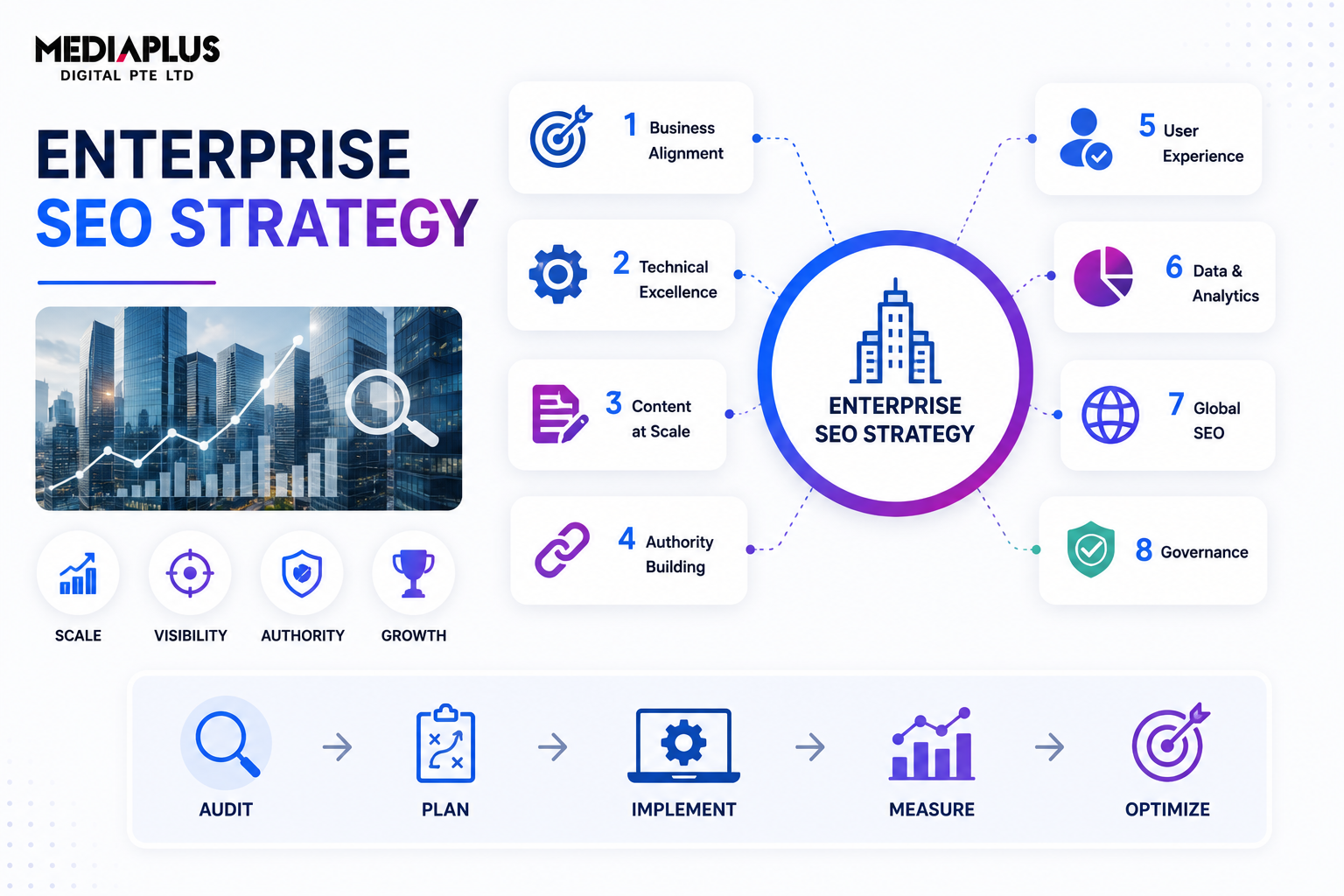
Enterprise SEO and SME SEO share a name but barely anything else. A small site SEO programme is a campaign: a few priority keywords, a content calendar, monthly reporting. An enterprise SEO programme is a system: thousands to millions of URLs, multiple business units, multiple markets, multiple languages, a stack of integrated tools, and a governance layer that keeps all of it from breaking when one team ships a CMS update on a Friday.
In 2026, the work has shifted again. AI search, generative engine optimisation, entity authority, and the rapid growth of zero-click search mean enterprise SEO is no longer about managing pages. It is about managing systems: programmatic content with editorial guardrails, autonomous QA, real-time citation tracking, and a governance discipline strong enough to survive reorgs.
This guide reframes enterprise SEO strategy as an operating model: how the function should be structured, what the technical substrate must do, how content and AI search fit together, and the 90-day roadmap that gets a large Singapore or APAC organisation from “scattered SEO tactics” to “systematic SEO programme”.
What Makes Enterprise SEO Different (Beyond Size)
Many definitions reduce enterprise SEO to “sites with thousands of pages”. That misses the real distinction. Five characteristics actually separate enterprise SEO from SME SEO:
- Scale of URLs. Tens of thousands to millions of pages, often generated programmatically from product, location, or content databases.
- Multi-team ownership. Marketing, product, engineering, content, regional teams, each ships changes that touch SEO without consulting it.
- Multi-market and multi-language. Sites span Singapore, Indonesia, Malaysia, Thailand, the Philippines, plus global headquarters with US or EU canonicals.
- Compliance overhead. PDPA, MAS TRM for financial services, MOH advertising rules for healthcare, GDPR for European arms, accessibility (WCAG 2.2 AA) for government tenders.
- Governance complexity. Change-management processes, security reviews, approvals, audit trails. SEO has to fit inside these, not around them.
A startup SEO team running a 200-page site can hold the whole site in their head. An enterprise SEO team running a 50,000-page site cannot. The strategy must therefore look completely different: less reliance on individual judgement, more reliance on systems, templates, automation, and governance.
The Operating Model: Centralised Strategy, Distributed Execution
The single most important strategic decision in enterprise SEO is how the function is organised across the business. Three patterns dominate; only one consistently produces results at scale.
Pattern 1: Fully Centralised
A single SEO team owns all SEO work for every market and product. Strong consistency but a bottleneck. Local market knowledge gets diluted, regional teams feel ignored, and the central team becomes a constraint on every campaign launch.
Pattern 2: Fully Distributed
Each business unit, market, or product team has its own SEO resource. Faster local execution but no coherence. The same brand entity gets described differently across markets, internal linking collapses, and technical debt accumulates because no one owns the cross-cutting concerns.
Pattern 3: Centralised Strategy, Distributed Execution (Recommended)
A small central SEO Centre of Excellence owns standards, templates, technical foundations, and measurement. Regional and business-unit teams execute against those standards with autonomy on content, localisation, and campaign-level decisions. This is the model that scales without breaking.
In practice, the central team owns:
- The technical substrate (schema templates, internal linking architecture, crawl budget management, performance budgets).
- Measurement (one source of truth for rankings, traffic, conversions, AI citation share).
- Tooling (the shared SEO stack: Semrush or Ahrefs, BrightEdge or Conductor, Screaming Frog, monitoring tools).
- Standards (content briefs, on-page templates, link guidelines, governance documents).
- Cross-cutting initiatives (site migrations, schema rollouts, AI search readiness).
Regional and business-unit teams own:
- Local keyword research and content calendar.
- Localisation, translation, and cultural adaptation.
- Campaign-level landing pages and promotional SEO work.
- Local link building and PR.
- Day-to-day reporting against shared dashboards.
A common rule of thumb for sizing: one central SEO lead per 200 to 500 URLs of priority commercial pages, plus one local resource per major market.
The Technical Substrate: What Must Be True at Scale
Enterprise sites have technical SEO problems SME sites never face: crawl budget exhaustion, duplicate URLs in the thousands, programmatic page templates that break in unexpected ways, schema implementations that drift, internal linking that calcifies. The technical substrate is the layer that makes the rest of SEO possible.
Crawl Budget Management
Google does not crawl every URL on a large site equally. Crawl budget is real, and on a 500,000-URL site, the difference between Google crawling priority commercial pages once a week versus once a quarter shows up in rankings within 60 to 90 days. Practical moves:
- Block low-value URLs in robots.txt (faceted navigation combinations, internal search results, infinite calendar pages).
- Use canonical tags consistently to consolidate duplicate signals.
- Maintain a clean XML sitemap that lists only canonical, indexable URLs.
- Monitor server logs to confirm Google is crawling priority URLs at the desired frequency.
- Remove or 410 old URLs aggressively; soft 404s waste crawl budget.
Canonicalisation at Scale
E-commerce sites with faceted navigation often have one product appearing on 200+ URLs through filter combinations. Without canonical tags, Google chooses arbitrary winners and index dilution begins. Programmatic canonical implementation, baked into the templates, is a non-negotiable for any product or directory site above 5,000 URLs.
Schema and Structured Data
Programmatic schema deployment matters more in 2026 than in any prior year because AI engines parse structured data heavily. Article, Product, Organisation, FAQPage, HowTo, BreadcrumbList, and Review schemas should all be templated and deployed across the CMS, not hand-written per page. Read our deeper take on E-E-A-T and topical authority for the entity-authority dimension of schema work.
Internal Linking Architecture
At scale, internal linking is no longer “add three contextual links per article”. It is an architecture: pillar-cluster hubs, programmatic related-content modules, breadcrumb structures, hub pages by topic, hub pages by location. The content cluster strategy guide covers the SMB version of this; enterprise builds the same pattern at 50 to 500x scale.
Site Performance Budgets
A 200KB JavaScript payload that ships on every page becomes a 200KB JS budget multiplied by every variant a programmatic template can generate. Performance budgets at the template level (not the page level) are how enterprise sites avoid the slow creep of bloat.
The Content Engine: Programmatic with Human-in-the-Loop
No enterprise SEO programme in 2026 can hand-write every page. The maths does not work. A site with 80,000 product pages, each needing localised descriptions in five languages, requires 400,000 unique content units. Even at an aggressive 4 articles per writer per day, you need 1,250 writer-years.
The 2026 pattern that works: programmatic content generation with a strict human editorial layer. AI generates the first draft from structured data inputs. Templates enforce structure (H1, H2 hierarchy, FAQ section, schema). Human editors review for accuracy, brand voice, and compliance before publishing. This produces volume without producing the AI slop that Google has been quietly demoting since 2024.
Where Programmatic Works (and Where It Does Not)
|
Content type |
Programmatic fit |
Why |
|
Product pages |
Strong |
Structured inputs, predictable format, scale demands it |
|
Location pages |
Strong |
Templated with local data injection |
|
Comparison pages ([A] vs [B]) |
Moderate |
AI drafts, human refines positioning |
|
Category pages |
Moderate |
Templated intro plus curated content |
|
Editorial / thought leadership |
Weak |
Original analysis cannot be programmed |
|
Case studies |
Weak |
Real client outcomes need human storytelling |
|
Regulated content (healthcare, finance) |
Weak |
Compliance review required per page |
Information Gain: The Differentiator AI Cannot Fake
AI content that paraphrases what is already on the web does not rank in 2026. Google’s Helpful Content System and AI engines both filter heavily for “information gain”: original data, expert analysis, proprietary research, named author expertise. Enterprise content programmes that publish at scale also need a small parallel stream of high-effort, information-gain content (original surveys, benchmark studies, expert interviews) that earns citations and links. The programmatic pages then internally link to the information-gain pillar pages, distributing authority.
AI Search and Entity Authority
The shift from ranking pages to being cited by AI is the central 2026 story for enterprise SEO. Google AI Overviews now appear on roughly 38% of Singapore SERPs (BrightEdge), and a growing share of B2B and SaaS buyers consult ChatGPT or Perplexity before clicking any blue link. Our deep dive on AI SEO and Generative Engine Optimisation in Singapore covers the mechanics; here is the enterprise-specific layer.
From Keyword Ranking to Entity Authority
AI engines do not just retrieve documents. They build entity graphs. “Singtel” is an entity with attributes (telco, Singapore, public company, subsidiary brands). “DBS” is another. AI engines cite sources that strengthen and verify entity attributes. Enterprise SEO in 2026 invests in:
- Organization schema with explicit sameAs references to LinkedIn, Crunchbase, Wikipedia, regulatory filings.
- Consistent NAP (Name, Address, Phone) across the site and external directories.
- Named authors on editorial content with author entity markup.
- Expert quotes that build the entity graph around topics.
- Original research published with explicit entities, dates, and citations.
Share of Citation: The Real Enterprise KPI
Position in an AI Overview citation list is unstable; the same query returns slightly different sources on different crawls. The metric that holds up is share of citation across a query basket of 200 to 500 priority queries. Enterprise programmes should track this monthly using tools like Profound, ZipTie, or Peec AI alongside classic SEO rank-tracking.
Governance: The Layer That Decides Whether Any of This Survives
Enterprise SEO programmes die from governance gaps more often than tactical mistakes. A CMS upgrade ships on a Friday and breaks 30% of canonical tags. A product team launches a new category and forgets to add it to the sitemap. Compliance signs off a new disclaimer that pushes priority content below the fold. Each of these is a single decision; together they erode rankings over a year.
A functioning governance layer includes:
- A change-management process that requires SEO review for any production deploy that touches templates, navigation, schema, or canonicals.
- A documented escalation path for incidents (sudden traffic drops, index removal, manual actions).
- A monthly SEO review with stakeholders from marketing, product, engineering, content, and regional teams.
- A quarterly business review tying SEO outputs to revenue and pipeline.
- A risk register that names known SEO risks (third-party scripts, performance regressions, content gaps) and the owner of each.
- An incident response template for ranking incidents with defined SLAs.
Most enterprise SEO consultancies sell “strategy”. The work that actually moves rankings at scale is governance: getting the process to survive turnover, reorgs, and competing priorities.
Measurement: Dashboards That Tie SEO to Revenue
Enterprise SEO measurement runs at three layers. Most programmes do the bottom layer well and the top two badly.
|
Layer |
What it tracks |
Tools |
|
Tactical |
Rankings, traffic, impressions, CTR, technical health |
GSC, GA4, Ahrefs, Semrush, Screaming Frog, BrightEdge |
|
Operational |
Pipeline created, MQLs, SQLs, attribution to source |
HubSpot, Salesforce, GA4 + CRM integration, Dreamdata |
|
Strategic |
Revenue influenced, market share, brand authority, AI citation share |
Custom BI dashboards, Profound, ZipTie, Looker / Power BI |
A monthly executive dashboard should answer four questions in one screen: are we growing organic traffic in priority markets, is that traffic converting at the expected rate, are we losing share to specific competitors, and is our AI search visibility holding or eroding. Everything else is a tactical view that belongs in working dashboards, not executive ones.
A 90-Day Enterprise SEO Roadmap
Three workstreams running in parallel rather than a linear sequence. Each owns a different failure mode and produces visible results inside the quarter.
Track 1: Technical Substrate (Weeks 1 to 12)
- Weeks 1 to 3: Full site crawl, server log analysis, crawl budget audit, canonical audit.
- Weeks 3 to 6: Schema templating rollout, sitemap consolidation, robots.txt cleanup.
- Weeks 6 to 10: Template-level performance budgets, Core Web Vitals remediation.
- Weeks 10 to 12: Internal linking architecture review and programmatic link module deployment.
Track 2: Content and Entity Authority (Weeks 1 to 12)
- Weeks 1 to 4: Entity audit. Map core business entities. Identify “Answer Gaps” where competitors are cited by AI instead of you.
- Weeks 3 to 8: Build the priority query basket (200 to 500 queries) and baseline AI citation share.
- Weeks 4 to 10: Publish one to three information-gain pillars (original research or benchmark studies).
- Weeks 6 to 12: Programmatic content pipeline build with editorial review and template enforcement.
Track 3: Governance and Measurement (Weeks 1 to 12)
- Weeks 1 to 2: Stakeholder mapping. Define the SEO Centre of Excellence and regional execution model.
- Weeks 2 to 4: Set up the three-layer measurement stack (tactical, operational, strategic).
- Weeks 4 to 8: Document standards (content briefs, on-page templates, schema templates).
- Weeks 8 to 12: Implement change-management process; first cross-team SEO review.
By the end of 90 days the organisation is not at full performance, but the system is in place. Meaningful ranking and traffic improvements on competitive enterprise keywords typically appear in months 5 to 9.
The Enterprise SEO Tools Stack
|
Category |
Reference tools |
Why it matters at enterprise scale |
|
Rank and visibility |
BrightEdge, Conductor, Ahrefs, Semrush |
Large keyword universes, multi-market tracking, automated alerts |
|
Technical crawling |
Screaming Frog, Sitebulb, Botify, Oncrawl |
Million-URL crawls, log file analysis, crawl-budget insight |
|
AI search visibility |
Profound, ZipTie, Peec AI, Otterly |
Citation tracking across ChatGPT, Perplexity, AI Overviews |
|
Content production |
Clearscope, MarketMuse, Frase |
Briefs and topic coverage at scale, AI-assisted drafting |
|
Analytics and BI |
GA4, Looker, Power BI, Dreamdata |
Multi-touch attribution, executive dashboards, revenue tie-out |
|
Compliance and governance |
OneTrust, Cookiebot, custom CMS workflows |
Consent, audit trails, change management |
The Five Enterprise SEO Failures That Repeat
- No central owner. SEO is “everyone’s job”, which means no one’s priority. The first months disappear into stakeholder alignment without shipping.
- Treating AI search as a separate initiative. Two parallel programmes (classic SEO + AI search) duplicate work; one integrated programme compounds.
- Over-investing in programmatic content without information-gain pillars. Volume without authority is invisible to both Google and AI engines.
- Skipping governance. Three months of strong work erased by one untracked CMS deploy.
- Measuring only tactical KPIs. Executives lose patience when “rankings up 12 positions” cannot be tied to revenue.
Singapore and APAC Layers Most Frameworks Miss
- PDPA at scale. Enterprise sites trigger consent flows, DPO contact placement, and data residency requirements on every page. A single mishandled consent banner can produce a PDPC notification across millions of impressions.
- MAS TRM for financial services. Bank, insurance, and fintech enterprise sites in Singapore operate under stricter content-approval workflows than most SEO templates anticipate.
- Multi-language. Mandarin, Bahasa Indonesia, Bahasa Malaysia, Thai, Vietnamese. Each market needs proper hreflang, locally indexed content, and entity-graph consistency.
- Singapore as APAC headquarters. Many global enterprises run their APAC SEO programme from Singapore. The central team often owns markets where they have no native speakers; distributed execution becomes mandatory.
- PSG and EDG grant fit. Where enterprise SEO work is part of a broader digital transformation programme, parts may qualify for IMDA or Enterprise Singapore co-funding when packaged correctly.
- WCAG 2.2 AA for tenders. Government and GLC tenders increasingly require accessibility compliance; enterprise sites that fail automated audits fail the tender.
Common Questions
At what size does a business need enterprise SEO?
Two thresholds matter more than employee count. First, the URL count: above 5,000 to 10,000 indexable URLs, the work transitions from tactical to systemic. Second, the team structure: when two or more business units, markets, or product teams ship changes to the same site, governance and shared standards become essential.
How long before enterprise SEO investments produce results?
Technical fixes show in 30 to 60 days (crawl efficiency, index coverage, Core Web Vitals). Content investments show in 90 to 180 days. Meaningful ranking and revenue gains on competitive enterprise keywords usually appear in months 5 to 9. AI citation share moves faster than classic ranking, often within 60 to 90 days of structured-data and information-gain investments.
Should we run enterprise SEO in-house or with an agency?
Most large Singapore enterprises run a hybrid: a small in-house Centre of Excellence (lead plus two to four specialists) for strategy, governance, and measurement, with an agency partner for technical SEO, content production, and AI search expertise. Fully in-house is rare because tooling and specialist talent costs do not amortise well below the largest organisations.
How much should an enterprise SEO programme cost annually?
Mid-market enterprise SEO programmes in Singapore typically run SGD 120,000 to SGD 480,000 annually all-in (tools, agency fees, internal headcount). Larger enterprises with multi-market scope often exceed SGD 1 million annually. Investment scales with URL count, market count, and how aggressive the AI search workstream is.
How does enterprise SEO change with the rise of AI search?
The biggest shift: entity authority replaces page-level optimisation as the primary lever. Schema, named authors, consistent NAP, original research, and structured FAQ content all matter more. Programmatic pages without information-gain pillars no longer compound. AI citation share becomes a board-level KPI alongside traditional rankings.
Enterprise SEO is not the SME playbook scaled up. It is a different operating model with different failure modes, different timeframes, and different governance demands. The 2026 layer (AI search, entity authority, programmatic content with editorial guardrails) does not replace the technical and content fundamentals; it sits on top of them. Organisations that build the substrate first and add the AI layer second compound across years. Those that chase AI tactics without the substrate underneath usually find themselves rebuilding fundamentals in eighteen months.
For Singapore and APAC enterprises planning, scaling, or restructuring an SEO function, the team at MediaPlus SEO Singapore partners across the technical substrate, content engine, and AI search workstreams. Related reads: AI SEO and Generative Engine Optimisation, E-E-A-T and topical authority, content cluster strategy, B2B SEO ranking playbook, how AI is transforming digital marketing, and the MediaPlus blog.