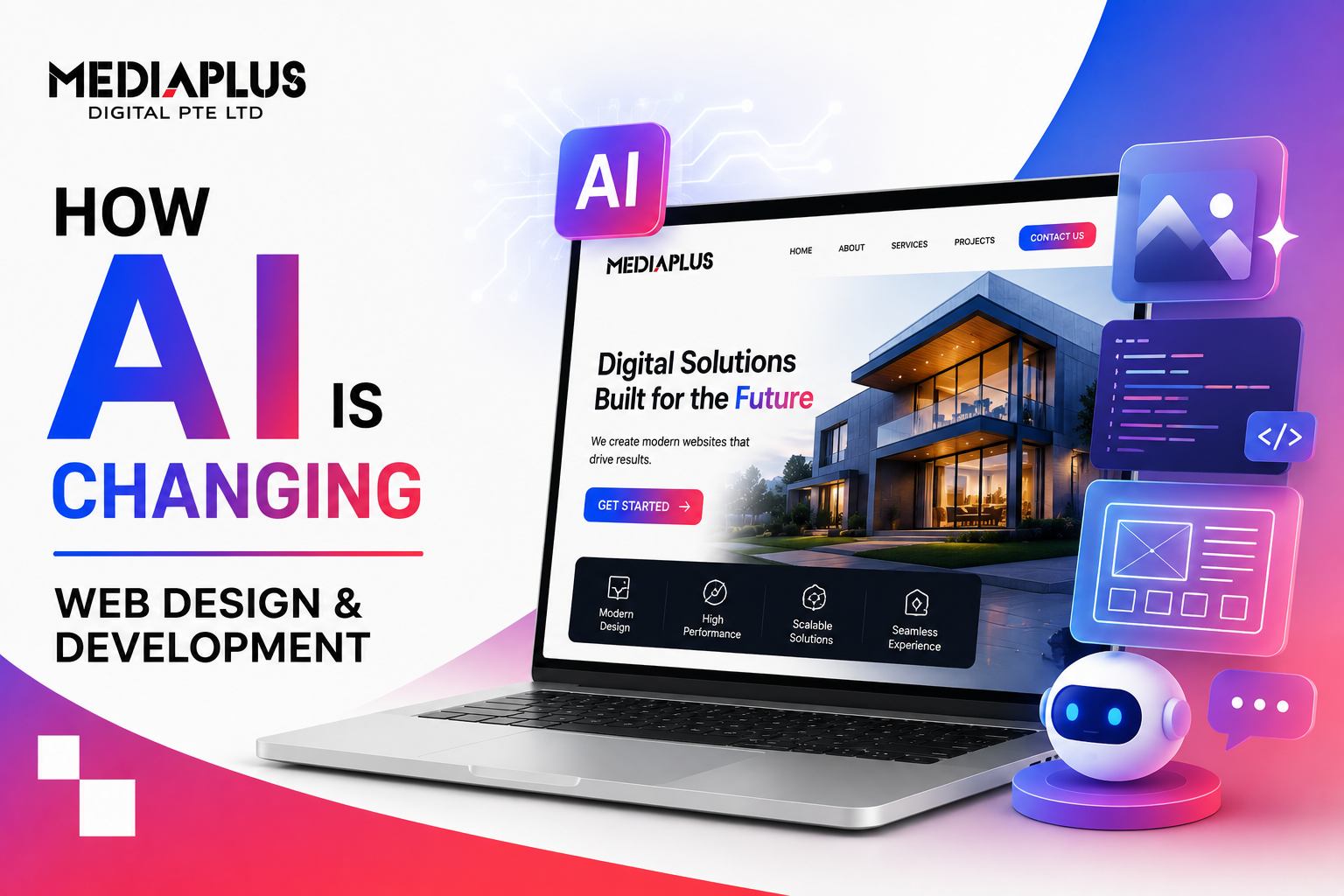
In a Singapore studio in 2026, the path from “we want a website” to “the site is live” looks completely different from how it did even two years ago.
A founder describes their business in a paragraph. Forty minutes later, an AI returns a sitemap, twelve wireframes, draft copy for every section, and three brand-direction mood boards. The designer does not start from a blank canvas. They start by editing.
A few hours later, a developer paste-imports the chosen Figma file into Cursor. A small agent reads the design tokens, the screenshots, and the responsive rules, then writes the first pass of React code. Hover states, micro-animations, accessibility roles, all baked in. The developer reviews, refactors the parts the AI got wrong, wires the CMS, and ships.
A site that took three weeks in 2023 lands in two days in 2026.
This is not a future scenario. This is the median agency workflow now. The interesting question is: what does it actually mean for the people doing the work?
Eight Shifts That Have Already Happened
1. The blank canvas is gone
Relume, Galileo AI, and Uizard have made “starting from nothing” obsolete. Designers spend less time arranging blocks and more time choosing which generated layout to refine. According to the Figma 2026 Designer Report, 93% of designers now use a generative AI tool in their workflow at least weekly.
2. Design-to-code crossed a real threshold
Vercel v0, Cursor with Figma MCP, and Lovable can now generate production-grade React and Next.js from a Figma file or a prompt. Stack Overflow’s 2025 developer survey found 68% of developers use AI to generate code during development. The 2026 number is higher. The bar that has shifted is not “can it write code” but “can the code be merged without a rewrite”. For framework code (forms, tables, marketing pages), the answer is now yes.
3. Personalisation has moved to the edge
Cloudflare Workers, Vercel Edge, and personalisation platforms like Mutiny serve different heroes, CTAs, and offers per visitor in under 50 milliseconds. McKinsey reports 71% of consumers now expect personalised experiences, and 76% feel frustrated when they do not get them. A static one-size-fits-all homepage in 2026 is a competitive disadvantage.
4. Search is no longer about ten blue links
BrightEdge data puts AI Overviews in roughly 38% of Singapore SERPs in early 2026. SparkToro puts global zero-click search above 65%. Web designers now optimise for citation inside ChatGPT, Perplexity, and Gemini, not just for ranking. That has changed how we structure content: shorter answer paragraphs at the top, clearer schema, more original data, more named expert authors.
5. Accessibility has finally become non-optional
AI testing agents (axe AI, Mabl, Reflect) audit WCAG 2.2 compliance on every commit. A team that hand-tested before launch in 2022 now closes its accessibility gap during normal sprints. The legal floor in many markets is WCAG 2.2 AA, and the practical floor is rising as AI catches what humans miss.
6. 3D and motion got cheap
Spline AI generates web-ready interactive 3D models from a text prompt, including lighting, materials, and embed snippets. Framer Motion, GSAP, and Lottie make production-grade animation a one-day job rather than a one-week one. The result: more depth, more delight, less cost.
7. The designer-developer handoff is collapsing
Cursor reads Figma. Figma generates React. Tools like Storybook + AI scaffold component documentation automatically. The “designer hands a static file to a developer” ritual is shrinking. In its place: shared design tokens, generative tools that produce both the pixel and the code from a single source of truth, and tighter loops.
8. QA is now mostly autonomous
AI agents run thousands of cross-browser, cross-device, regression, and accessibility tests on every pull request. Most agencies have dropped one or two manual QA roles. The engineers and designers absorb the judgement calls AI cannot make.
The Numbers Behind the Shift
|
Metric |
Value |
Source |
|
Designers using AI in workflow weekly |
93% |
Figma 2026 Designer Report |
|
Designers naming AI as the #1 impact |
73% |
Figma 2026 Designer Report |
|
Developers using AI to write code |
68%+ |
Stack Overflow 2025; rising in 2026 |
|
Developers reporting productivity gains |
81% |
GitHub Copilot 2025 study |
|
Time to ship a 5-page marketing site |
2 to 3 days |
Practitioner reports, AI-native stack |
|
Singapore SERPs with AI Overviews |
~38% |
BrightEdge 2026 |
|
Zero-click search globally |
65%+ |
SparkToro |
|
Consumers expecting personalisation |
71% |
McKinsey 2025 |
What This Means for Designers
The first thing to notice: AI did not flatten the designer role. It moved it. The work that paid in 2022 (pushing pixels, recreating common patterns, polishing layouts) now happens in seconds. The work that pays in 2026 sits one level higher.
- Strategy: positioning the brand, defining the audience, choosing the message. AI cannot do this.
- Taste and curation: filtering through AI-generated variants, knowing which one is on-brand and which is just plausible.
- Systems: design tokens, component libraries, accessibility patterns. The compounding asset that makes future AI runs faster.
- Storytelling: editorial structure, hierarchy, voice. Particularly important for AI Overview citation, where the writing matters more than the layout.
- Client navigation: turning vague requirements into specific decisions. AI accelerates output but cannot facilitate a stakeholder workshop.
What This Means for Developers
Developers who treated AI as a threat in 2023 spent 2024 wrong. The ones who treated it as a power tool (and learned to use it well) now ship more, cleaner, faster.
- Architecture is the new bottleneck. Anyone can scaffold a feature; few can design a system that scales without rot.
- Code review is the new core skill. AI ships first drafts that need critical reading, not endless auto-merge.
- Performance and Core Web Vitals matter more, not less. AI-generated code is often fine but rarely optimised.
- Security and privacy review fall on humans. AI does not yet catch a leaky API or a misconfigured CSP reliably.
- Domain knowledge is leverage. AI knows React; it does not know your billing logic, your fraud rules, or your local payment gateway integrations.
What This Means for Clients
For Singapore SMEs commissioning websites, the practical impact is threefold. Quality has gone up at every price point, because AI raises the floor of what an average build looks like. Time to launch has dropped, with most marketing sites now realistic in two to four weeks instead of six to ten. And the right thing to pay for has changed: clients should pay less for “build the site” and more for “design the strategy, brand, and systems that will compound across every future AI-driven update”.
What Has Not Changed (And Will Not)
Despite all of this, a meaningful chunk of web work has not been touched by AI in any real way:
- Customer interviews and qualitative discovery.
- Stakeholder politics and decision facilitation.
- Brand strategy and positioning.
- Editorial judgement on legal, regulated, or sensitive copy.
- Multi-region launches with payment, tax, and compliance integrations.
- High-trust accessibility nuance for assistive-tech users.
- Account management and senior client relationships.
These are the parts that distinguish a USD 5,000 website from a USD 50,000 one in 2026, and they are also the parts AI will not flatten in the next 24 months.
Looking Ahead to 2027
The shift that is already starting: agentic web development. Tools like Lovable, Replit Agent, and the next generation of Cursor are moving from “AI writes code” to “AI manages a multi-step build, deploys it, monitors it, and fixes its own bugs”. For simple internal tools and prototypes, this is here. For production marketing and commerce sites, this is the 2027 conversation.
The studios that win this period will not be the fastest at adopting tools. They will be the ones that get sharpest at the work AI cannot do, and use AI to free up enough time to actually do it.
If you want to talk about how to apply this in your next build, get in touch with MediaPlus web design. For more on AI in marketing and SEO, see AI SEO services in Singapore and how AI is transforming digital marketing.