
Offering a free gift instead of a discount is one of the oldest tricks in retail, and one of the few that still works. A gift with purchase lifts order values, moves stock you want to move, and gets customers to try products they would never have bought, all without training shoppers to wait for a sale. This guide explains what a gift with purchase is, how it works, the types and best ideas, and how to run one that actually makes money.
Quick answer: A gift with purchase (GWP) is a promotion where the customer gets a free item after meeting a condition, usually spending a minimum amount or buying a specific product. Unlike a discount, it adds value instead of cutting price, so it protects your margin and brand perception while lifting average order value. It works best when the gift is genuinely wanted, relevant to the purchase, and the qualifying rule is simple enough to understand in one sentence.
What is a gift with purchase?
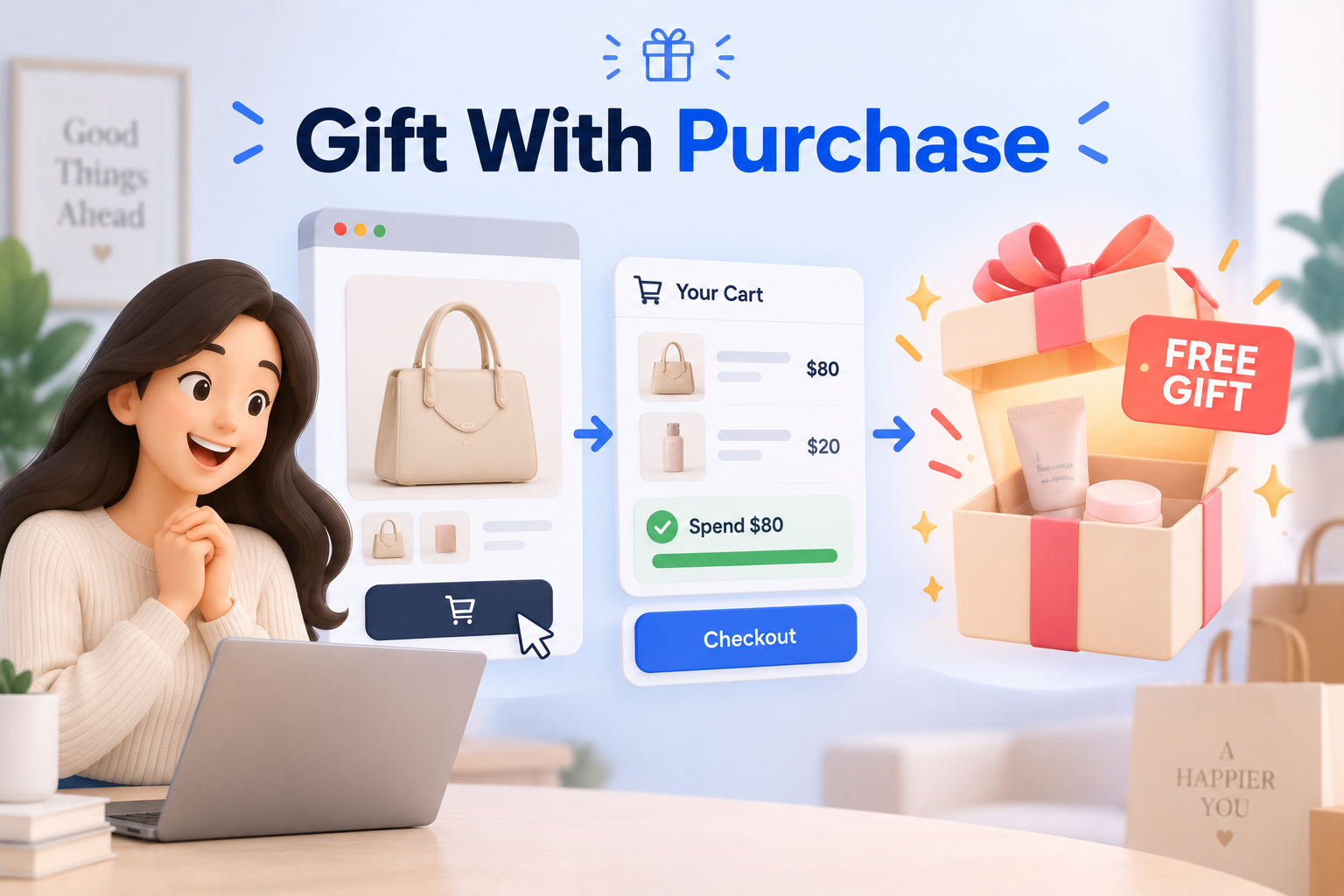
A gift with purchase is a sales promotion where a customer receives a free item or reward once they meet a defined purchase condition, for example “spend $80 and get a free travel-size serum” or “buy any laptop and get a free sleeve”.
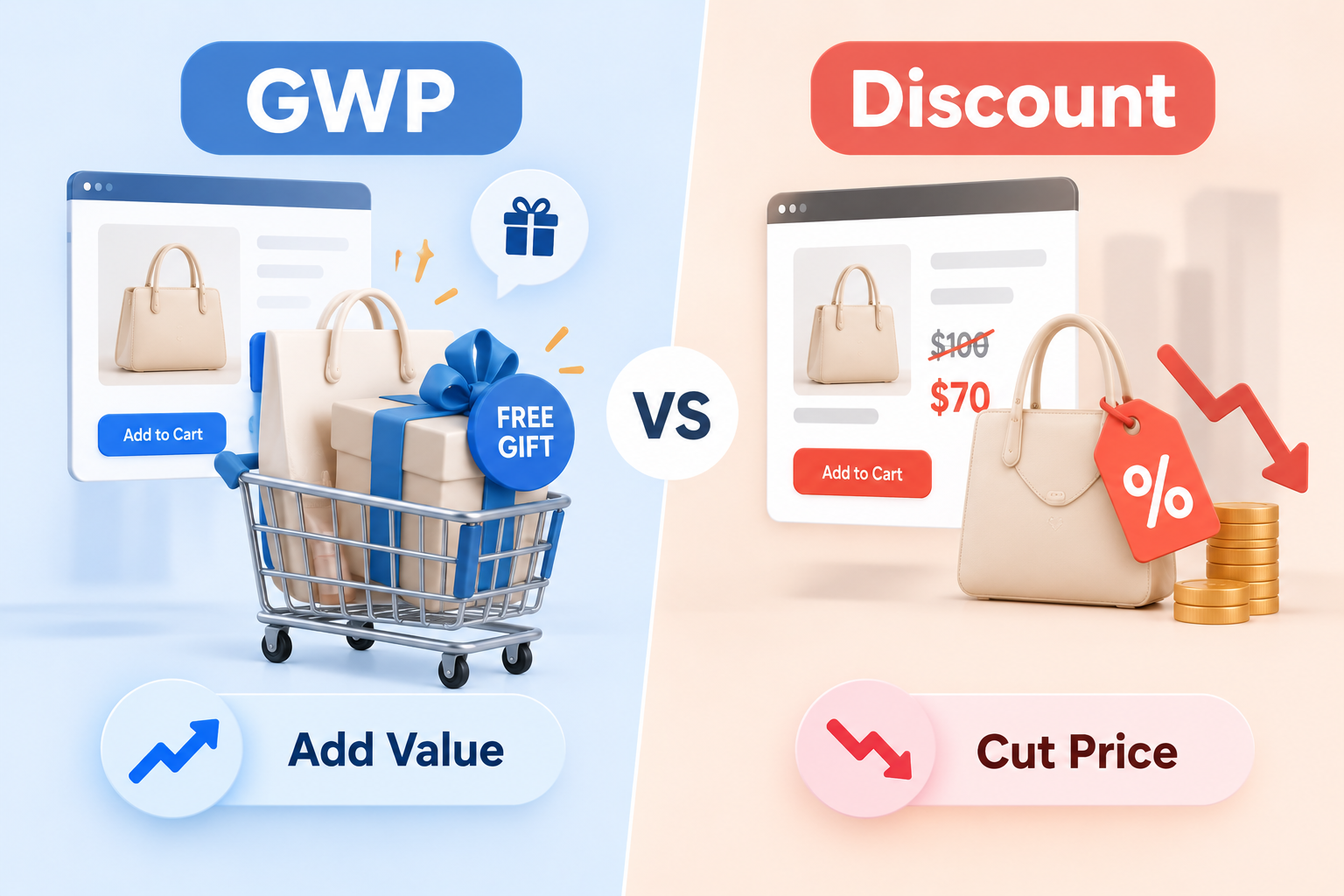
The key difference from a discount is what it does to price. A discount takes money off, which cuts your margin and teaches shoppers your products are worth less than the sticker price. A gift adds something on, so the perceived value of the order goes up while your price stays intact.
The tactic is not new. Estée Lauder is widely credited with pioneering the free gift with purchase from around 1946, when she founded her company, offering a free sample with every purchase to bring customers back. It became standard practice across beauty and then spread to electronics, fashion, and food and beverage, because it kept working.
How does a gift with purchase work?
Every GWP promotion is built from four moving parts. Get these right and the campaign runs itself.
- The qualifying condition. What the customer must do: spend a minimum, buy a specific product, buy a bundle, or belong to a segment (members, new customers).
- The gift logic. What they get, and whether it is fixed, a choice of options, or tiered (spend more, get more).
- The redemption method. How the gift is claimed: added automatically at checkout, unlocked with a code, or gated to a specific audience.
- The controls. Stock limits, one-per-customer rules, expiry dates, and whether the offer can stack with other promotions.
The five steps to running one
- Identify the target audience. Who are you trying to influence: new customers, lapsed buyers, or high spenders? The audience decides the gift.
- Choose the right gift. It must be something they actually want and that relates to what they are buying. A random freebie adds cost, not conversions.
- Set clear terms. Minimum spend, dates, stock limits, and one-per-customer. Ambiguity creates support tickets and disappointed buyers.
- Promote the offer. Put it where it changes behaviour: product pages, the cart (“spend $12 more to get your free gift”), banners, email, and social.
- Deliver the gift. Make fulfilment automatic and reliable. Nothing sours a promotion like a missing gift.
Gift with purchase vs discount
|
Gift with purchase |
Discount |
|
|
Effect on price |
Price stays intact |
Price is cut |
|
Margin |
Costs you the gift’s cost (often low) |
Costs you full discount value |
|
Brand perception |
Adds value, feels premium |
Can cheapen the brand over time |
|
Customer behaviour |
Encourages spending to qualify |
Trains shoppers to wait for sales |
|
Extra benefit |
Drives trial of other products |
None beyond the sale |
This is the strongest argument for GWP: a gift that costs you $5 wholesale can feel worth $25 to the customer, while a $25 discount costs you the full $25 and teaches them to expect it next time.
Types of gift with purchase
|
Gift type |
Best used for |
|
Free sample or travel size |
Product launches, driving trial |
|
Full-size product |
Premium orders, VIP or loyalty rewards |
|
Accessory or bundle item |
Electronics, fashion, complementary add-ons |
|
Exclusive or limited-edition merchandise |
Seasonal campaigns, building hype |
|
Service-based gift |
Free delivery, installation, extended warranty |
|
Tiered gifts |
Spend more, get more, to push order values up |
Tiered gifts are especially effective for lifting average order value, because there is always a reason to add one more item.
Why gift with purchase works for ecommerce brands
- It lifts average order value. A spend threshold gives shoppers a concrete reason to add more to the cart.
- It improves conversion. A free gift is often the nudge that turns a hesitant browser into a buyer.
- It drives product discovery. Samples get customers to try products they would never have selected, which creates future full-price purchases.
- It protects price perception. You add value rather than discounting, so your pricing stays credible.
- It moves inventory. Slow-moving or overstocked items become gifts instead of markdowns.
- It builds loyalty. Customers remember feeling rewarded, which is why beauty brands have run GWP for decades.
- It is margin-friendly. The gift’s cost to you is usually far below its perceived value.
Gift with purchase examples
- Beauty: the category that built the tactic. Estée Lauder, Sephora, and most beauty retailers run “spend $X, choose your free gift” campaigns, often with a branded pouch of samples. It drives both order value and trial of new lines.
- Electronics: a free case, sleeve, or accessory with a device purchase, which raises the perceived value of a high-ticket item without discounting it.
- Food and beverage: branded glassware or merchandise with a purchase, common for spirits brands like Aperol, turning a bottle into a gift-worthy set.
- Fashion: a free tote, pouch, or accessory above a spend threshold, which also doubles as walking advertising.
- Ecommerce generally: free shipping or a free add-on above a cart threshold, one of the most reliable ways to raise average order value.
In Singapore, GWP is especially effective around peak retail moments (11.11, 12.12, Black Friday, festive periods) when shoppers are already comparing offers and a gift stands out more than another percentage off.
Top gift with purchase ideas
- Branded merchandise (tote, pouch, bottle) that customers actually use, giving you ongoing brand exposure.
- A complementary product that pairs naturally with the purchase, which feels thoughtful and increases the chance they buy it next time.
- A limited-edition or seasonal item that creates urgency, because scarcity is what turns “maybe later” into “buy now”.
- A sample set of new products to drive trial and future full-price sales.
- A service upgrade (free express delivery, installation, extended warranty), which costs little but removes a real purchase barrier.
What makes a good GWP strategy
- Keep qualification simple. A customer should understand how to get the gift in one sentence. Complicated rules kill conversions.
- Make the gift relevant. It should relate to what they are buying. Relevance is what makes it feel valuable rather than like clearance.
- Control stacking. Decide upfront whether the gift can combine with other discounts or codes, or your margin can disappear.
- Plan stock properly. Running out mid-campaign creates angry customers. Set limits and communicate them (“while stocks last”).
- Make it visible where it matters. The cart is the highest-leverage place: “You are $12 away from your free gift” is what actually lifts order value.
- Protect the claim route. Use unique codes or gated access if the gift is high-value, so it is not exploited.
- Measure incrementally. Would those sales have happened anyway? That is the question the numbers must answer.
How to measure whether it worked
Track these before, during, and after the campaign:
|
Metric |
What it tells you |
|
Average order value (AOV) |
Whether the threshold pushed spending up |
|
Conversion rate |
Whether the gift closed more sales |
|
Redemption rate |
How many qualifying orders claimed the gift |
|
Incremental revenue |
Sales the promotion actually created |
|
Margin per order |
Whether the gift cost was worth it |
|
Repeat purchase rate |
Whether the gift drove customers back |
The number that matters most is incremental margin, not gross sales. A promotion that lifts revenue while destroying margin is not a win. See our guide to conversion rate optimisation.
Common gift with purchase mistakes
- A gift nobody wants, which adds cost and does nothing for conversion.
- A threshold set too high, so shoppers give up instead of adding to cart.
- Complicated terms that confuse buyers and generate support tickets.
- Running out of stock mid-campaign and disappointing customers.
- Hiding the offer instead of promoting it at the cart, where it changes behaviour.
- Letting it stack with other discounts until the order is unprofitable.
- Not measuring incrementality, so you never learn whether it worked.
Frequently asked questions
What does GWP mean?
GWP stands for gift with purchase. It is a promotion where a customer receives a free item after meeting a condition, usually a minimum spend or buying a specific product.
What is the difference between a gift with purchase and a discount?
A discount cuts your price, reducing margin and training shoppers to wait for sales. A gift adds value on top while your price stays intact, which protects margin and brand perception and can drive trial of other products.
Who started gift with purchase?
Estée Lauder is widely credited with pioneering the free gift with purchase from around 1946, offering a free sample with every purchase. It became standard in beauty and then spread to other industries.
How do I choose the right gift?
Pick something your target customer genuinely wants and that relates to what they are buying, at a cost that stays well below its perceived value. Relevance matters more than expense.
Does gift with purchase work for small businesses?
Yes. It often works better than discounting for smaller brands, because a low-cost gift with high perceived value lifts order value without eroding your margin or your pricing credibility.
Where should I promote the gift?
Everywhere it influences the decision, but the cart matters most. A message like “spend $12 more to unlock your free gift” is what turns the promotion into a higher order value.
Turn promotions into profit
A gift with purchase only pays off if your store makes it easy to qualify, easy to claim, and visible at the right moment. If you want an ecommerce site built to run promotions that lift order value, talk to MediaPlus Digital. Explore our ecommerce website development and Shopify design and development services, or read our guides to improving ecommerce sales and reducing cart abandonment, with PSG support for eligible SMEs.