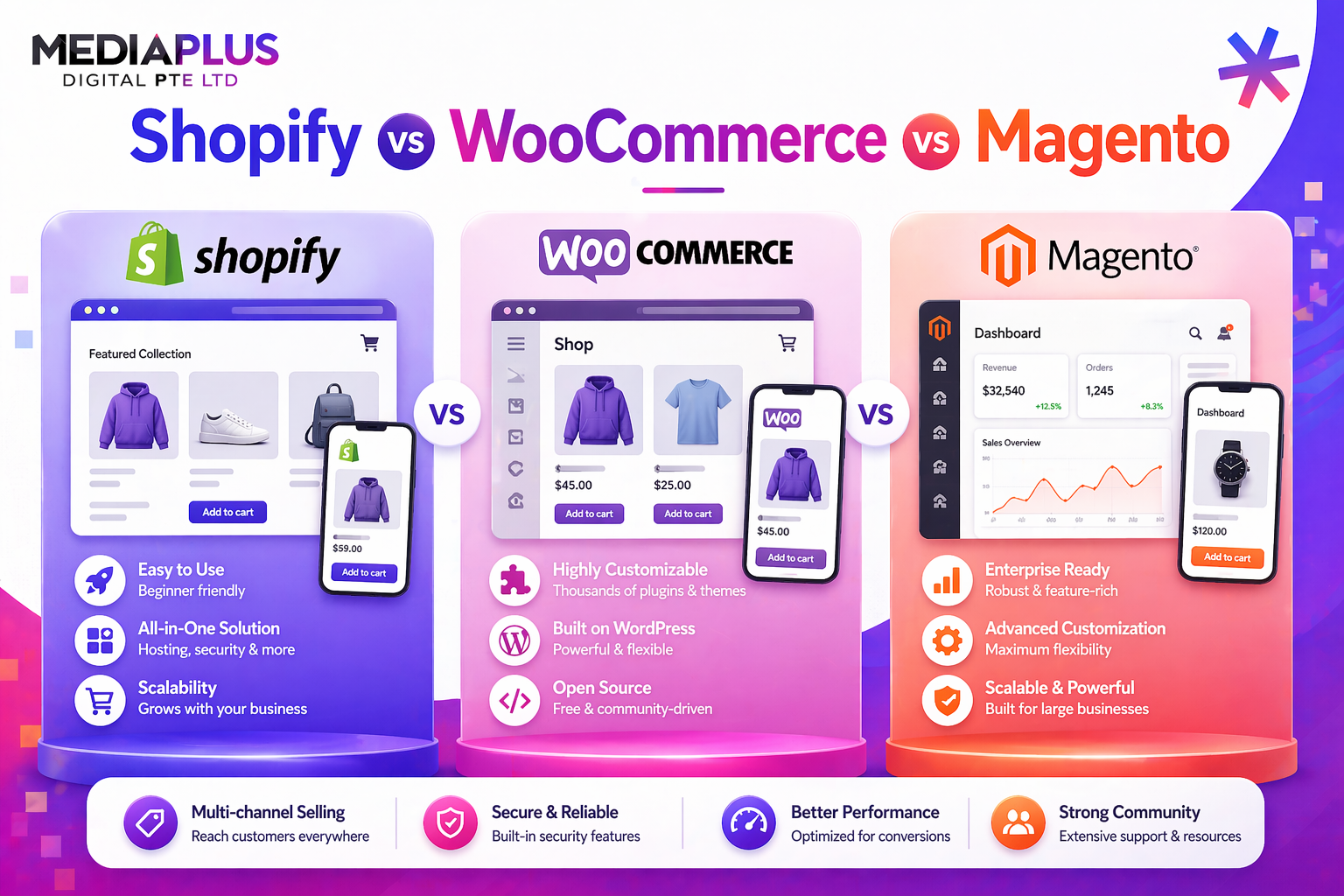
Choosing the wrong ecommerce platform can cost you S$10,000 to S$50,000 in migration costs, months of lost productivity, and missed sales. This guide provides an honest, data-driven comparison of the three leading platforms to help you choose the right one from the start.
Quick Verdict: Which Platform Is Right for You?
|
If You Are… |
Choose |
Why |
|
Small business, new to ecommerce |
Shopify |
Easiest setup, lowest maintenance, everything included |
|
Blogger/content creator selling products |
WooCommerce |
Best content tools, full WordPress ecosystem |
|
Tech-savvy with a developer on hand |
WooCommerce |
Most flexible, lowest ongoing costs, full control |
|
Dropshipping business |
Shopify |
Best app ecosystem for dropshipping (DSers, Spocket) |
|
Mid-to-large business with complex needs |
Magento (Adobe Commerce) |
Most powerful for custom workflows, B2B, multi-store |
|
Enterprise with $1M+ revenue |
Magento or Shopify Plus |
Enterprise features, scalability, customisation |
|
Budget under S$500/month |
WooCommerce |
Lowest running costs with self-hosted setup |
Platform Overview: At a Glance
|
Feature |
Shopify |
WooCommerce |
Magento (Adobe Commerce) |
|
Type |
Hosted SaaS |
Self-hosted (WordPress plugin) |
Self-hosted (open source) / Cloud (Adobe) |
|
Pricing |
S$39 – S$532/month |
Free plugin + hosting (S$15 – S$100/month) |
Free (open source) / S$30K+/year (Adobe Commerce) |
|
Ease of use |
Very easy (no coding) |
Moderate (some tech skills needed) |
Difficult (developer required) |
|
Market share |
28.6% of ecommerce sites |
20.1% of ecommerce sites |
4.9% of ecommerce sites |
|
Themes |
200+ (free and paid) |
11,000+ (free and paid) |
Limited (but fully customisable) |
|
Apps/Extensions |
8,000+ apps |
59,000+ plugins |
6,000+ extensions |
|
SEO |
Good (built-in) |
Excellent (WordPress ecosystem) |
Excellent (full technical control) |
|
Performance |
Fast (managed hosting) |
Depends on hosting quality |
Fast when optimised (resource-intensive) |
|
Scalability |
High (Shopify Plus for enterprise) |
Moderate (hosting-dependent) |
Very high (built for scale) |
|
Security |
Managed by Shopify (PCI Level 1) |
Your responsibility |
Your responsibility |
|
Best for |
Small-medium businesses, beginners |
Content-driven stores, budget-conscious |
Enterprise, B2B, complex requirements |
Pricing and Total Cost of Ownership
Shopify Pricing
|
Plan |
Monthly Cost |
Transaction Fee (without Shopify Payments) |
Best For |
|
Basic |
S$39/month |
2.0% |
New stores, solo entrepreneurs |
|
Shopify |
S$105/month |
1.0% |
Growing businesses |
|
Advanced |
S$399/month |
0.6% |
Scaling businesses with analytics needs |
|
Plus |
From S$2,300/month |
Negotiable |
Enterprise with custom requirements |
Shopify includes hosting, SSL, and security. Hidden costs: premium themes (S$180-$400), premium apps (S$20-$300/month each), and transaction fees if not using Shopify Payments.
WooCommerce Costs
|
Component |
Annual Cost (SGD) |
Notes |
|
WooCommerce plugin |
Free |
Open source |
|
Hosting |
S$180 – S$1,200/year |
Shared to managed WordPress hosting |
|
Domain + SSL |
S$15 – S$50/year |
SSL often included with hosting |
|
Premium theme |
S$60 – S$200 (one-time) |
Quality themes from ThemeForest, Flavor |
|
Essential plugins |
S$200 – S$1,000/year |
SEO, security, backups, performance |
|
Payment gateway |
0% – 2.9% per transaction |
Stripe, PayPal; no platform fee |
|
Total Year 1 |
S$455 – S$2,450 |
Significantly cheaper than Shopify |
Magento / Adobe Commerce Costs
|
Component |
Annual Cost (SGD) |
Notes |
|
Magento Open Source |
Free |
Self-hosted, community edition |
|
Adobe Commerce Cloud |
S$30,000 – S$200,000+/year |
Enterprise licence, managed hosting |
|
Hosting (open source) |
S$1,200 – S$12,000/year |
VPS or dedicated server required |
|
Development |
S$15,000 – S$100,000+ |
Initial setup and customisation |
|
Extensions |
S$500 – S$10,000/year |
Fewer free options than WooCommerce |
|
Maintenance |
S$5,000 – S$30,000/year |
Security patches, updates, optimisation |
3-Year TCO Comparison
|
Scenario |
Shopify |
WooCommerce |
Magento Open Source |
|
Small store (under 100 products) |
S$5,000 – S$8,000 |
S$2,000 – S$5,000 |
S$15,000 – S$30,000 |
|
Medium store (500+ products) |
S$10,000 – S$20,000 |
S$5,000 – S$12,000 |
S$25,000 – S$60,000 |
|
Large store (5,000+ products) |
S$25,000 – S$50,000 |
S$12,000 – S$25,000 |
S$50,000 – S$150,000 |
WooCommerce is cheapest for most stores. Shopify is cheapest when you factor in the value of not needing a developer for maintenance. Magento only makes financial sense at enterprise scale.
SEO Capabilities
|
Feature |
Shopify |
WooCommerce |
Magento |
|
URL structure control |
Limited (forces /products/, /collections/) |
Full control |
Full control |
|
Meta tags and schema |
Built-in + apps |
Full control via Yoast/RankMath |
Full control |
|
Blogging |
Basic |
Excellent (WordPress is the best CMS for content) |
Limited (built-in blog is weak) |
|
Page speed |
Good (managed CDN) |
Depends on hosting and optimisation |
Excellent when optimised |
|
Sitemap generation |
Automatic |
Via plugins |
Built-in or extension |
|
Redirects |
Limited (manual or app) |
Full .htaccess control |
Full control |
|
Winner |
WooCommerce |
WooCommerce wins for SEO because WordPress is the strongest content platform. Shopify is good enough for most stores. Magento offers full technical control but requires expertise. For deep SEO guidance, read our ecommerce SEO guide.
Performance and Speed
|
Metric |
Shopify |
WooCommerce |
Magento |
|
Average TTFB |
200-400ms |
300-800ms (hosting dependent) |
400-1,000ms (before optimisation) |
|
Average page load |
1.3-2.5s |
1.5-4s (varies widely) |
2-5s (before optimisation) |
|
CDN included |
Yes (Shopify CDN) |
No (add Cloudflare or similar) |
No (add CDN separately) |
|
Core Web Vitals |
Generally good |
Requires manual optimisation |
Requires dedicated optimisation |
Shopify wins for out-of-the-box speed because it manages hosting, CDN, and caching. WooCommerce can match Shopify speeds with quality hosting (Cloudways, Kinsta) and caching plugins. Magento requires significant server resources and optimisation expertise.
AI and Automation Features (2026)
AI is becoming a major differentiator between platforms:
|
Feature |
Shopify |
WooCommerce |
Magento |
|
AI product descriptions |
Shopify Magic (built-in) |
Via plugins (AI Content Writer) |
Via extensions |
|
AI-powered search |
Shopify Search & Discovery |
Via Algolia or ElasticSearch plugins |
Adobe Sensei (Commerce Cloud) |
|
Personalised recommendations |
Built-in + apps |
Via plugins |
Adobe Target (Commerce Cloud) |
|
AI chatbot |
Shopify Inbox + third-party |
Via plugins (Tidio, ChatBot) |
Via extensions |
|
Automated marketing |
Shopify Flow (automation builder) |
Via WooCommerce AutomateWoo |
Limited (requires extensions) |
Shopify leads in AI integration for SMEs with Shopify Magic and Flow built into the platform. Adobe Commerce (Magento) has the most powerful enterprise AI through Adobe Sensei. WooCommerce relies on third-party plugins but has the widest selection.
Security
|
Aspect |
Shopify |
WooCommerce |
Magento |
|
PCI DSS compliance |
Level 1 (managed by Shopify) |
Your responsibility |
Your responsibility |
|
SSL certificate |
Included (free) |
Via hosting or Let’s Encrypt |
Via hosting or Let’s Encrypt |
|
Security patches |
Automatic |
Manual (plugin/core updates) |
Manual (community patches) |
|
Fraud protection |
Built-in fraud analysis |
Via plugins |
Via extensions |
|
Winner |
Shopify |
Shopify wins for security by a wide margin because it handles everything: PCI compliance, SSL, patches, and hosting security. WooCommerce and Magento put security responsibility on you, which is fine if you have a developer managing updates, but risky if you do not.
Payment Gateways for Singapore
|
Payment Method |
Shopify |
WooCommerce |
Magento |
|
Credit/Debit Cards |
Shopify Payments (built-in) |
Stripe, PayPal, iPay88 |
Stripe, Braintree, iPay88 |
|
PayNow |
Via third-party app |
Via plugin |
Via extension |
|
GrabPay |
Via Shopify Payments |
Via plugin |
Via extension |
|
Atome (BNPL) |
Via app |
Via plugin |
Via extension |
|
FPX (Malaysia) |
Via app |
Via plugin (iPay88) |
Via extension (iPay88) |
|
Transaction fees |
0% with Shopify Payments; 0.6-2% otherwise |
Gateway fees only (no platform fee) |
Gateway fees only |
All three platforms support Singapore payment methods, but WooCommerce and Magento have zero platform transaction fees (you only pay the payment gateway). Shopify charges additional fees if you do not use Shopify Payments. See our guide on the best payment gateways in Singapore.
Who Should Choose Which Platform?
Choose Shopify If…
- You want the fastest, easiest path to selling online.
- You do not have a developer and do not want to manage hosting or security.
- Your store has fewer than 5,000 products and standard requirements.
- You value reliability over maximum customisation.
- You sell through multiple channels (Instagram, TikTok Shop, in-person POS).
Choose WooCommerce If…
- Content and SEO are central to your strategy (blog-driven ecommerce).
- You want full control over your store with no platform restrictions.
- Your budget is tight and you can handle basic WordPress management.
- You need specific functionality that requires custom plugin development.
- You already have a WordPress website and want to add ecommerce.
Choose Magento If…
- You are a mid-to-large enterprise with complex catalogue and pricing requirements.
- You need B2B features (company accounts, quote workflows, custom pricing).
- You operate multiple stores or brands from one backend.
- You have a dedicated development team or agency.
- Performance at scale (millions of products, high concurrent traffic) is critical.
For help choosing, explore our ecommerce website development services or read about Shopify vs WordPress for a deeper two-way comparison.
Frequently Asked Questions
Which ecommerce platform is best for beginners?
Shopify. It requires no technical skills to set up and manage. Everything is included: hosting, security, payments, and support. You can have a store live within a day.
Which platform is cheapest to run?
WooCommerce. The plugin is free, and hosting costs S$15-S$100/month. With careful plugin selection, you can run a professional store for under S$500/year. However, factor in the value of your time for maintenance.
Which platform is best for SEO?
WooCommerce, because it runs on WordPress, which is the strongest content management system for blogging and SEO. Shopify is good enough for most stores, but its rigid URL structure and limited blogging tools are weaknesses.
Can I switch platforms later?
Yes, but migration is costly and risky. Expect S$2,000-S$15,000 for migration (depending on complexity) and 2-8 weeks of work. SEO rankings can be preserved with proper redirects, but expect temporary fluctuations.
Is Magento still relevant in 2026?
Yes, for enterprise. Magento (Adobe Commerce) powers major brands with complex requirements. It is not suitable for small businesses due to cost and complexity, but for enterprise B2B and multi-store setups, it remains the most powerful option.
Which platform has the best AI features?
Shopify leads for SMEs with Shopify Magic (AI product descriptions, image editing) and Shopify Flow (automation). Adobe Commerce (Magento) has Adobe Sensei for enterprise-level AI personalisation and analytics.
Do I need a developer for WooCommerce?
Not for basic setup and management, but having developer access for custom functionality, performance optimisation, and troubleshooting is recommended. Many agencies offer WooCommerce maintenance plans starting from S$200/month.
Key Takeaways
- Shopify is best for ease of use, managed security, and speed to market. Ideal for SMEs and non-technical founders.
- WooCommerce is best for SEO, content-driven stores, budget-conscious businesses, and maximum flexibility.
- Magento is best for enterprise, B2B, and complex multi-store requirements.
- WooCommerce is cheapest over 3 years for most stores. Shopify is cheapest when you factor in no developer needed.
- All three support Singapore payment methods (PayNow, GrabPay, Atome). WooCommerce and Magento have zero platform transaction fees.
- Choose your platform based on your technical capacity, budget, and growth plans, not just features.
Need Help Building Your Ecommerce Store?
At MediaPlus Digital, we build ecommerce stores on Shopify, WooCommerce, and custom platforms. Our Singapore-based team helps you choose the right platform and build a store optimised for conversions. Explore our Shopify development services, WooCommerce development, or ecommerce solutions.