B2B marketing in Singapore has become more complex and more competitive than ever. According to Forrester, 67% of the B2B buying journey is now self-directed, and the median buying committee for deals over USD 50,000 has grown to 11.2 stakeholders, up from 9.7 in 2024. Buyers consume an average of 13.4 pieces of content before they ever speak to a sales rep, which means a single channel is no longer enough to win.
Singapore sits at the centre of this shift. With 5.78 million internet users (98.4% penetration), more than 4 million LinkedIn members, and over USD 2.79 billion in total advertising spend in 2025 (Statista, DataReportal), it is the most digitally mature B2B hub in Southeast Asia. This guide breaks down the 14 most effective types of B2B marketing used by Singapore brands today, including data, examples, KPIs, budget benchmarks, and where to start.
Need a customised plan? Speak to the team at MediaPlus Digital Marketing Agency Singapore for a free consultation.
B2B Marketing in Singapore at a Glance (2026)
|
Metric |
Value |
Source |
|
Internet penetration |
98.4% |
DataReportal 2026 |
|
Internet users |
5.78 million |
DataReportal 2026 |
|
LinkedIn members in Singapore |
4 million + |
LinkedIn / Hashmeta |
|
Median B2B buying committee |
11.2 stakeholders |
Forrester 2026 |
|
B2B content consumed before sales |
13.4 pieces |
CMI 2026 |
|
Self-directed B2B buying journey |
67% |
Forrester 2026 |
|
B2B marketing budget (median) |
9.1% of revenue |
Gartner CMO Spend 2026 |
|
LinkedIn CPL benchmark in Singapore |
SGD 100 to SGD 150 |
Marketing Agency SG |
|
Total Singapore advertising market |
USD 2.79B |
Statista 2025 |
|
Share of digital ad spend by 2029 |
82% |
Statista 2025 |
1. What Is B2B Marketing in 2026?
B2B (business-to-business) marketing is the practice of promoting products and services from one company to another. Unlike B2C, the buyer is rarely a single person. It is a decision-making unit (DMU) of users, influencers, technical evaluators, finance gatekeepers, and executive approvers. In 2026, Singapore B2B sales cycles run 3 to 12 months on average, and 50% or more of large B2B purchases are now expected to flow through digital self-serve channels (Forrester Predictions 2025).
For marketers, this changes everything. The job is no longer to “generate leads” alone. It is to build awareness, educate the committee, surface intent signals, and remove friction long before sales gets a meeting. That is why the most successful Singapore B2B teams now run 5 to 7 marketing channels in parallel, each tied to a specific stage of the buying journey.
2. Why a Multi-Channel Approach Beats Single-Tactic Strategies
In 2026, no single tactic moves a buyer from awareness to closed-won. LinkedIn alone cannot replace SEO. Cold email cannot replace ABM. Even the best content programme falls flat without paid amplification. Singapore brands that lean on one channel typically see CAC inflate 30 to 60% within 12 months as that channel saturates.
The fix is a layered model. Awareness channels (SEO, LinkedIn organic, PR) build a constant stream of new contacts. Consideration channels (webinars, retargeting, content) educate them. Decision channels (ABM, SEM, sales enablement) close them. Retention channels (email, customer marketing) expand them. The 14 types below populate each layer.
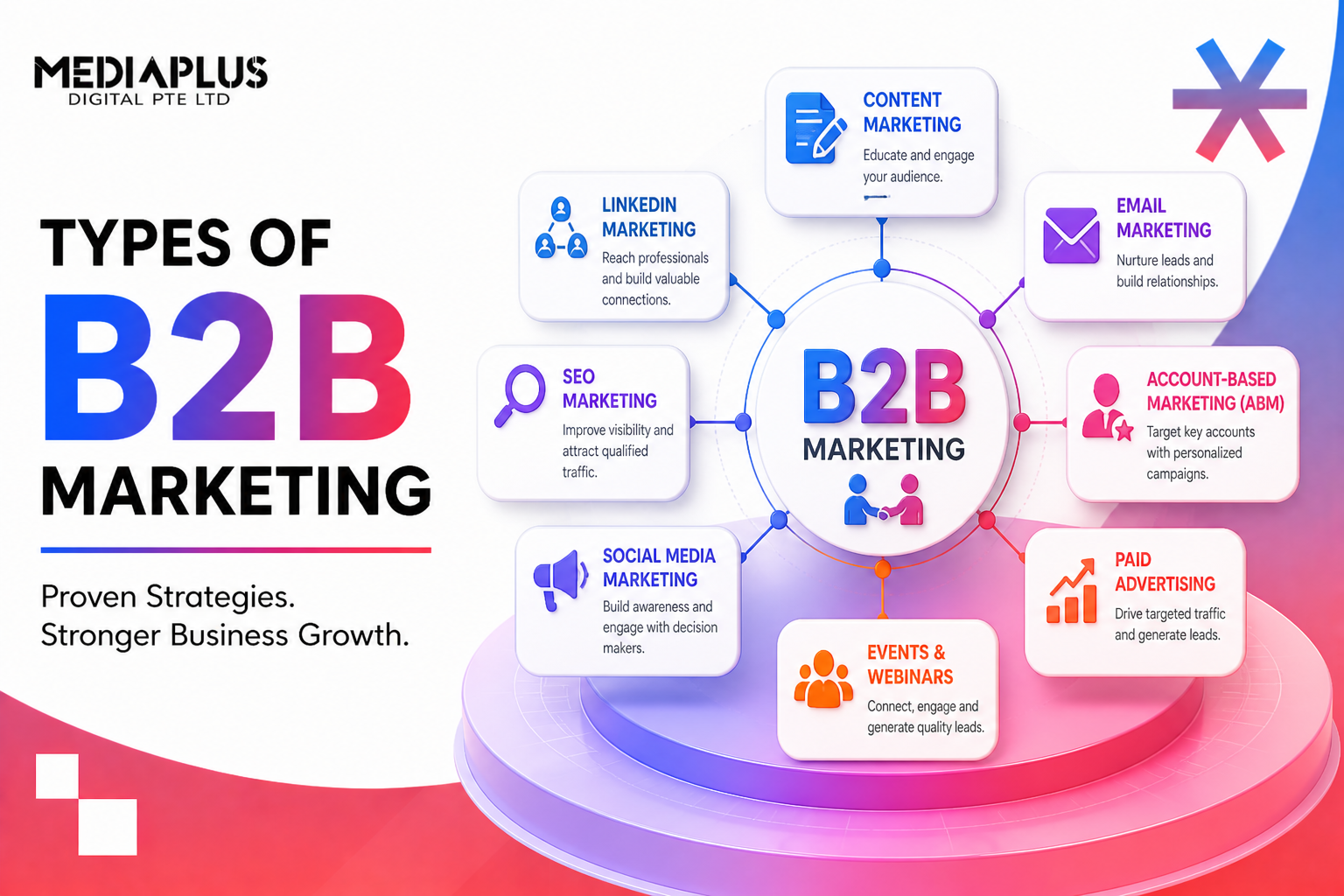
3. The 14 Types of B2B Marketing
3.1 Content Marketing
Content marketing is the foundation of every modern B2B programme. According to the Content Marketing Institute, B2B buyers consume 13.4 pieces of content on average before contacting a vendor, and 70% choose a winner before a sales conversation begins. Whitepapers, case studies, comparison guides, industry reports, and long-form blogs build the authority buyers need to shortlist your brand.
In Singapore, the most effective B2B content programmes follow a hub-and-spoke model. A pillar page anchors a topic, supported by 8 to 15 related articles. This is exactly the approach in our content cluster strategy guide. Pair it with disciplined blogging for SEO to compound traffic for years.
Typical KPIs: organic sessions, time on page, content-assisted conversions, MQLs from gated content, pipeline influenced by specific assets.
3.2 Search Engine Optimization (SEO)
SEO captures buyers at the moment they search Google for solutions. Search advertising is already the largest segment of Singapore digital ad spend at USD 815.6 million in 2025 (Statista), but organic search still drives 53% of all trackable B2B website traffic globally (BrightEdge). Bottom-of-funnel keywords such as “ERP software Singapore” or “managed IT services SME” deliver the highest-value leads at almost zero marginal cost once you rank.
B2B SEO in 2026 is a discipline of three layers: technical SEO, on-page optimisation, and E-E-A-T and topical authority. Read our playbook on how to boost SEO rankings for B2B websites or work with our SEO services in Singapore team.
KPIs: keyword rankings, organic sessions, organic conversions, branded vs non-branded traffic, share of voice in target topics.
3.3 Search Engine Marketing (SEM) and PPC
Paid search captures buyers actively researching solutions. In Singapore B2B, average CPCs range from SGD 4 to SGD 18 for commercial keywords, with conversion rates of 3% to 8% on well-optimised landing pages. Lead costs of SGD 80 to SGD 250 are realistic for mid-funnel offers (demos, audits, free trials).
Combine Google Ads with PPC services, remarketing on the Google Display Network, and B2B-friendly YouTube Ads for a complete paid search funnel.
3.4 Account-Based Marketing (ABM)
ABM treats each high-value account as a market of one. Sales and marketing align around a list of 20 to 200 target companies, then deliver personalised ads, content, and outreach to each one. ITSMA reports that 87% of marketers say ABM outperforms other marketing investments, and Singapore B2B teams running ABM see 2 to 3 times higher win rates and 40% larger deal sizes on average.
Tools to use: 6sense, Demandbase, Bombora for intent data; LinkedIn Matched Audiences for ad targeting; HubSpot or Salesforce for CRM. Start with our complete guide to Account-Based Marketing.
3.5 Email Marketing and Marketing Automation
Email still delivers the highest ROI of any B2B channel, with average returns of USD 36 to USD 42 for every dollar spent (Litmus 2024). In Singapore, B2B open rates average 23% to 32% and click-through rates 2.5% to 4.5% across industries. The biggest gains come from automation: lead scoring, behavioural triggers, and MQL-to-SQL handoff inside HubSpot, Marketo, Pardot, or ActiveCampaign.
Effective B2B email programmes include: welcome sequences (5 to 7 emails), nurture tracks by persona, product or vertical, monthly newsletter with original insight, sales-enabled follow-ups triggered by website behaviour, and re-engagement sequences for cold contacts.
3.6 LinkedIn and Paid Social Media
LinkedIn is the single most important paid channel for B2B in Singapore. The platform has more than 4 million Singapore members, equivalent to roughly two-thirds of the workforce, and 82% of B2B marketers globally report their best performance on LinkedIn (LinkedIn B2B Institute).
Singapore-specific LinkedIn Ads benchmarks (2026): CPC SGD 8 to SGD 18, CPM SGD 35 to SGD 80, average CPL SGD 100 to SGD 150 for sponsored content campaigns, and SGD 250 to SGD 500 for high-value enterprise demo offers. A meaningful test budget starts at SGD 6,000 per month for 50 qualified leads.
Top-performing formats in 2026: thought leader ads, document ads, conversation ads, and lead-gen forms. Layer in retargeting and YouTube via our social media advertising services for full-funnel reach.
3.7 Event and Webinar Marketing
Singapore is the regional capital for B2B events. ATxSG, Tech Week Singapore, the Singapore FinTech Festival, and SaaStock APAC each draw 10,000 to 60,000 attendees. A trade show booth typically costs SGD 25,000 to SGD 80,000 fully loaded, while a 45-minute expert webinar can be produced for SGD 3,000 to SGD 8,000 and generate similar pipeline.
Strong B2B event marketing programmes combine: pre-event targeted ads to known accounts, on-site meeting booking, branded content sponsorships, post-event nurture sequences, and on-demand replay distribution. Webinars typically convert 30% to 45% of registrations to attendees and 5% to 15% of attendees to MQLs.
3.8 Influencer and Industry Analyst Marketing
In B2B, influencer marketing has nothing to do with lifestyle creators. It is about earning credibility with industry analysts (Gartner, Forrester, IDC), niche subject-matter experts, and respected LinkedIn voices. Edelman research shows that 88% of B2B decision-makers say thought leadership is effective for enhancing their perception of an organization, and 54% have purchased a new product or service after reading a thought leadership piece.
Singapore-specific tactics: pursue inclusion in Gartner Magic Quadrants, sponsor IDC research, build long-term relationships with LinkedIn creators in your category, and ghostwrite thought leadership for your CEO or CTO.
3.9 Referral and Partner Marketing
Channel partners, system integrators, resellers, and structured referral programmes extend reach without adding headcount. According to Forrester, partner-influenced revenue accounts for 28% to 76% of total revenue across mature B2B firms. In Singapore, partnerships with associations such as SGTech, the Singapore Business Federation, and industry chambers also unlock high-trust leads at low CAC.
3.10 Public Relations and Thought Leadership
PR builds the authority that paid ads cannot buy. Earned coverage in The Business Times, The Straits Times, e27, Tech in Asia, or DealStreetAsia drives long-term backlinks (helping SEO), attracts inbound partnerships, and improves close rates because prospects encounter your brand before sales calls. Combine media relations with award submissions, contributed articles, and analyst briefings.
3.11 Direct and Outbound Marketing
Cold email, cold calling, SDR outreach, and direct mail to named accounts remain critical for high-value enterprise deals. According to RAIN Group, 82% of buyers accept meetings with sellers who proactively reach out. AI-assisted SDR workflows are now reducing cost per lead by 38% and booking 2.4 times more meetings per rep in 2026 (Salesforce, LinkedIn). Direct mail (high-end packages to C-suite at named accounts) is also making a comeback as digital inboxes saturate.
3.12 Inbound Marketing and Lead Generation
Inbound pulls prospects in through valuable content, SEO, lead magnets, and conversion-optimised landing pages. According to HubSpot, inbound leads cost 61% less than outbound on average and convert 8 to 10 times higher when properly nurtured. Combine inbound with strong conversion rate optimization and our complete guide to lead generation to design a full funnel.
3.13 Programmatic and Display Advertising
Programmatic lets B2B brands reach decision-makers across the open web (display, native, video, CTV) far beyond search and social. With Singapore B2B audiences spending 7 hours+ per day online and 34 hours/month on TikTok alone (DataReportal 2026), programmatic is essential to keep your brand visible. Talk to our programmatic advertising agency for full-funnel campaigns and account-targeted display.
3.14 Product Marketing
Product marketing creates the positioning, messaging, competitive intel, and sales enablement materials that make every other channel work harder. A B2B brand without strong product marketing burns paid budget on weak landing pages and confused sales pitches. KPIs include win rate, sales cycle length, discount rate, and message resonance scores.
4. Channel ROI and Cost Benchmarks for Singapore B2B (2026)
|
Channel |
Typical CPL |
Time to ROI |
Best For |
|
SEO and content |
SGD 30 to SGD 120 |
6 to 12 months |
Long-term inbound demand |
|
Google Ads (SEM) |
SGD 80 to SGD 250 |
1 to 3 months |
Bottom-funnel, intent capture |
|
LinkedIn Ads |
SGD 100 to SGD 150 |
1 to 2 months |
Targeted persona reach |
|
ABM |
SGD 300 to SGD 1,500 per account |
3 to 6 months |
Enterprise, named accounts |
|
Email automation |
SGD 5 to SGD 20 |
1 to 3 months |
Nurture + retention |
|
Webinars |
SGD 60 to SGD 180 |
1 to 2 months |
Mid-funnel education |
|
Trade shows |
SGD 250 to SGD 1,000 |
3 to 9 months |
Brand + relationships |
|
Programmatic |
SGD 80 to SGD 250 |
2 to 4 months |
Awareness + retargeting |
|
Cold outbound (SDR) |
SGD 200 to SGD 600 |
1 to 3 months |
Outbound pipeline |
|
Referrals / partners |
SGD 0 to SGD 100 |
Ongoing |
Trusted, low-CAC pipeline |
5. How to Combine Channels by Buyer Journey Stage
- Awareness: SEO, content marketing, LinkedIn organic, PR, programmatic display, YouTube ads.
- Consideration: Webinars, case studies, comparison content, retargeting, paid social, email nurture.
- Decision: ABM, SEM bottom-funnel keywords, sales enablement, demos, ROI calculators, customer references.
- Retention and Expansion: Customer marketing, advocacy programmes, NPS-driven content, account-based upsell campaigns.
6. Common B2B Marketing Mistakes to Avoid
- Relying on a single channel and then scaling it past saturation, which inflates CAC by 30 to 60%.
- Treating MQLs as a vanity metric instead of tracking pipeline and revenue influenced.
- Running ABM without sales alignment, which produces personalised ads that no salesperson follows up on.
- Underinvesting in SEO and content because results take 6 months, missing 12 months of compounding traffic.
- Letting LinkedIn ad copy default to generic feature lists instead of buyer-pain-led narratives.
- Skipping CRO on landing pages, leaving 30 to 70% of paid traffic uncaptured.
- Forgetting retention: existing customers cost 5 to 25 times less to grow than new logos to acquire.
7. A 90-Day Implementation Roadmap
|
Phase |
Weeks |
Activities |
|
Foundation |
1 to 4 |
Define ICP, target accounts, buyer personas. Audit website, SEO, CRM. Install GA4 + LinkedIn Insight Tag + HubSpot or Salesforce tracking. |
|
Launch |
5 to 8 |
Publish 6 pillar pages and 12 cluster articles. Launch Google Ads on bottom-funnel keywords. Launch LinkedIn Sponsored Content for top 3 personas. Set up email nurture and lead scoring. |
|
Scale |
9 to 12 |
Layer ABM on top 50 named accounts. Run first webinar. Activate retargeting + programmatic. Begin PR and analyst outreach. Review KPIs and reallocate budget. |
8. Frequently Asked Questions
What are the most effective types of B2B marketing in Singapore?
For most Singapore B2B brands, the highest-impact mix is SEO and content, LinkedIn ads, Google Ads, email automation, ABM, and webinars. Together these channels cover 80% of the buying journey for typical SaaS, IT, finance, and professional services companies.
How much should a Singapore B2B firm spend on marketing?
Gartner reports a median B2B marketing budget of 9.1% of revenue in 2026, with high-growth firms investing 12 to 18%. For a SGD 5 million company, this works out to SGD 450,000 to SGD 900,000 per year, with 60 to 80% allocated to digital channels.
How long before B2B marketing produces results?
Paid channels (Google Ads, LinkedIn) can produce qualified leads within 14 to 30 days. SEO and content marketing usually need 3 to 6 months to gain momentum and 12 months to compound. ABM typically delivers first opportunities within 60 to 90 days.
Is LinkedIn really worth it for Singapore B2B?
Yes. With more than 4 million members and 82% of B2B marketers reporting LinkedIn as their top-performing channel, it is the most concentrated source of decision-makers in the region. Expect a CPL of SGD 100 to SGD 150 with a budget of SGD 6,000+ per month.
Should I do all 14 types of B2B marketing?
No. Most successful Singapore B2B teams run 5 to 7 channels at once, chosen by ICP and buyer journey. Start with SEO + content + LinkedIn + email + Google Ads, then add ABM, webinars, and partner marketing as you scale.
What is the difference between inbound and ABM?
Inbound attracts a broad pool of prospects through content and SEO. ABM targets a specific list of high-value accounts with personalised campaigns. The two are complementary, not competing, and most enterprise B2B teams now run both.
9. Conclusion and Next Steps
B2B marketing in Singapore in 2026 is a multi-channel discipline. The brands that grow fastest combine long-term assets like SEO and content with short-term performance channels like Google Ads, LinkedIn, and ABM. They measure pipeline rather than vanity metrics and reallocate budget every quarter. Above all, they treat the buying committee as the customer, not the buyer alone.
If you would like a tailored 90-day plan or a complete B2B marketing audit, talk to MediaPlus Digital. From SEO and SEM to Account-Based Marketing and social media advertising, we help Singapore B2B brands turn marketing into measurable revenue. Browse more on the MediaPlus blog.