
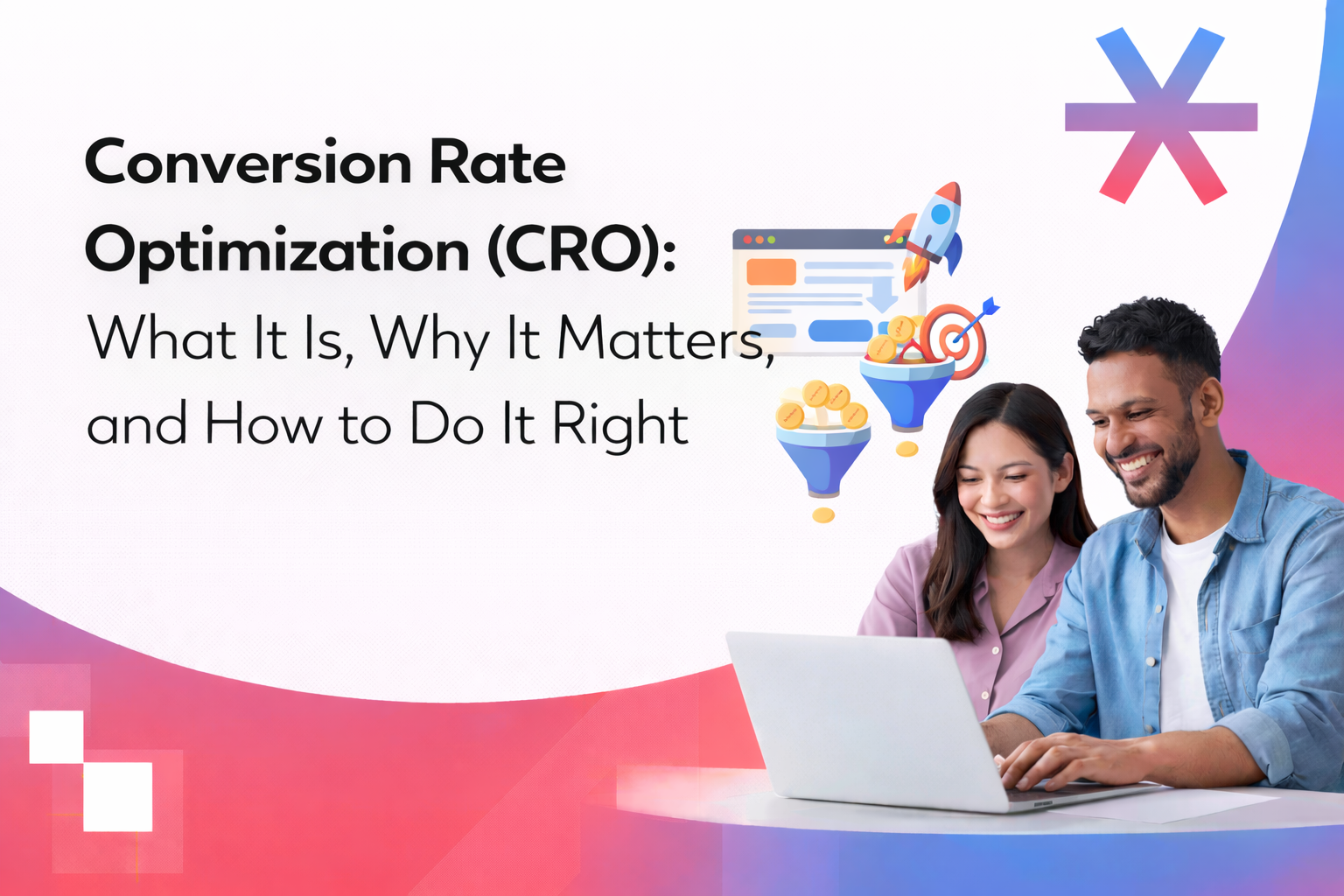
You’ve invested time and money into bringing visitors to your website but are they actually converting? Whether you’re running ads, optimizing for SEO, or managing email campaigns, the true measure of success lies in how effectively your website turns visitors into customers.
This is where Conversion Rate Optimization (CRO) comes in. In this guide, we’ll break down what CRO means, why it matters, and how you can start optimizing your site for more sales, leads, and engagement all without spending more on traffic.
What Is CRO?

Conversion rate optimization, or CRO, is the process of increasing the percentage of visitors who take a meaningful action on your website. That action could be making a purchase, adding a product to the cart, signing up for a trial, or submitting a form.
At its core, CRO is about improving how users experience your site. Instead of driving more traffic, it focuses on helping existing visitors complete what they came to do by reducing friction, clarifying intent, and making key actions easier and more compelling.
Why you should take a customer-centric approach to CRO
Many conversion rate optimization strategies focus almost entirely on numbers. Percentages, benchmarks, averages, and uplift charts tend to dominate CRO conversations. While improving conversion rates is the goal, a purely numerical mindset has limits.
The more you stare at spreadsheets and dashboards, the easier it is to forget that every data point represents a real person making a real decision.
A customer-centric approach to CRO shifts the focus from metrics to motivation. Instead of asking only what users are doing, it asks why. What are they trying to achieve? What’s creating hesitation? What builds enough confidence for them to take the next step?
When you understand what drives, blocks, and persuades people, conversion improvements stop being guesswork. They become a natural outcome of better experiences.
With that in mind, let’s walk through six practical steps to start building a customer-centric CRO strategy.
Why Conversion Rate Optimization Matters for Businesses
Conversion rate optimization, or CRO, is about getting more value from the traffic you already have. Instead of spending more money to bring in new visitors, you focus on helping existing visitors take action.
With a solid CRO strategy, you can:
-
Increase revenue per visitor
-
Lower customer acquisition costs
-
Get more value from your current users
-
Convert more visitors into customers and grow sustainably
Here’s a simple example.
A landing page gets 2,000 visitors per month and converts at 10 percent. That means 200 conversions. If you improve the page and raise the conversion rate to 15 percent, conversions jump to 300. That’s a 50 percent increase without adding a single new visitor.
In digital marketing, there’s always room to improve how people move through your site. The strongest companies don’t treat conversion rates as fixed numbers. They continuously test, learn, and refine their websites and apps to create smoother experiences and drive better results.
What makes an effective CRO strategy
A strong CRO approach usually combines several core elements:
-
User research: Deeply understanding what your audience needs, expects, and struggles with.
-
Website analytics: Tracking and analyzing real user behavior to spot patterns and problems.
-
User experience design: Making interactions clear, intuitive, and enjoyable.
-
Landing page optimization: Improving key entry points so visitors immediately understand the value.
-
Copywriting: Writing clear, persuasive messages that guide users toward action.
-
Page load speed: Ensuring pages load quickly on all devices, especially mobile.
-
Trust building: Using social proof, reviews, and credibility signals to reduce hesitation.
-
Conversion funnel analysis: Identifying where users drop off and fixing those weak points.
-
Mobile optimization: Delivering a seamless experience across phones, tablets, and desktops.
At its core, CRO is not about tricks or hacks. It’s about understanding people better and designing experiences that make it easier for them to say yes.
Businesses partnering with MediaPlus Digital often see CRO as part of a full-funnel marketing strategy. By improving landing pages, ad performance, and UX design, MediaPlus helps clients achieve measurable conversion uplifts across both B2B and ecommerce sites.
A User-Centric Approach to CRO
Traditional CRO focuses heavily on numbers but the best results come from understanding the people behind the data.
A user-centric CRO strategy examines what drives, stops, and persuades users to act. The goal isn’t just to push conversions; it’s to create smoother, more satisfying experiences that naturally guide users toward action.
Here’s how you can adopt a customer-first CRO mindset:
-
Understand user intent – What are they trying to achieve?
-
Identify pain points – What’s confusing or frustrating them?
-
Provide clarity – Make CTAs clear and navigation intuitive.
-
Earn trust – Display reviews, credentials, and guarantees.
-
Deliver value quickly – Help users reach their goals with minimal friction.

CRO quick start guide: 6 steps for success
Effective CRO always starts with the same principle: understand your customers first, then optimize around what you learn.
It’s tempting to jump straight into tactics and tools, but conversion gains come from insight, not shortcuts. When you understand what users are trying to achieve, what slows them down, and what gives them confidence, optimization becomes much more straightforward.
Below is a practical six-step framework to help you move from raw data to meaningful conversion improvements.
Step 1: identify your most important conversions
A conversion is the action you want more users to take. What qualifies as a conversion depends entirely on your business and your goals.
For an ecommerce site, that might be a completed purchase or an add-to-cart action.
For a SaaS product, it could be a free trial signup or demo request.
For a content-driven site, it might be a newsletter subscription or account creation.
The key is focus. Choose the actions that actually move your business forward and optimize around those, rather than trying to improve everything at once.
Once you define the action, you can start optimizing the rate at which users complete it, your conversion rate.
How to calculate your conversion rate
The calculation is simple:
(Number of conversions ÷ Number of visitors) × 100
For example, if a page receives 450 visitors in a month and generates 18 purchases, the conversion rate is 4%.
Most analytics tools handle this automatically, but understanding the math helps you interpret results and spot real improvement versus noise.
A quick word on “average” conversion rates
You’ll often see average conversion rates quoted somewhere between 1% and 4%. In reality, this number has limited value.
That’s because:
-
Every website, audience, and page is different
-
Most companies don’t publish accurate conversion data
-
Conversion rates vary widely depending on the action being measured
Benchmarks can provide loose context, but they shouldn’t guide strategy. The only number that truly matters is whether your conversion rate is improving over time for the right reasons.
Step 2: analyze your conversion funnel
Next, examine the full path users take toward conversion. This is known as funnel analysis.
The goal is to understand where users drop off and which steps create friction before the final action.
Funnel analysis helps answer questions like:
-
Which pages see the biggest exits?
-
At what step do users hesitate or abandon?
-
Are there differences across devices, traffic sources, or user segments?
Looking at each step in isolation often reveals issues that are invisible when you only focus on the final conversion rate.
Step 3: gather user data and context
Once you identify drop-off points, move beyond the numbers and focus on understanding user behavior.
This is often the most important step in CRO.
Sometimes the problem is obvious, such as a bug or broken flow blocking users from converting. Other times, everything works technically, yet users still don’t act. When that happens, the only way forward is to understand why.
Before any conversion happens, three forces are always at play:
-
Drivers that bring users to your site
-
Barriers that push them away
-
Hooks that persuade them to act
Drivers: what brings users in
Drivers are the motivations that lead users to your site in the first place.
These may include search intent, ads, referrals, recommendations, or offline influences like word of mouth. Traffic analysis and user research help clarify what users are trying to accomplish when they arrive.
Organizing this insight into clear user goals or personas helps keep optimization efforts aligned with real needs rather than assumptions.
Barriers: what gets in their way
Barriers are anything that creates friction, confusion, or frustration.
Behavioral analysis is especially valuable here. Observing where users hesitate, rage-click, abandon forms, or miss important elements helps identify issues that numbers alone cannot explain.
Patterns matter more than individual sessions. Repeated friction in the same areas is a strong signal that something needs to change.
Hooks: what convinces them to convert
Hooks are the reasons users decide to move forward instead of leaving.
The most reliable way to uncover them is to talk to users who already converted. Ask what persuaded them, what reassured them, and what almost made them leave.
Surveys and interviews often surface insights about messaging, trust signals, pricing clarity, or timing that directly inform better design and content decisions.
Step 4: create hypotheses
With user insights in hand, the next step is to turn them into clear hypotheses.
A good hypothesis connects a problem to a proposed change and a measurable outcome. For example:
“If we clarify pricing earlier in the funnel, more users will complete checkout.”
You don’t need to get this perfect. CRO is iterative by nature. Hypotheses exist to be tested, not proven right on the first attempt.
Step 5: test your hypotheses
Testing is where ideas meet reality.
A/B testing is a common way to evaluate changes, whether that means adjusting copy, layout, flow, or visual hierarchy. Quantitative data tells you what changed, while qualitative insights help explain why it changed.
Not every test will win, and that’s expected. The goal is learning, not perfection.
Step 6: review, learn, and iterate
CRO does not end after a single test.
Review the results, understand the impact on user behavior, and decide what to keep, refine, or discard. Over time, small improvements compound into meaningful gains.
The strongest CRO programs are continuous. They evolve as users, products, and markets change.
When you consistently combine data, user insight, and experimentation, conversion improvements become a natural outcome of better experiences, not forced optimizations.
Conversion Rate Optimization Examples
Conversion rate optimization is all about small, smart changes that make it easier for users to take action. Below are real-world style examples that show how CRO works in practice.
1. Improving a landing page headline
A landing page was getting traffic but visitors were bouncing quickly. The original headline focused on features instead of outcomes.
After rewriting the headline to clearly state the main benefit and who it’s for, conversions increased by 20 percent.
Lesson: clarity beats cleverness every time.
2. Simplifying a signup form
A SaaS website required users to fill out 8 fields to create an account. By reducing the form to just email and password, signups increased by 35 percent.
Lesson: fewer steps mean less friction.
3. Adding social proof
An ecommerce product page had strong traffic but low add-to-cart rates. Adding customer reviews, star ratings, and a short testimonial near the call-to-action increased conversions by 18 percent.
Lesson: people trust people more than brands.
4. Optimizing call-to-action buttons
A button that said “Submit” was replaced with more action-oriented copy like “Get My Free Trial.” The color was also adjusted to stand out more on the page.
Result: click-through rate increased by 25 percent.
Lesson: words and visibility matter.
5. Improving page load speed
A mobile landing page took over 5 seconds to load. After compressing images and cleaning up unnecessary scripts, load time dropped to under 2 seconds.
Conversions on mobile increased by 30 percent.
Lesson: speed is a conversion factor.
6. Making pricing clearer
A pricing page caused confusion because plans were poorly explained. By adding short descriptions, highlighting the most popular plan, and answering common questions below the pricing table, conversions increased by 22 percent.
Lesson: reduce uncertainty before users have to ask.
7. Optimizing for mobile users
An ecommerce site designed mainly for desktop had small buttons and hard-to-read text on mobile. After redesigning the layout for thumbs and smaller screens, mobile conversions increased by 40 percent.
Lesson: mobile optimization is no longer optional.
8. Using exit-intent offers
Visitors were leaving a page without converting. An exit-intent popup offering a small discount or free resource captured email leads that would have been lost.
Result: lead capture rate increased by 15 percent.
Lesson: the last moment still matters.
Pairing these practices with services like SEO, SEM, and UX design creates compounding benefits. At MediaPlus Digital, conversion optimization is often integrated with social media ad campaigns and search engine marketing to create full-funnel growth.

CRO best practices
Strong CRO results don’t come from guesswork. They come from deliberate action, testing, and a clear understanding of how real people behave on your site. Below are practical CRO best practices you can start applying right away.
-
Know your audience first: Study your users and traffic sources. Understand what they’re trying to achieve, where they get stuck, and what problems they want solved. Good CRO starts with empathy, not tools.
-
Use clear, intentional CTAs: Your call to action should match the visitor’s level of readiness. Don’t rush people into buying too early. Guide them step by step with CTAs that feel natural and relevant.
-
Keep each page focused: Avoid cramming too much information onto one page. Every page should have a single goal and lead users toward one clear next step.
-
Optimize for mobile experiences: Make sure your site works flawlessly on mobile devices. Buttons should be easy to tap, text should be readable, and all CTAs and forms must function properly.
-
Improve page load speed: Slow pages kill conversions. Reduce load times by optimizing images, scripts, and overall performance to keep users engaged and lower bounce rates.
-
Build trust visibly: Add trust signals such as customer testimonials, case studies, reviews, security badges, and recognizable logos. These elements reduce hesitation and increase confidence.
-
Personalize where it makes sense: Tailor content, messaging, or product recommendations based on user behavior, location, or past interactions. Relevance drives action.
-
Use heatmaps to spot friction: Analyze where users click, scroll, or stop engaging. Use these insights to fix weak areas and strengthen sections that already perform well.
Common CRO Tools and Techniques
If you’re ready to begin testing, here are some industry-favorite tools:
-
Google Optimize (free) – A/B testing tool for small to medium sites
-
Hotjar or Crazy Egg – Heatmaps and session recordings
-
Optimizely / VWO – Advanced experimentation platforms
-
Google Analytics 4 (GA4) – Funnel tracking and user behavior insights
Combine at least one behavioral tool with one analytics platform to gain both the “what” and the “why” behind user actions.
Conversion Rate Optimization Services in Singapore by MediaPlus Digital
If you’re ready to turn insights into measurable growth, MediaPlus Digital’s Conversion Rate Optimization services help businesses in Singapore identify bottlenecks, test new ideas, and achieve higher ROI across every digital channel.
Unlike standard analytics or ad agencies, MediaPlus combines data-driven UX design, SEO & SEM strategy, and CRO experimentation to deliver real-world results.
Our CRO process includes:
-
In-depth website and funnel audits
-
A/B and multivariate testing
-
Form and CTA optimization
-
Heatmap and behavioral analytics
-
Landing page redesign for higher engagement
By integrating CRO with SEO and Social Media Ads, MediaPlus helps brands convert visitors into loyal customers faster without increasing ad spend.
Whether you manage an ecommerce store, B2B site, or service-based business, CRO ensures that every click leads closer to conversion.
FAQs
Q: How long does it take to see CRO results?
Typically 2–6 weeks per A/B test, depending on your traffic volume and goals.
Q: What’s a good conversion rate?
The average website conversion rate is between 2%–5%, but it varies by industry and offer type.
Q: Do I need technical skills for CRO?
Not necessarily. Many tools now offer visual editors. However, expert CRO agencies like MediaPlus can handle technical testing setup and data analysis.
Q: Is CRO only for ecommerce?
No. CRO applies to any digital goal from lead generation to event sign-ups.



![What Is a Native App? Definition, Examples and Guide [2026]](https://mediaplus.com.sg/wp-content/uploads/2026/04/4-2.png)
