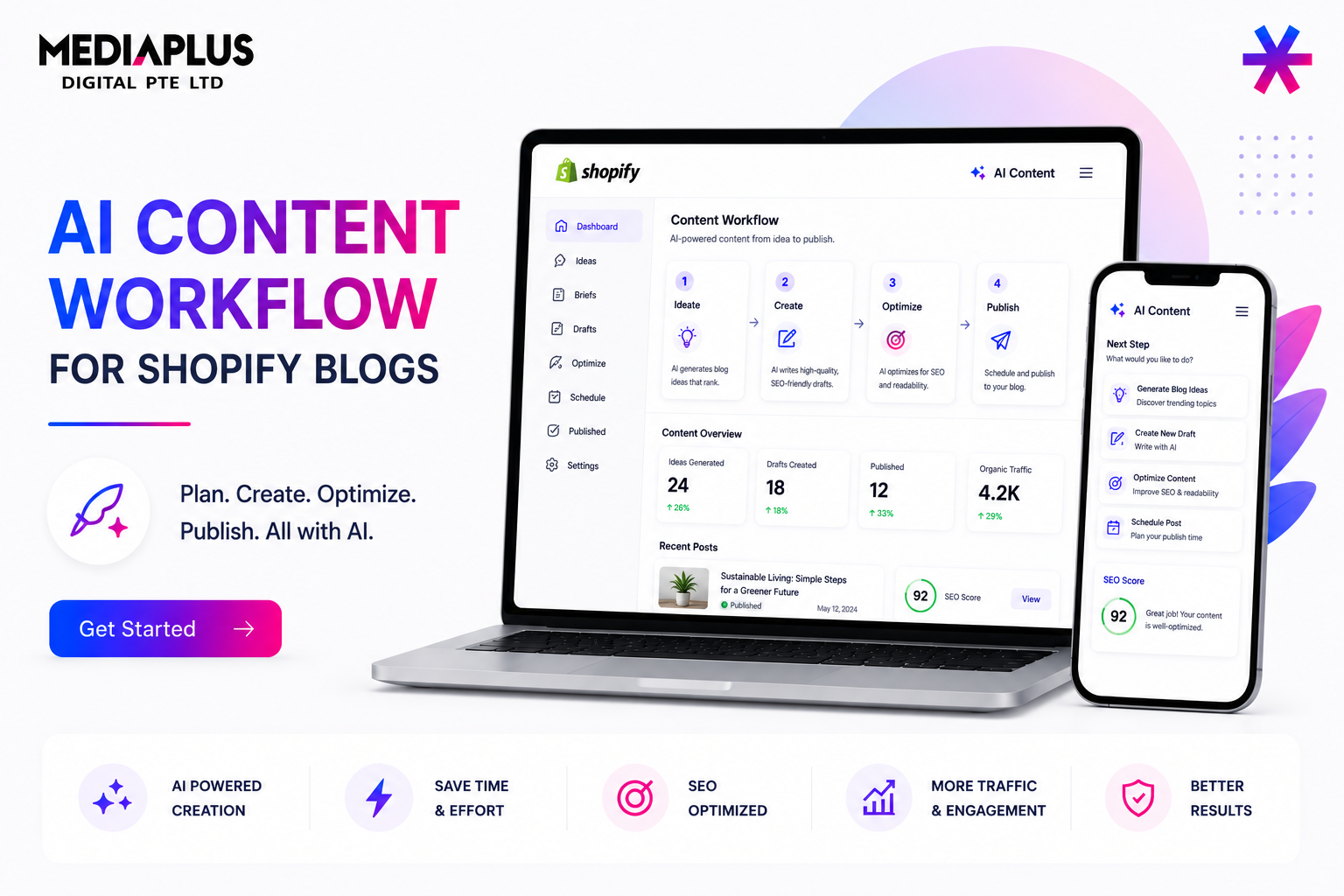
AI can generate a blog post in seconds, which is exactly why so many Shopify blogs now sound the same. Content that ranks well and earns citations from AI search engines requires a workflow where AI handles research and drafting while humans own strategy, expertise, and final quality control.
This guide outlines a complete Shopify blog workflow, from research and briefing through publishing and performance tracking.
Where AI Fits and Where It Does Not
AI works best as a research and drafting assistant. It should not replace content strategy, subject matter expertise, or editorial review.
One common problem is that AI-generated content often removes the experience and expertise signals that help establish trust. Human editors need to add these elements back into the final article.
Step 1: Research and Intent Mapping
Start with search demand and customer questions rather than topics chosen purely by preference.
- Create topic clusters instead of isolated blog posts using a structured content cluster strategy.
- Use keyword mapping to align content with buyer intent and site structure.
- Conduct keyword research using Ahrefs, Semrush, or similar tools.
- Use AI to expand primary keywords into related questions and supporting topics.
- Review top-ranking competitors manually to identify content expectations.
Step 2: Build a Detailed Content Brief
The quality of the brief has a major impact on the quality of AI-generated output.
Include:
- Brand voice guidelines
- Target audience and buying stage
- Unique value proposition
- Detailed H2 and H3 structure
- Target word count
- Primary and secondary keywords
- Restricted phrases, jargon, and banned terms
A reusable brief template helps maintain consistency across all content.
Step 3: Draft in Sections
Generate content section by section rather than requesting an entire article in a single prompt.
Section-based drafting produces tighter content, better alignment with the brief, and easier editing.
Shopify Magic can assist with shorter content blocks, while long-form articles are usually easier to manage in dedicated AI writing tools.
Step 4: Human Review and E-E-A-T Enhancement
This stage often determines whether content performs well in search.
Add elements AI cannot reliably provide:
- Firsthand experience through real examples and observations.
- Original insights including proprietary data, screenshots, and case studies.
- Named authorship with a credible author profile.
- Expert commentary from qualified sources.
Review every paragraph and ask whether it contributes unique value. Remove generic filler wherever possible.
For more guidance, see our article on E-E-A-T and topical authority.
Step 5: Fact-Check Every Claim
AI systems can generate inaccurate information with confidence.
Verify every statistic, claim, date, and technical detail against authoritative sources before publishing.
This step is especially important for health, finance, legal, compliance, and product-related topics.
Step 6: Humanise the Content
- Replace passive constructions with active language.
- Remove unnecessary jargon.
- Vary sentence structure and pacing.
- Run plagiarism checks.
- Have a second editor review the article where possible.
The goal is not to pass AI detection tools. The goal is to create content readers trust.
Step 7: Optimise for SEO and AEO Together
| SEO | AEO |
|---|---|
| Keyword-focused meta title and description | Direct-answer FAQ section |
| Internal links to products, collections, and pillar pages | FAQPage schema markup |
| Descriptive image alt text | Question-based headings |
| Logical heading hierarchy | Fact-rich and quotable content |
Learn more about structured data in our Shopify schema and structured data guide.
For broader AI search optimisation, see our Shopify AEO optimisation resource.
Step 8: Publish in Shopify
- Go to Online Store → Blog Posts.
- Click Create Blog Post.
- Paste and format the finished content.
- Select a real author profile.
- Add a featured image and descriptive alt text.
- Configure the search engine listing title and meta description.
- Add tags and assign the correct blog category.
- Create internal links to relevant products, collections, and related articles.
- Use scheduled publishing if required.
- Validate the published page using Google Rich Results Test.
Step 9: Measure and Improve
- Monitor rankings in Google Search Console.
- Track organic traffic in Shopify Analytics.
- Measure AI referral traffic and visibility using the techniques covered in our AI Overview traffic tracking guide.
- Refresh content periodically to maintain rankings.
Editorial QA Checklist
- Content matches the approved brief.
- All facts and statistics are verified.
- Original experience or data has been added.
- A named author is assigned.
- Meta title and description are optimised.
- Internal links are included.
- FAQ content is present where appropriate.
- Image alt text is completed.
- Plagiarism checks are passed.
- Schema validation has been completed.
Where This Fits for a Singapore Store
For lean ecommerce teams, this workflow enables consistent publishing without sacrificing quality.
The elements that create differentiation, including firsthand experience, local examples, original insights, and expert authorship, are also the signals most likely to earn trust from both readers and AI systems.
Our AI SEO services in Singapore and Shopify SEO services help businesses implement this process at scale.
For foundational guidance, see our article on blogging for SEO.
For prompt ideas, explore AI prompts every Singapore marketing team should save.
FAQ
Will Google penalise AI-written blog posts?
No. Google evaluates content quality rather than whether AI assisted in creating it.
What is the most important human contribution?
Adding E-E-A-T signals such as firsthand experience, original insights, expert review, and fact-checking.
How do I schedule a Shopify blog post?
Set the Visibility option to a future publish date instead of publishing immediately.
Should I generate an entire article at once?
Section-by-section drafting generally produces stronger content and simplifies editing.
Want a Shopify blog that ranks on Google and gets cited by AI systems? Our AI SEO team in Singapore can manage the entire brief-to-publish workflow.