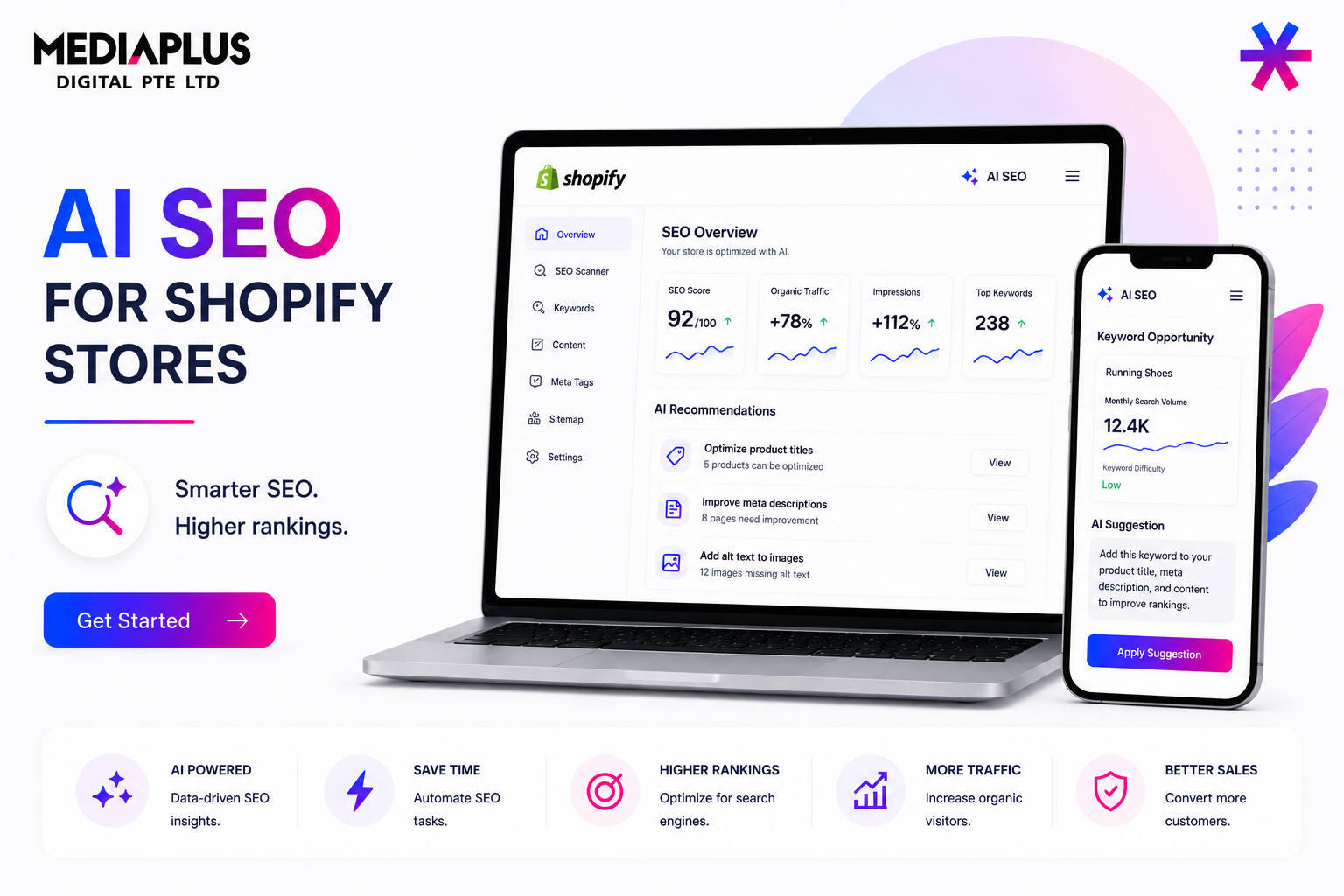
Most AI SEO guides for Shopify stop at “use ChatGPT to write descriptions.” That misses the part that actually determines rankings: how Shopify’s URL structure, canonical tags, and thin collection pages interact with AI-assisted content.
This guide combines both sides of the equation. You’ll learn how to use AI on product, collection, and blog pages while avoiding the Shopify SEO issues that prevent pages from ranking.
Where AI Helps and Where It Does Not
AI is a strong assistant in the middle of the workflow, but it is not a substitute for strategy or quality control.
Google allows AI-assisted content. What it penalises is content created solely to manipulate rankings, regardless of whether AI was involved.
| Use AI For | Keep Human-Led |
|---|---|
| Keyword and topic research at scale | SEO strategy and prioritisation |
| Drafting product and collection content | Fact-checking specifications and claims |
| Title tag and meta description variations | Brand voice and final editing |
| Alt text suggestions | Technical SEO decisions |
| Internal linking suggestions | Canonical and indexation management |
Product Page Optimization
Product pages rank and convert when they answer buyer questions rather than simply repeating product specifications.
- Lead with the buyer’s problem. Start with who the product is for and the problem it solves before listing features. Use Shopify Magic to create a first draft, then add genuine product details.
- Never reuse manufacturer descriptions. Supplier content is duplicated across multiple retailers and weakens uniqueness signals.
- Write metadata intentionally. Create keyword-focused titles and persuasive meta descriptions that encourage clicks.
- Add descriptive image alt text. Include product names and important attributes where relevant.
- Use internal links. Link to related collections and complementary products.
- Add FAQ content. Include real customer questions and implement FAQ schema where appropriate. See our guide to Shopify schema and structured data.
Collection Page Optimization: The Most Common Weak Point
Collection pages are often the biggest SEO weakness on Shopify stores. Many target high-value commercial keywords but contain little or no useful content.
A strong collection page should include:
- A 150 to 250-word category description explaining the category, differentiators, and buying considerations.
- A clear H1 heading aligned with the primary target keyword.
- Breadcrumb navigation to support hierarchy and structured data.
- A category-level FAQ section covering sizing, materials, shipping, and care questions.
- Internal links to related collections and supporting blog content.
If your collection pages are thin, improving them is often the fastest SEO win available.
Shopify URL and Canonical Mechanics That Affect Indexation
This is where many AI SEO guides stop, even though it is often where rankings are won or lost.
Shopify exposes products through two URL structures:
/products/product-handle/collections/collection-name/products/product-handle
Shopify automatically applies canonical tags to point collection-based product URLs back to the clean product URL.
However, several SEO issues still require attention:
| Issue | Why It Matters | Recommended Fix |
|---|---|---|
| Internal links using collection-based product URLs | Can waste crawl budget and create duplicate URL signals | Use clean product URLs whenever possible |
| Filtered and sorted collection URLs | Create near-duplicate collection pages | Use canonicalisation or noindex directives where appropriate |
| Variant and tracking parameters | Fragment ranking signals across multiple URLs | Never canonicalise parameterised URLs |
Remember that canonical tags are hints rather than commands. Strong internal linking and valuable collection content remain essential.
Blog Optimization
Blogs help capture informational searches and comparison queries that product pages cannot easily target.
- Target informational and comparison keywords buyers search before purchasing.
- Include firsthand experience and original insights to strengthen E-E-A-T signals. Learn more about E-E-A-T and topical authority.
- Add FAQ content where relevant.
- Link blog posts to related products and collections.
- Build content clusters instead of isolated articles using a structured content cluster strategy.
For a complete workflow, see our guide to AI content workflows for Shopify blogs.
Tools: Native Features, AI Assistants and SEO Platforms
- Native Shopify Tools: Shopify Magic and Search & Discovery.
- AI Assistants: ChatGPT, Gemini and Claude for research, outlines and drafts.
- SEO Platforms: Surfer, Frase, Clearscope, Ahrefs and Semrush. Explore our AI SEO tools guide.
- Shopify Apps: Useful for bulk editing metadata and alt text on large catalogues.
A Note on AI SEO Statistics
Many AI SEO tools promote impressive productivity statistics. Treat these as vendor marketing claims rather than independent research.
The metrics that matter most are your own rankings, organic traffic, conversions, and revenue growth measured through Google Search Console and Shopify Analytics.
Where This Fits for a Singapore Store
For Singapore ecommerce businesses, some of the biggest opportunities come from improving thin collection pages and fixing URL structure issues before scaling AI-generated content.
That combination of technical SEO and AI-assisted content creation is central to our Shopify SEO services in Singapore and AI SEO services.
For additional background, see our guides on what ecommerce SEO is and ecommerce SEO versus traditional SEO.
FAQ
Does Shopify automatically fix duplicate product URLs?
Shopify applies canonical tags to collection-based product URLs, but internal linking and faceted navigation still require optimisation.
Will AI-written content rank on Shopify?
Yes, provided the content is accurate, useful, edited by humans, and aligned with search intent.
What is the biggest SEO mistake on Shopify stores?
Thin or missing collection page content targeting valuable commercial keywords.
Do I need an SEO app?
Large catalogues often benefit from SEO apps for efficiency. Smaller stores can frequently achieve strong results through manual optimisation and theme improvements.
Want your Shopify product and collection pages built to rank on both Google and AI search? Talk to our Shopify SEO team in Singapore.