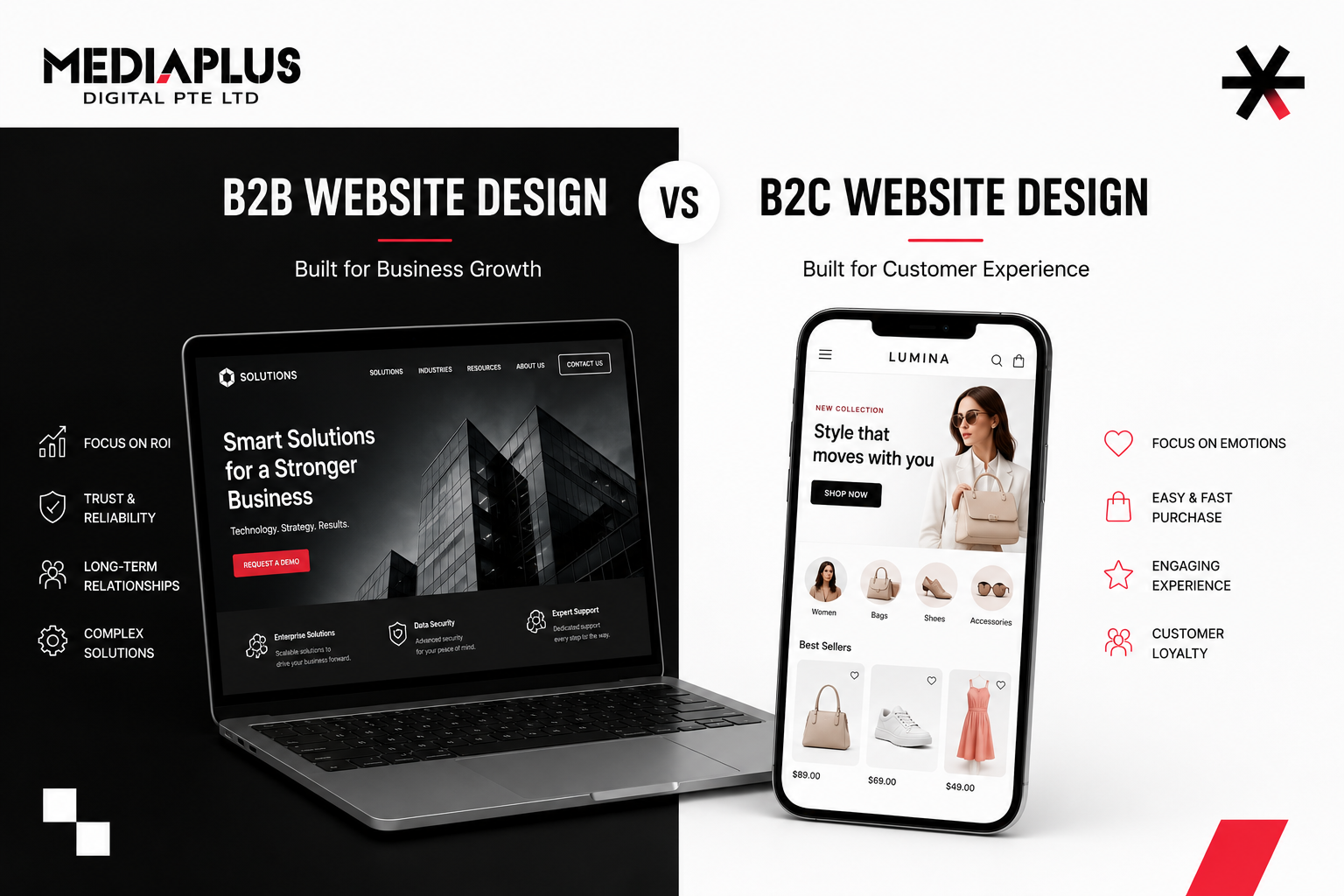
Walk through any sample of Singapore B2B websites and you will spot the same problem within thirty seconds: the site looks like a B2C store with the prices removed.
The hero says “Welcome to ACME Solutions”. The CTA says “Contact us”. The homepage tries to sell five products to fifteen industries in one scroll. The pricing page is a phone number. And the team page, on the rare site that has one, is three founders in matching polo shirts.
This is not a stylistic complaint. It is a conversion problem. B2C structure does not work for B2B traffic, and treating the two as the same is the single most common reason a Singapore B2B site loses pipeline that should have been won.
This guide unpacks what changes, why it changes, and what that means for the site you build next.
1. You Are Not Selling to a Person. You Are Selling to a Committee.
B2C is one buyer making one decision in one session. B2B is a buying committee, average size 6 to 11 stakeholders depending on deal size (Forrester, 2026), making a sequence of decisions over 3 to 12 months.
These stakeholders never visit your site together. They visit separately, at different stages, with different jobs, asking different questions:
- The end user wants to know what it is and whether it will make their daily work better.
- The technical evaluator wants to know how it integrates and whether it breaks anything.
- The economic buyer wants to know what it costs and what they will get back.
- The procurement gatekeeper wants to know whether you are a real company with insurance, certifications, and a stable financial profile.
- The executive sponsor wants to know whether buying this is a defensible decision in front of a board.
A B2C website does not need to answer all of those at once because B2C buyers are not asking those questions. A B2B website that does not answer all of them in some form has simply ejected part of the committee and lost the deal it never realised it had.
This single fact, that the B2B site is read by different people for different jobs, drives every other difference below.
2. The Pages Themselves Mean Different Things
B2B and B2C use the same page names but the pages do entirely different work.
|
Page |
B2C role |
B2B role |
|
Homepage |
Showcase the hero product, push to checkout |
Answer “what is this, who is it for, what next” in five seconds (HubSpot, Stripe pattern) |
|
Product / Service page |
Photos + price + buy button |
Long-form: problem, mechanism, integrations, ROI math, evidence, FAQs, demo CTA |
|
About page |
Brand story, optional |
Critical trust signal: founders, team, certifications, address, financials |
|
Pricing page |
Visible price, one-click buy |
Anchored ranges or tiered packaging; never “contact us” alone |
|
Case studies |
Reviews and UGC |
Quantified before-after with named clients, used as procurement evidence |
|
Contact page |
Address + chat |
Routing: demo booking, sales, support, partnerships, careers |
|
Blog |
Lifestyle content for SEO |
Authority hub: pillar pages, technical deep dives, comparisons |
|
Resources |
Rare |
Whitepapers, ROI calculators, templates, comparison guides |
On a B2C site you can drop pages and lose little. On a B2B site, every missing page is a missing answer for a stakeholder who will not ask twice.
3. Information Architecture: Vertical, Not Horizontal
B2C navigation is wide and shallow. Categories on top, products underneath, you arrive at a checkout in three clicks. B2B navigation has to be deep and contextual, because the same product is sold to different industries with different language and different proof points.
The pattern that works in 2026 is what HubSpot and Salesforce both use: dual segmentation. A primary “by product” axis (Marketing Hub, Sales Hub, Service Hub) crossed with a “by industry” or “by use case” axis (Manufacturing, Financial Services, B2B SaaS). The same product appears in multiple paths, but with different language and different case studies depending on entry point.
A Singapore B2B site selling, say, an HR tech platform, should not have one HR page. It should have an HR-for-banks page, an HR-for-manufacturing page, an HR-for-startups page, each with the relevant compliance language (MAS, MOM, SkillsFuture), the relevant integrations, and the relevant peer logos.
This is not template copy. It is the actual difference between a 1.5% and a 4% conversion rate, because the buyer believes the site was written for them rather than for “everyone”.
4. Content Depth: A B2B Service Page Has 15 Sections, Not 5
A consumer product page has product photos, price, description, reviews, and a buy button. Five sections do the job. A B2B service page has roughly fifteen, and each one services a different stakeholder concern.
A serviceable 2026 B2B service page typically includes:
- Hero: outcome-led headline, sub-headline that names who it is for, two CTAs (book demo, see pricing).
- Problem statement: what it costs the buyer to not solve this. Specific, painful, quantified.
- How it works: a diagram or three-step explainer.
- Core capabilities: 6 to 9 features, each tied to an outcome rather than a feature label.
- Live product surface: real screenshots, video, or interactive demo, never stock illustrations.
- Integration list: which tools it connects to. Logos help here.
- Industry use cases: 2 to 4 vertical-specific stories.
- ROI / business case: a numerical claim or calculator.
- Quantified case studies: 3 named-client outcomes, not generic testimonials.
- Social proof block: customer logos, analyst recognition, awards.
- Pricing anchor: at minimum a starting price, ideally a tier breakdown.
- Implementation summary: how onboarding works, time to value.
- Security and compliance: ISO 27001, SOC 2, MAS TRM, PDPA, hosting region.
- FAQ: 8 to 12 real buyer questions.
- Closing CTA: book a demo with calendar, plus a softer alternative (download whitepaper, watch product tour).
B2C teams often look at this and say “but no one will read all of that”. They are partly right. No single user reads all of that. Every section is for a different reader, and the right reader scrolls straight to the one that answers their question. The page is a choose-your-own-adventure for stakeholders, not a linear narrative for a single buyer.
5. Trust Is Earned in B2B, Not Implied
In B2C, trust is mostly transactional: SSL padlock, recognisable payment provider, return policy, a few reviews. Buyers are spending SGD 50 to SGD 500. They will take the risk.
In B2B, the average deal is SGD 10,000 to SGD 1 million plus, and the buyer’s career is on the line. Trust has to be built explicitly, and the website is the most asynchronous tool you have to build it. The Singapore B2B sites that win do this with five layered signals:
- Real client logos visible above the fold. Not “trusted by 200+ companies”, but actual recognisable logos with permission.
- Named team page with photos, real bios, LinkedIn links, and disclosure of leadership tenure.
- Quantified case studies with named clients, real numbers, verifiable outcomes.
- Industry analyst or media coverage (Gartner, Forrester, IDC, The Business Times, Tech in Asia).
- Compliance badges that match the buyer’s sector (ISO 27001 for general SaaS, SOC 2 for US-facing, MAS TRM for Singapore finance, MTCS for cloud, IMDA for telco).
Singapore B2B sites that hide their team page, redact their client list, or rely on a single anonymous testimonial signal the opposite of trust. Procurement teams notice.
6. CTAs: “Buy Now” Is Not a B2B Verb
B2C CTAs are direct: Add to Cart, Buy Now, Subscribe. They close the loop in one click, because that is the whole job.
B2B CTAs are not closing anything. They are opening a conversation that may take six months to close. The CTA hierarchy that works in 2026:
- Primary CTA on every commercial page: “Book a Demo” with an embedded calendar (Calendly, HubSpot Meetings, Chili Piper). No form-then-email-back. Calendars convert 30 to 60% better than form fills.
- Secondary CTA for buyers not ready to talk to sales: “See Pricing”, “Watch Product Tour”, “Try Free”, “Download Comparison Guide”. Each captures intent without forcing a meeting.
- Tertiary CTA for early-stage research: “Subscribe to Newsletter”, “Read Customer Stories”, “Join Slack Community”. Builds the long arc of engagement.
The most common Singapore B2B mistake is having only the primary CTA. A buyer doing initial research is not ready to book a demo, hits the dead-end of “Contact Us”, and leaves. The tertiary and secondary CTAs are the leak you did not realise you had.
7. Personalisation: B2B Sites in 2026 Adapt by Industry, Not Device
B2C personalisation is mostly retargeting and recommendations. “You looked at running shoes; here are more running shoes.” Useful, narrow.
B2B personalisation in 2026 is industry-aware and account-aware. The same homepage shows different heroes, different case studies, and different CTAs depending on whether the visitor’s IP belongs to a financial services firm, a manufacturer, or an SME. Tools like Mutiny, Demandbase, and 6sense make this routine; edge runtimes (Vercel Edge, Cloudflare Workers) make it fast.
You do not need this on day one. You do need it before you scale. The bigger the deal size, the more your homepage cannot afford to look generic to a known target account.
8. The Metrics Are Different. Stop Measuring B2C Things.
A B2C website succeeds when conversion rate, AOV, and ROAS go up. A B2B website succeeds on entirely different metrics, because the website is feeding a sales motion that closes deals weeks or months later.
|
Metric |
B2C focus |
B2B focus |
|
Primary conversion rate |
2.1 to 2.5% (purchase or signup) |
1.5 to 4% (demo, trial, lead) |
|
Average deal size |
SGD 30 to 500 |
SGD 10K to 1M+ |
|
Time to revenue |
Minutes to hours |
3 to 12 months |
|
Quality of conversion |
Implicit (they paid) |
MQL > SQL > Opportunity > Win |
|
Site KPI worth tracking |
ROAS, AOV, repeat purchase |
Pipeline influenced, demo-show rate, CAC payback |
|
Attribution model |
Last click |
Multi-touch, account-based |
Singapore B2B teams that report “website conversion rate” alone usually undervalue their website. The right number is pipeline created, then revenue influenced. A 1.5% conversion rate that produces SGD 4 million in pipeline beats a 4% conversion rate that produces SGD 80K.
9. Three Sites Worth Studying (and What to Steal From Each)
Rather than reinvent these patterns from scratch, look at the sites that have already solved them.
HubSpot
HubSpot answers three questions on every product page in five seconds: what is this, who is it for, what should I do next. The information architecture is split by product line (Marketing Hub, Sales Hub, Service Hub, CMS Hub, Operations Hub) crossed with use cases. Demo CTAs are everywhere; soft CTAs (“Get Started Free”) catch the tier of buyer not ready for a sales call. Steal: the dual segmentation pattern, and the discipline of answering who-is-it-for explicitly.
Stripe
Stripe sells to two very different audiences (developers and finance buyers) without alienating either. Developer pages have code blocks, API references, and live snippets. Business pages have ROI language, compliance badges, and case studies. The site lets each audience self-serve the path that fits their evaluation. Steal: the audience split, and the discipline of resisting the urge to dumb everything down to one tone.
Salesforce
Salesforce sells to the largest enterprises on earth and structures the site like the org charts of those enterprises: industry-first navigation (Financial Services, Healthcare, Manufacturing, Retail), each with its own visual identity, language, and proof. The result is enormous and slow, but the buyer who lands on the right vertical lands in a custom-feeling experience. Steal: the industry-first navigation pattern for any B2B selling to multiple verticals.
10. The Singapore-Specific Layer Most Sites Skip
A Singapore B2B website has obligations a global B2B template will not anticipate:
- The PDPA consent layer must apply to every form. Cookie banner with explicit accept / reject. DPO contact published.
- Pricing should appear in SGD where possible. USD-only pricing flags you as a global brand that has not bothered to localise.
- Compliance badges relevant to the local buyer (MAS TRM, MTCS, IMDA, ISO/IEC 27001) carry more weight in Singapore procurement than the equivalent US badges.
- Government and GLC tenders increasingly expect WCAG 2.1 AA accessibility. A site that fails an automated accessibility scan also fails the tender.
- PSG grant eligibility, where relevant. SMEs filtering for grant-eligible vendors expect this signalled clearly.
- Multilingual capability where the buyer base genuinely uses it. Singapore B2B is mostly English, but financial services and government often need Mandarin variants.
These are not blockers in isolation. Stacked together, they are the difference between a site that closes Singapore deals and one that gets shortlisted but loses to a competitor who understood the local context.
The One-Line Summary
B2C websites sell. B2B websites convince. The grammar of design is the same; the sentences are entirely different.
If you are commissioning a B2B site in Singapore in 2026 and the proposal you are reviewing looks like a beautiful B2C site with the prices removed, ask the agency to start over. Ask them what page exists for each member of your buying committee. Ask them what the procurement gatekeeper sees. Ask them what changes when an Indonesian banking buyer lands on the homepage instead of a local SME. If they cannot answer, you are buying the wrong site.
If you want a candid second opinion on a B2B site you are planning, building, or rebuilding, talk to MediaPlus web design and development. The full B2B vs B2C breakdown also pairs with our blog on B2B vs B2C digital marketing.