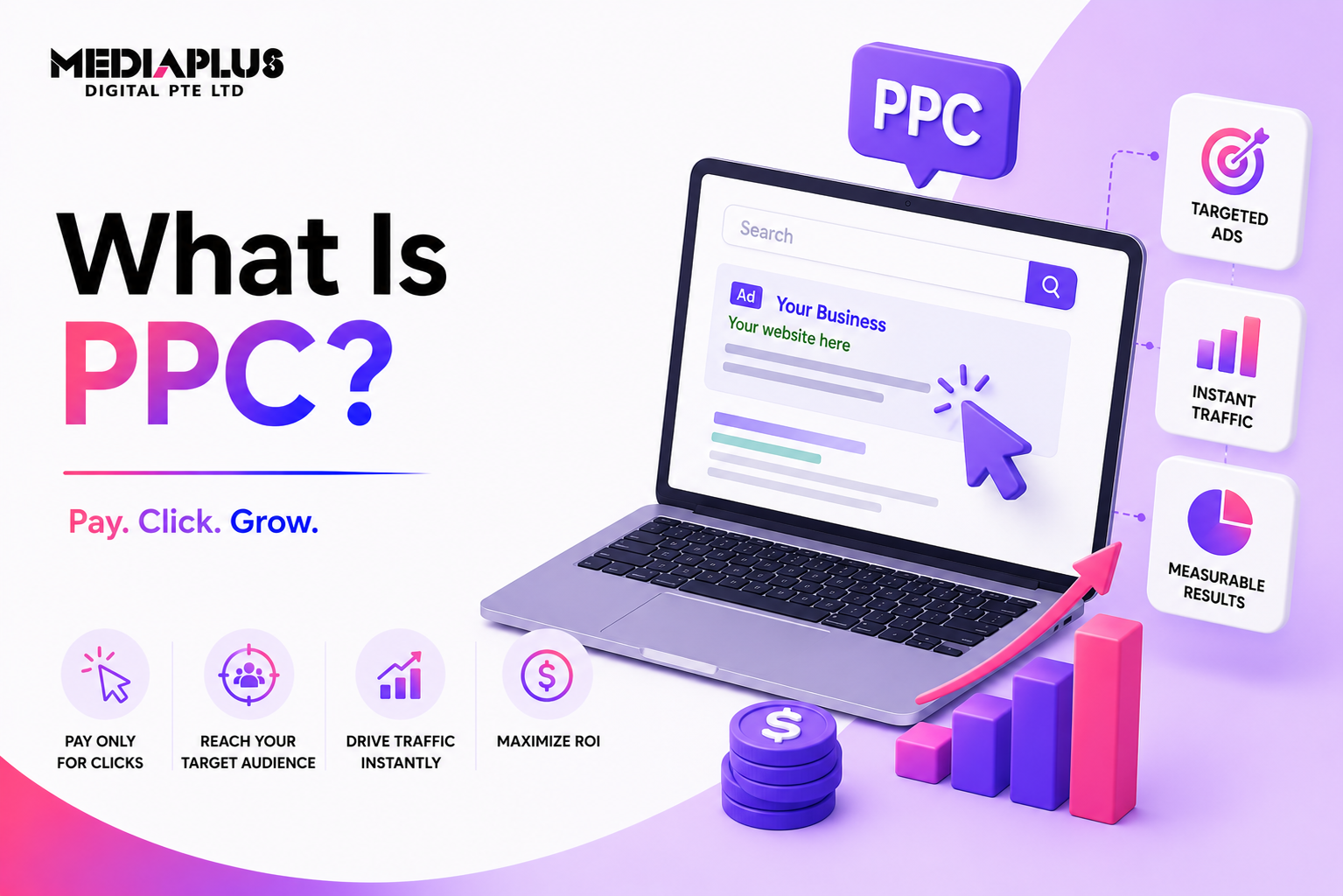
PPC is one of the fastest ways to put your business in front of customers who are ready to buy. Instead of waiting months to rank, you pay to appear at the top of search results and other placements, and you only pay when someone clicks. This guide explains what PPC is, how it works, the types and platforms, the metrics that matter, and how to run it without wasting budget.
Quick answer: PPC (pay-per-click) is a form of digital advertising where you pay a fee each time someone clicks your ad. It is most associated with search ads on Google, where advertisers bid on keywords to appear at the top of results. You control the budget, target precisely, and can drive leads within days.
What is PPC?
PPC stands for pay-per-click. It is an advertising model where you pay only when a user actually clicks your ad, rather than paying for the ad to be shown. The most common form is paid search, the ads at the top of Google when you search, but PPC also covers shopping, display, video and social ads.
The appeal is simple: you reach people at the moment they are looking, you only pay for actual clicks, and every dollar is measurable.
How does PPC work? The ad auction
You do not simply pay to be first. Each time someone searches, the platform runs an auction in milliseconds to decide which ads appear and in what order. Your position depends on two things:
- Your bid: the maximum you will pay for a click.
- Quality Score: how relevant and useful your keyword, ad and landing page are.
This is why a smaller advertiser with highly relevant ads and a strong landing page can outrank a bigger spender, and pay less per click. Better quality means better positions for less money.
Types of PPC ads
PPC is more than search ads:
- Search ads: text ads on search results for keywords you target.
- Shopping ads: product ads with image and price, ideal for ecommerce. See Google Shopping.
- Display ads: visual banners across websites and apps.
- Remarketing: ads that follow visitors who did not convert.
- Video ads: on YouTube and video placements.
- Paid social ads: on Meta, TikTok and LinkedIn, also billed per click or impression.
PPC platforms
- Google Ads is the dominant platform, covering Search, Shopping, Display and YouTube.
- Microsoft Advertising (Bing) reaches a smaller, often cheaper audience.
- Meta, TikTok and LinkedIn run paid social on a similar model.
Most Singapore businesses start with Google Ads, run through PPC services or a Google Ads agency.
Key PPC metrics
|
Metric |
What it tells you |
|
Cost per click (CPC) |
What each click costs |
|
Click-through rate (CTR) |
How compelling your ad is |
|
Quality Score |
Relevance of keyword, ad and page |
|
Conversion rate |
How well clicks become leads or sales |
|
Cost per acquisition (CPA) |
What each conversion costs |
|
Return on ad spend (ROAS) |
Revenue earned per dollar spent |
Judge PPC on CPA and ROAS, not clicks.
PPC vs SEO
PPC buys instant, paid visibility; SEO earns organic visibility over time. PPC stops when the budget stops, while SEO compounds. The strongest strategy uses both: PPC for quick wins, SEO for long-term cost efficiency. PPC and SEM are also closely linked, PPC is the pricing model, while SEM is the broader discipline of paid search.
Benefits of PPC
- Immediate results, unlike SEO
- Precise targeting by keyword, location, device and audience
- Full control of budget and pacing
- Measurable ROI, every click and conversion tracked
- Easy to test and scale up or down
Common PPC mistakes
- Sending clicks to your homepage instead of a relevant landing page
- No conversion tracking, so you cannot tell what works
- Broad keywords with no negative keywords
- Judging success on clicks rather than leads and ROAS
- Ignoring Quality Score and overpaying
- Setting and forgetting, with no optimisation
How to get started with PPC
- Set a clear goal and the metric you will measure.
- Research keywords with real buying intent.
- Structure tight, themed campaigns and ad groups.
- Write relevant ads and build dedicated landing pages.
- Set up conversion tracking before spending.
- Add negative keywords to protect budget.
- Launch, then optimise bids, creative and audiences.
Frequently asked questions
What is PPC in simple terms?
Paid advertising where you pay each time someone clicks your ad. It puts your business at the top of search results and other placements instantly.
How much does PPC cost in Singapore?
Most SMEs run a media budget of SGD 1,000 to 6,000+ per month plus a management fee. Cost per click varies by industry and competition. PSG can offset qualifying costs.
Is PPC the same as Google Ads?
Google Ads is the biggest PPC platform, but PPC also includes Microsoft Ads and paid social. PPC is the model; Google Ads is one platform.
Is PPC better than SEO?
Neither is better overall. PPC delivers immediate results; SEO compounds over time. Most businesses use both.
How soon does PPC work?
Almost immediately. You can be live and driving clicks within days, with performance improving over the first weeks.
Get PPC working for your business
PPC rewards structure, relevance and constant optimisation. If you want paid advertising that drives leads without wasting budget, talk to MediaPlus Digital. Explore our PPC services, Google Ads and Google Shopping, with PSG support for eligible SMEs.