Singapore is one of the most digitally mature advertising markets in Southeast Asia. According to Statista, digital ad spend in Singapore now accounts for roughly 65 to 70 percent of total media investment, while traditional channels such as print, radio, and out-of-home continue to play an important role in brand building. For marketers, the question is no longer “digital or traditional”, but how to combine both effectively, especially in business-to-business (B2B) sectors where buying cycles are long and decision-makers are hard to reach.
This guide compares digital advertising and traditional advertising in the Singapore context, then walks through the main types of B2B marketing used by local agencies and in-house teams. If your company is exploring how to grow leads, brand awareness, and revenue, the digital marketing services at MediaPlus Digital can help you design a strategy that blends both worlds.
1. What Is Digital Advertising?
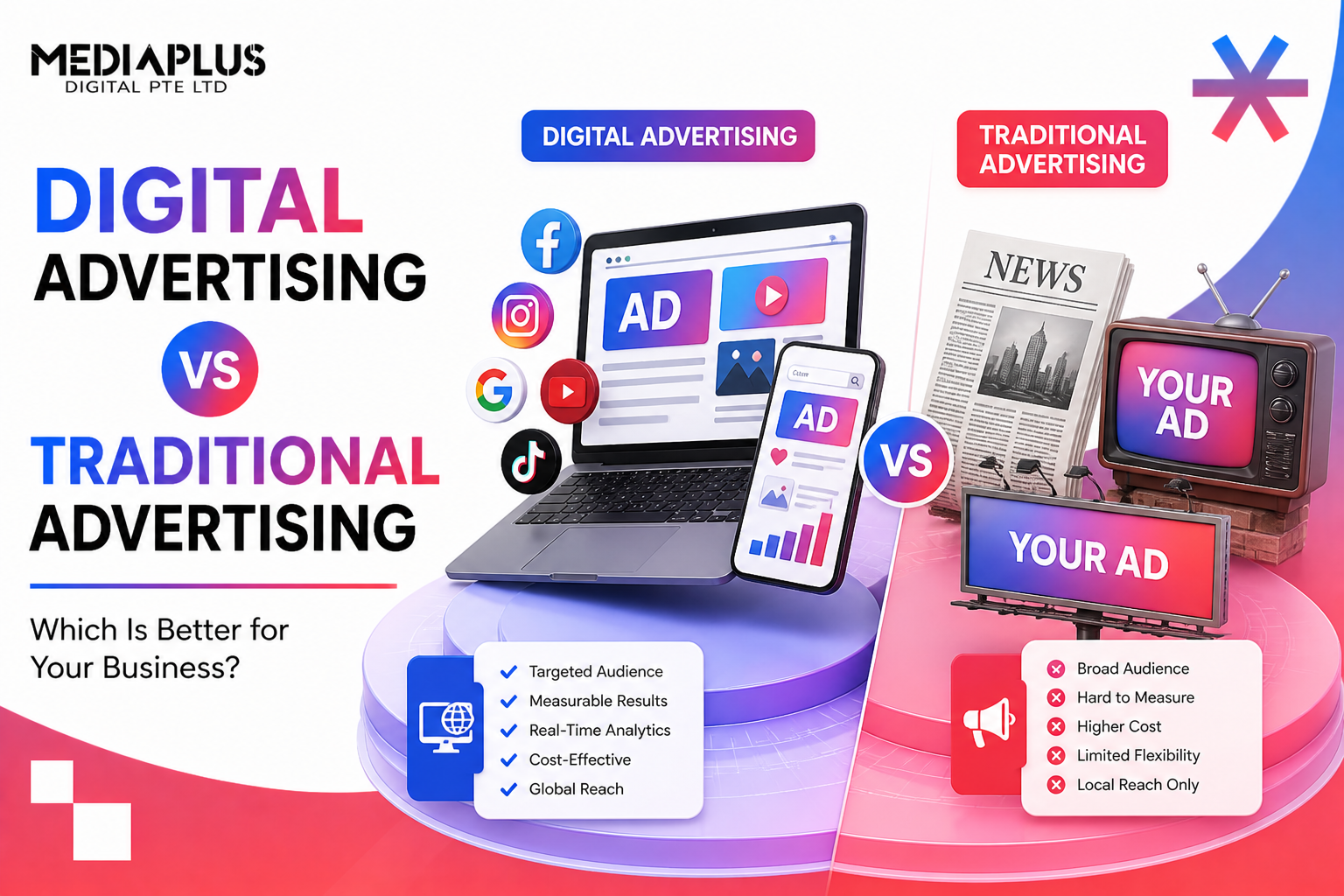
Digital advertising refers to any paid promotional activity that takes place on internet-connected devices and platforms. It includes search engine ads on Google, paid posts on Facebook, Instagram, TikTok, and LinkedIn, YouTube video ads, programmatic display banners, native ads, and in-app mobile advertising. In Singapore, this category is dominated by Search Engine Marketing (SEM), social media ads, and programmatic advertising.
The defining traits of digital advertising are precision targeting, real-time measurement, and flexible budgets. A small Singapore SME can launch a campaign with as little as a few hundred dollars and adjust it within hours based on performance data such as click-through rate (CTR), cost per acquisition (CPA), and return on ad spend (ROAS).
2. What Is Traditional Advertising?
Traditional advertising covers offline media that existed long before the internet: television commercials on Mediacorp channels, radio spots, newspaper ads in The Straits Times or Lianhe Zaobao, magazine inserts, billboards along the PIE and CTE, MRT and bus advertising, taxi wraps, direct mail, and event sponsorships. These formats still work for mass-market consumer brands, government campaigns, property launches, and corporate brand building because they reach broad audiences and carry a sense of authority.
3. Digital Advertising vs Traditional Advertising: 10 Key Differences
|
Criteria |
Traditional Advertising |
Digital Advertising |
|
Channels |
TV, radio, print, billboards, direct mail |
Google, Meta, TikTok, LinkedIn, YouTube, programmatic |
|
Targeting |
Broad demographics and geography |
Granular by interest, behavior, intent, device, and location |
|
Cost structure |
High fixed cost, large minimum spend |
Flexible CPC, CPM, or CPA models, scalable from low budgets |
|
Measurement |
Estimated reach and circulation figures |
Real-time analytics: CTR, CPA, ROAS, conversions |
|
Speed to launch |
Weeks of production and booking |
Hours to a few days |
|
Personalization |
One message for all |
Dynamic creative tailored per audience segment |
|
Interactivity |
One-way communication |
Two-way: clicks, comments, shares, direct purchases |
|
Lifespan |
Fixed campaign window |
Always-on, easily updated |
|
Credibility |
Often perceived as more trustworthy |
Mixed; depends on platform, ad fraud, and ad blocking |
|
Best use case |
Mass awareness and brand building |
Lead generation, e-commerce sales, performance marketing |
For Singapore businesses that want to capture high-intent buyers actively searching on Google, paid search through a Google Ads agency often delivers the fastest measurable returns. For brands that need to dominate visual feeds, Facebook Ads, Instagram Ads, and TikTok Ads are the natural choices.
4. Pros and Cons of Each Approach
Advantages of Traditional Advertising
- Massive reach across age groups, including audiences less active online.
- High perceived credibility, particularly in print and television.
- Strong emotional impact through sight, sound, and motion in TV commercials.
- Effective for hyper-local visibility, such as MRT panels in CBD or Orchard.
Disadvantages of Traditional Advertising
- High production and placement costs, often beyond SME budgets.
- Difficult to measure exact return on investment.
- Long lead times for booking and creative production.
- No personalization or two-way interaction with the audience.
Advantages of Digital Advertising
- Precise targeting by job title, industry, location, intent, and behavior.
- Transparent metrics and full-funnel attribution.
- Flexible budgets that can scale up or down within hours.
- Higher engagement through interactive ad formats and direct response.
Disadvantages of Digital Advertising
- Rising competition and CPC inflation in major Singapore keyword categories.
- Ad fatigue, banner blindness, and growing use of ad blockers.
- Tighter privacy rules under the PDPA and global iOS or browser changes.
- Steep learning curve for advanced platforms such as programmatic DSPs.
5. Which One Is Better for Singapore Businesses?
There is no universal answer, but the data leans heavily toward digital. The Infocomm Media Development Authority (IMDA) reports that more than 96 percent of Singapore residents are online, and average daily internet use exceeds seven hours. For most SMEs, this means digital should take the largest share of the budget, while traditional channels are layered on for high-impact brand moments such as new product launches or anniversary campaigns.
A balanced Singapore advertising mix often looks like this:
- Search ads to capture demand from buyers ready to purchase.
- Social media ads to build awareness and retarget warm audiences.
- SEO and content marketing to win long-term organic traffic.
- Programmatic display and YouTube ads for upper-funnel reach.
- Selective traditional placements for brand prestige and trust.
To compare two of the most popular paid channels for Singapore SMEs, read our deep dive on Google Ads vs Facebook Ads.
6. Frequently Asked Questions
Is digital advertising replacing traditional advertising in Singapore?
Not entirely. Digital now dominates spending, but traditional advertising still plays a strong role in mass brand awareness, government campaigns, and high-trust categories such as banking, property, and healthcare. The most effective approach blends both.
Which is more cost-effective for SMEs in Singapore: digital or traditional?
Digital advertising is almost always more cost-effective for SMEs because it allows small budgets, precise targeting, and real-time optimization. Many Singapore SMEs see qualified lead costs in the range of SGD 5 to SGD 30 through search and social ads.
10. Conclusion and Next Steps
Digital advertising and traditional advertising are not enemies. They are complementary tools that, when combined, cover the full spectrum of buyer attention. In B2B, success depends on choosing the right mix of content, SEO, paid media, ABM, events, and partner marketing, and on continuously measuring what drives pipeline.
If you are ready to grow your business in Singapore with a strategy that blends data, creativity, and proven execution, talk to the team at MediaPlus Digital. From SEO and SEM to social media advertising and Account-Based Marketing, we help Singapore brands turn marketing into measurable revenue.
Ready to scale your advertising in Singapore?
Get a free strategy consultation with our team. Visit mediaplus.com.sg or browse our latest insights on the MediaPlus blog.