
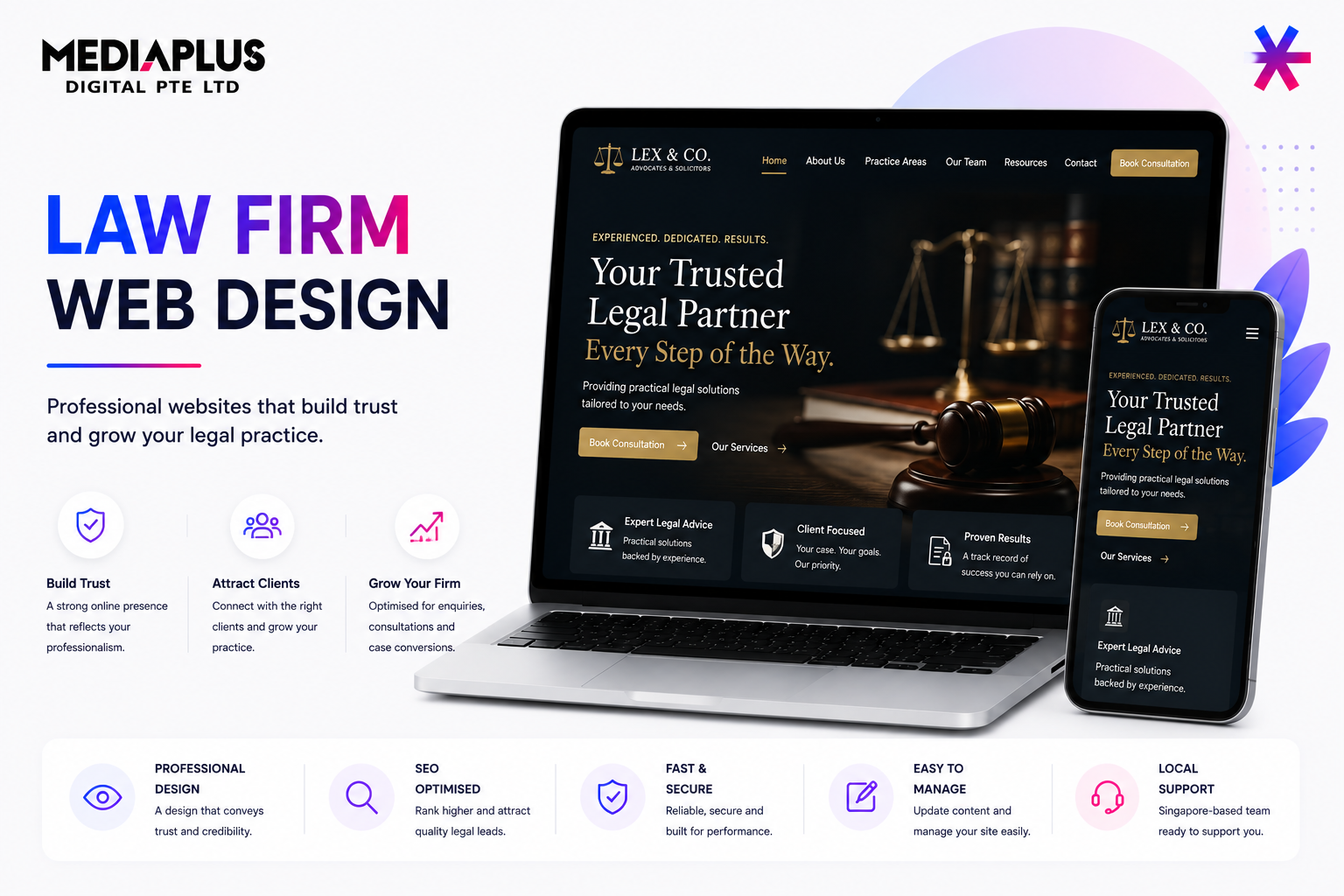
More than 85% of Singaporeans search for legal services online, and 77% research a firm before making contact. With over 800 law practices and 5,800 practising lawyers competing, your website is the first meeting. This is a detailed, executable guideline for designing a law firm website that builds trust, stays compliant, and converts searchers into consultations.
It builds on our core web design principles and applies them to the specific realities of legal services in Singapore.
Who Your Website Must Convince
Legal clients are usually anxious, time pressured, and unfamiliar with the process. They are not evaluating your design taste. They are scanning for three signals: are you credible, are you relevant to my exact problem, and is it easy and safe to reach you. Every design and content decision below should serve one of those three.
|
Visitor type |
What they need from the site |
|
Individual in distress (divorce, criminal, injury) |
Reassurance, clarity on process, a low-pressure way to ask |
|
Business client (corporate, contracts, disputes) |
Proof of relevant expertise, credentials, and track record |
|
Referral checking you out |
Confirmation you are legitimate, specialised, and contactable |
Page-by-Page Blueprint
A law firm website should be built around a clear, repeatable structure. Below is the recommended page set and what each page must contain.
Homepage, section by section
- Hero: firm name, a plain-language statement of what you do and for whom, and a primary call to action (Book a Consultation). No jargon, no superlatives.
- Practice areas: a clear grid linking to each practice area page, labelled by client problem (Divorce, Employment, Corporate) not internal department names.
- Why clients choose us: credibility framed around facts, such as years in practice, areas of focus, languages spoken, and professional memberships.
- Lawyer highlights: two to four featured profiles with photos, building the human connection.
- Insights preview: three recent articles to show active expertise.
- Trust band: bar admissions, accreditations, and recognitions that are factual and permissible.
- Closing CTA: a final, prominent prompt to book a consultation with phone, form, and email options.
Core inner pages
|
Page |
Must contain |
|
Practice area page (one per area) |
The problem in client language, how you help, the process, typical FAQs, and a CTA |
|
Lawyer profile (one per lawyer) |
Headshot, qualifications, jurisdictions, bio, languages, notable publications and talks |
|
About the firm |
History, values, areas of focus, office details, and team overview |
|
Insights / articles hub |
Educational content organised by practice area |
|
Contact |
PDPA-compliant form, phone, email, map, office hours, and parking or MRT notes |
|
Fees / consultation info |
How consultations work and what to prepare, framed to reduce anxiety |
Structure the insights hub as a content cluster so each practice area has a pillar page supported by related articles. This is the single biggest driver of organic visibility for a law firm.
Must-Have Features, in Detail
Lawyer profiles that build trust
People hire lawyers, not logos. Each profile should carry a professional headshot on a consistent background, full qualifications and admitting jurisdictions, a bio written in plain language that explains the kind of clients and matters the lawyer handles, languages spoken (important in Singapore), and links to genuine publications or speaking engagements. Avoid claims of being the best or most successful.
Practice area pages framed around client needs
Name pages after the client’s problem. A page titled Divorce and Family Law will be found and understood far more often than one titled Matrimonial Practice Group. On each page, describe the situation, explain how the firm helps, outline the process step by step, and answer the questions clients actually ask.
FAQs that reduce friction
FAQs that address fees, timelines, the legal process, and how to prepare for a first consultation lower the barrier to contact and earn featured snippet visibility. Add an FAQ block to every practice area page and mark it up with FAQPage schema.
Legal Profession (Publicity) Rules: Compliance Guideline
In Singapore, a law firm website is treated as publicity and is governed by the Legal Profession (Publicity) Rules under the Legal Profession Act. Breaches can trigger disciplinary action by the Law Society, including fines, suspension, or being struck off. Design and write the site within these limits from the start.
|
Do |
Do not |
|
State qualifications and genuine areas of focus |
Claim to be the best, cheapest, or most successful |
|
Describe your process and approach |
Advertise success rates or win statistics |
|
Publish educational, dignified content |
Compare or criticise other firms’ fees or services |
|
Show permissible accreditations |
Refer to past client matters that breach confidentiality |
|
Make justifiable expertise claims |
Use sensational, undignified, or touting language |
Practical rule: Build credibility through facts, clarity, and useful content, never superlatives. Have a practising lawyer review all copy against the current rules before publishing, since the rules are updated periodically.
Content Writing Guidelines
- Write in plain English at the reading level of an anxious non-lawyer.
- Lead each section with a direct answer, then explain. This helps users and AI search.
- Use the client’s vocabulary (custody, retrenchment, injury claim), not statute names.
- Keep paragraphs short and scannable, with descriptive subheadings.
- Every page should end with a single, clear next step.
Visual and Design Guidelines
Law firm design should feel calm, ordered, and authoritative. Specifics:
- Palette: a restrained primary (navy, deep green, burgundy, or charcoal) with one accent and generous white space.
- Typography: a serif for headings signals heritage and trust; pair with a clean sans-serif body. See the font selection guide.
- Imagery: real photos of the team and office beat generic gavel and scales stock images.
- Hierarchy: guide the eye from problem to solution to CTA using visual hierarchy.
Conversion Guidelines
- Place a clear call to action in the header, after each practice section, and in the footer.
- Offer multiple contact modes: form, phone (click to call on mobile), and email.
- Keep enquiry forms short and PDPA compliant: name, contact, matter type, brief message.
- Reassure on the form: state that enquiries are confidential and you reply within a set time.
Local SEO Guideline
- Optimise your Google Business Profile with practice categories, photos, and reviews.
- Build practice-area pages that target local search intent (for example, employment lawyer Singapore).
- Earn authority through an active insights hub and E-E-A-T signals such as authored articles.
Performance and Mobile
- Around 67% of legal queries are mobile, so design mobile-first.
- Pass Core Web Vitals and keep the site fast and secure with HTTPS.
Common Mistakes to Avoid
- Superlatives that breach the Publicity Rules (best, top, number one).
- Department-name navigation that clients do not understand.
- Stock photos of gavels instead of real lawyer headshots.
- Burying the phone number and consultation CTA.
- A neglected blog that signals the firm is inactive online.
Cost and Funding
A professional law firm website follows the ranges in our web design cost guide. SME firms may offset part of the build through the PSG web development grant.
Build a Law Firm Website That Earns Trust
MediaPlus designs credible, compliant, conversion focused legal websites through our web design and development services. See our portfolio, or get in touch. For existing sites, our website redesign service rebuilds them without losing search traffic.
Related Reads