If you sell online in Singapore, your platform choice quietly shapes how hard SEO will be for the next few years. Shopify and WooCommerce can both rank well, but they make different trade-offs: one hands you speed and simplicity, the other hands you control. Picking the wrong one for your strategy means fighting the platform instead of your competitors.
This guide compares the two on the SEO factors that actually move rankings, shows where each one wins, and gives a clear recommendation based on how you plan to grow.
The honest verdict up front
Neither platform “ranks higher” in the abstract. The deciding factor is who is doing the SEO work and what your strategy depends on.
- Choose Shopify if you want strong technical SEO out of the box with minimal fuss, and you are not a developer.
- Choose WooCommerce if content marketing and full technical control are central to your plan, and you have, or will hire, someone to manage WordPress.
Industry analysis in 2026 found WooCommerce stores tend to rank for more organic keywords on average in the same niche, largely because WordPress is a stronger content and blogging engine. Shopify, meanwhile, ships faster default speed and cleaner schema with less effort. Both observations point to the same conclusion: strategy decides the platform.
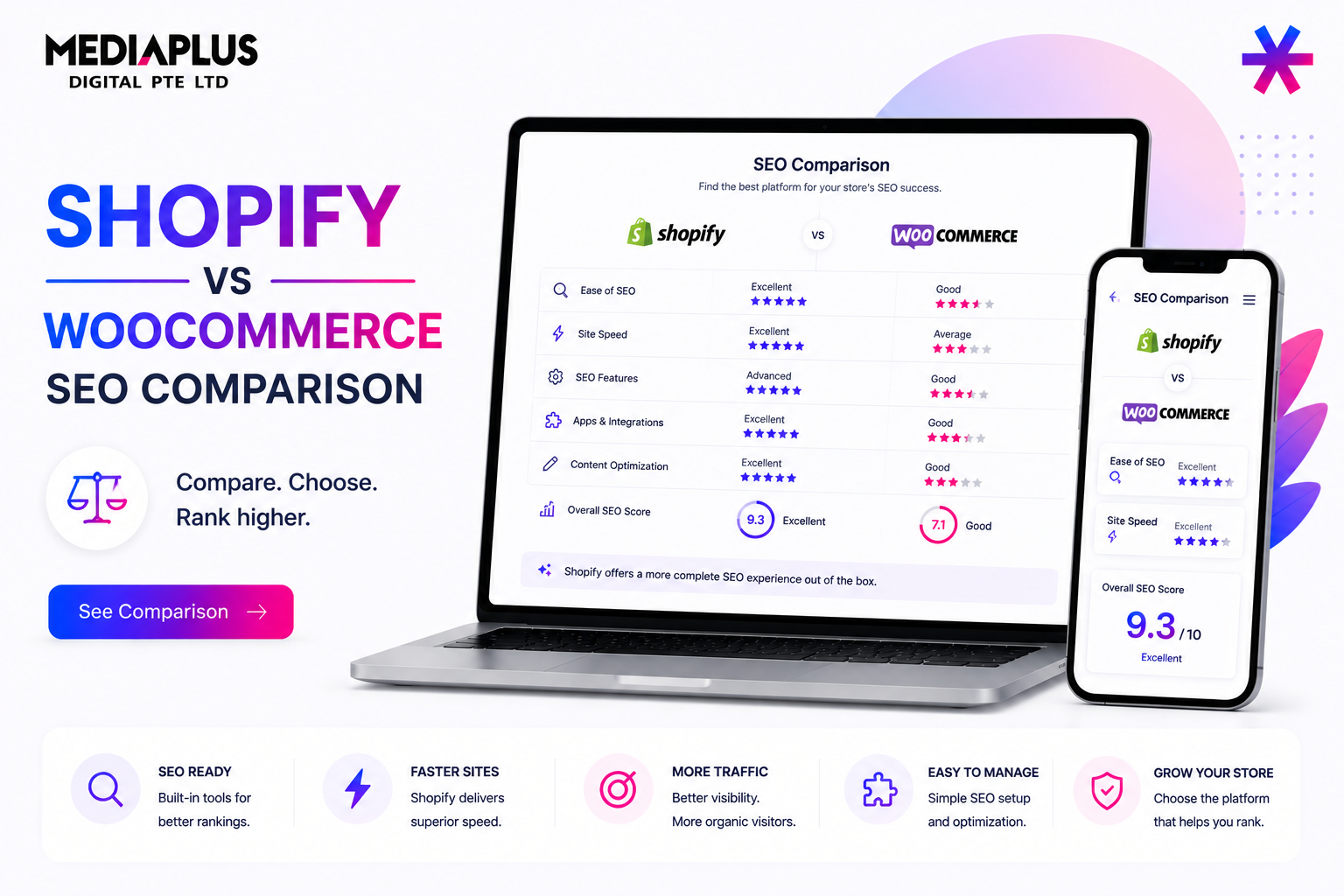
Head-to-head on the SEO factors that matter
|
SEO factor |
Shopify |
WooCommerce |
|
Setup speed to “good SEO” |
Fast, sensible defaults |
Slower, needs configuration |
|
Site speed (default) |
Fast out of the box |
Depends on hosting, theme, plugins |
|
URL structure control |
Limited, forces /products/ and /collections/ |
Full control |
|
Schema / structured data |
Clean by default |
Via Yoast or Rank Math |
|
Blogging and content |
Basic |
Strong, full WordPress CMS |
|
Technical SEO ceiling |
Capped by platform rules |
Very high, fully customisable |
|
robots.txt and crawl control |
Limited customisation |
Full control |
|
Maintenance burden |
Low, hosted |
Higher, you own updates and security |
URL structure
Shopify enforces fixed URL paths. Product pages always sit under /products/ and category pages under /collections/, and you cannot remove those segments. For most stores this is fine, but it limits how you architect a large catalogue.
WooCommerce gives you full URL control. You can shape clean, keyword-relevant paths and design a site structure that mirrors how customers and Google understand your catalogue. For a content-heavy or large store, that flexibility compounds.
Site speed
Shopify is fast by default because it is fully hosted and optimised, which removes a whole category of speed problems. WooCommerce speed is in your hands: with good hosting, a lean theme and disciplined plugin use it can be very fast, but a bloated install will drag. Either way, Core Web Vitals and website speed optimisation decide whether you pass Google’s page experience bar.
Content and blogging
This is WooCommerce’s biggest edge. WordPress is a mature content platform, so blog-led SEO, topic clusters and internal linking are far easier and more capable. Shopify’s blogging is functional but basic. If your organic growth plan leans on content, WooCommerce is materially stronger.
Schema and structured data
Shopify outputs clean product schema with little effort. WooCommerce reaches the same place and beyond through Yoast or Rank Math, but you configure it. For a Shopify-specific deep dive, see our guide on Shopify schema and structured data.
What actually moves rankings (more than the platform)
Before you over-weight the platform decision, remember the levers that outrank it:
- Content quality and depth across product, category and blog pages
- Site speed and Core Web Vitals
- Backlinks and domain authority, see what are backlinks
- Technical hygiene: indexing, canonicalisation, internal linking
- Search intent match on product and category pages
A well-run store on either platform beats a neglected store on the “better” one. For the fundamentals, read what is e-commerce SEO and how it differs from the rest in e-commerce SEO vs traditional SEO.
Choose by your growth strategy
Match the platform to how you intend to win:
- Content-led growth (blogs, guides, topic clusters drive your traffic): WooCommerce. Its WordPress core and URL control make a content engine far easier to scale.
- Speed-to-market and low overhead (you want to launch and sell, not manage infrastructure): Shopify. Defaults are strong and maintenance is minimal.
- Large or complex catalogue needing custom architecture and integrations: WooCommerce, for the control.
- Small team, no developer: Shopify, so the platform does the heavy lifting.
If you are still weighing the broader platform trade-offs beyond SEO, our Shopify vs WooCommerce vs Magento comparison covers cost, scalability and ease of use.
Migration: switch without losing rankings
Already on one platform and tempted to move? Migration is doable, but do it carefully or you will lose hard-won rankings:
- Map every old URL to its new one with 301 redirects
- Preserve titles, meta and content on key pages
- Recreate schema and rebuild internal links
- Submit a fresh sitemap and monitor indexing and traffic for weeks afterward
Our WooCommerce development team handles SEO-safe builds and migrations, and the principles in how to redesign your website without losing SEO traffic apply directly to a platform move.
Whichever you pick, the SEO work is the same shape
Platform sets the starting line, not the finish. On either one you still need keyword-mapped category and product pages, fast performance, structured data, content and links. That is where dedicated e-commerce SEO earns its keep:
- For Shopify stores: Shopify SEO services, plus SEO for Shopify and AI SEO for Shopify stores
- For WooCommerce stores: WooCommerce SEO service
- Building a new store first: e-commerce website design
Bottom line
Shopify gets you to good SEO faster with less effort. WooCommerce gives you a higher ceiling for content and technical control. Pick Shopify for simplicity and speed, WooCommerce for content depth and control, then invest in the SEO work that actually decides who ranks. Not sure which fits your catalogue and team? Talk to MediaPlus and we will recommend the platform and the SEO plan that suit how you intend to grow.