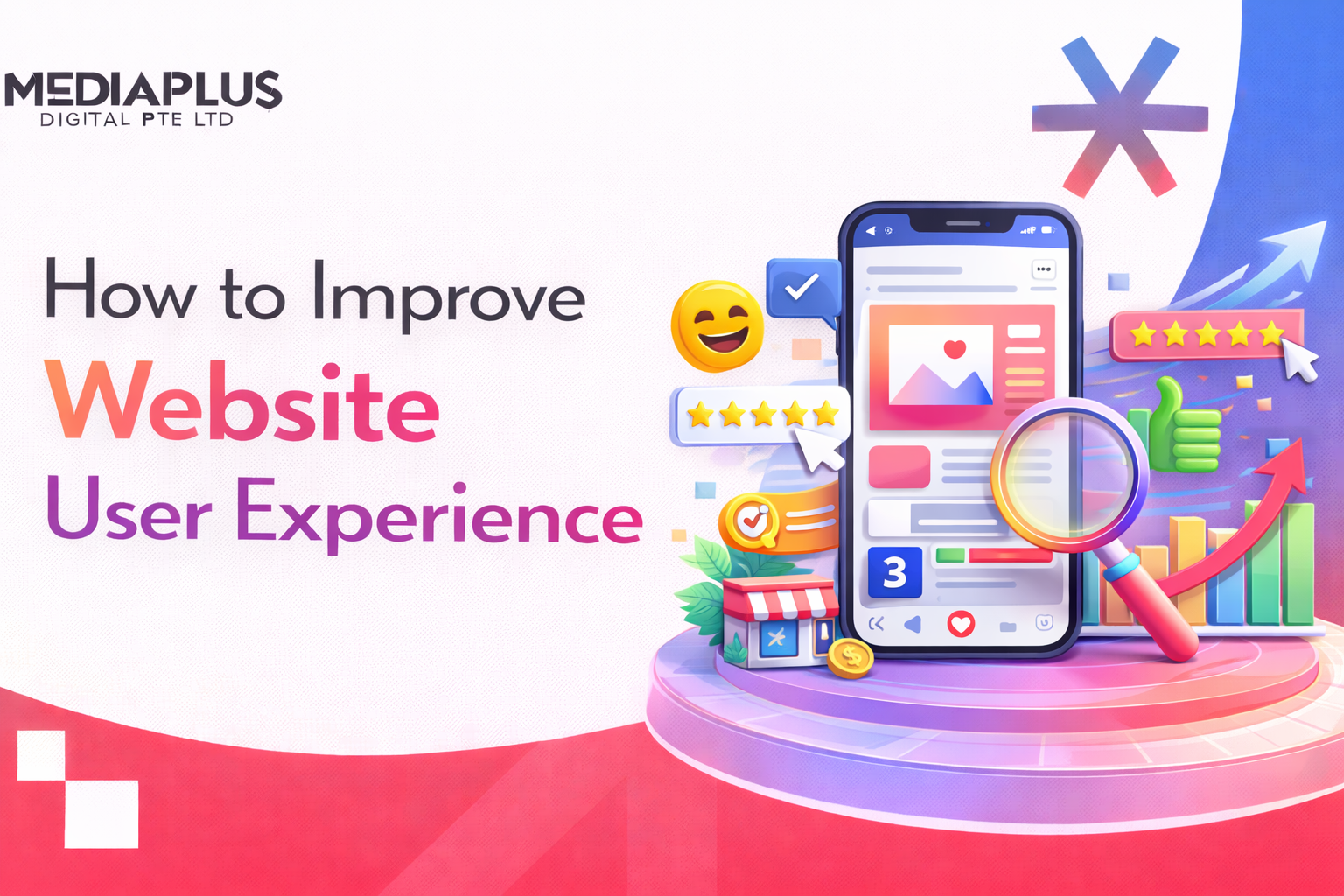
Users form an opinion about your website in 0.05 seconds. In that fraction of a moment, they decide whether to stay or leave. And the data backs this up: 88% of online users are less likely to return to a website after a bad experience.
Improving your website’s user experience is not about chasing design trends. It is about removing friction, anticipating user needs, and making every interaction feel effortless. In this guide, we share 20 practical strategies that cover everything from performance and navigation to micro-interactions and AI personalisation.
Why Website User Experience Matters
Good UX is good business. Forrester Research found that every dollar invested in UX returns $100. Beyond ROI, user experience directly affects:
- Conversion rates: A well-designed user flow can increase conversions by 200% or more.
- Bounce rates: Pages that load in under 2 seconds have an average bounce rate of 9%, compared to 38% for pages loading in 5 seconds.
- SEO rankings: Google uses Core Web Vitals (page speed, visual stability, interactivity) as ranking signals.
- Customer loyalty: 94% of first impressions are design-related, and users who have a positive experience are 3x more likely to return.
Understanding why web design is important is the first step toward making meaningful UX improvements.
Performance and Page Speed
Optimise Core Web Vitals
Core Web Vitals are Google’s metrics for measuring real-world user experience. They directly affect both SEO and user satisfaction.
| Metric | What It Measures | Target |
| LCP (Largest Contentful Paint) | How fast the main content loads | Under 2.5 seconds |
| CLS (Cumulative Layout Shift) | How much the page shifts during loading | Under 0.1 |
| INP (Interaction to Next Paint) | How fast the page responds to user input | Under 200ms |
- Compress images to WebP or AVIF format and use lazy loading for below-the-fold content.
- Minify CSS and JavaScript files. Remove unused code.
- Use a Content Delivery Network (CDN) to serve assets from servers closest to your users.
- Set explicit width and height on images and embeds to prevent layout shifts.
Use Skeleton Screens for Perceived Speed
Even when load times are optimised, perceived speed matters. Skeleton screens (placeholder outlines that mimic the page layout) give users an instant visual structure before content fully loads. This technique, used by Facebook, LinkedIn, and YouTube, makes waiting feel shorter because users can see progress.
For a deeper look at the connection between performance and rankings, read our guide on SEO-friendly web design.
Mobile-First Design
Design for Mobile First, Then Scale Up
Over 60% of global web traffic comes from mobile. In Singapore, the figure is even higher. Designing for the smallest screen first forces you to prioritise content and features, producing a focused experience that scales gracefully to larger screens.
- Use touch targets of at least 44x44px for all interactive elements.
- Place key actions within the thumb zone (lower half of the screen on mobile).
- Simplify forms for mobile: use auto-fill, input masks, and single-column layouts.
- Test on real devices across different screen sizes and operating systems.
Optimise Mobile Navigation
Desktop mega-menus do not work on mobile. Consider bottom navigation bars for app-like experiences, collapsible hamburger menus with clear labels, or sticky headers with the most important actions always visible.
Our guides on mobile-first design and responsive web design best practices cover this in detail.
Navigation and Information Architecture
Simplify Your Navigation Structure
If users cannot find what they need within 3 clicks, they leave. Clear navigation is the backbone of good UX.
- Limit primary navigation to 5-7 items. Every additional option increases decision fatigue.
- Use descriptive labels, not clever or ambiguous ones. “Services” is clearer than “What We Do”.
- Add breadcrumbs so users always know where they are and can backtrack easily.
- Test your navigation with real users through tree testing or card sorting.
Improve On-Site Search
For content-heavy websites, a good search function is essential. Users who search are often closer to conversion, so search UX deserves serious attention.
- Add autocomplete with relevant suggestions as users type.
- Display helpful zero-result pages with alternative suggestions instead of dead ends.
- Allow filtering and sorting on search results pages.
- Track search queries in your analytics to understand what users are looking for but not finding.
Good navigation starts with well-planned user flows that map out the paths your users take.
Visual Design and Layout
Establish Clear Visual Hierarchy
Visual hierarchy determines what users see first, second, and third. Without it, every element competes for attention and nothing stands out.
- Use size, colour, and contrast to make headlines and CTAs the most prominent elements.
- Follow natural scanning patterns: F-pattern for text-heavy pages, Z-pattern for landing pages.
- Maintain a consistent typographic scale (H1 > H2 > H3 > body) across all pages.
Use White Space Generously
White space is not wasted space. It improves readability, creates breathing room, and makes key elements feel more prominent. Research shows that white space around text increases comprehension by up to 20%.
Choose Authentic Imagery Over Stock Photos
A study by Marketing Experiments found that replacing a stock photo with a real photo of a company’s team increased conversions by 35%. Users can spot generic stock imagery instantly, and it erodes trust. Use real photos of your team, workspace, and products wherever possible.
For more guidance, explore our web design principles and web font selection guide.
Content and UX Writing
Make Content Scannable
Users do not read web pages word by word. They scan. Structure your content to support this behaviour:
- Use descriptive headings and subheadings that work as standalone scanning points.
- Break long paragraphs into short blocks (3-4 sentences maximum).
- Use bullet points and numbered lists for key information.
- Highlight important terms or statistics in bold.
- Add visual breaks (images, pull quotes, dividers) every 300-400 words.
Write Microcopy That Guides Users
Every button label, error message, tooltip, and form placeholder is an opportunity to guide users or confuse them.
- Write CTAs that are specific and action-oriented: “Get Your Free Quote” instead of “Submit”.
- Craft error messages that explain the problem and how to fix it: “Please enter a valid email address (e.g. name@example.com)” is far more helpful than “Invalid input”.
- Use placeholder text sparingly. Labels should remain visible after the user starts typing.
Learn more about creating effective calls to action that drive conversions.
Calls to Action and Conversion Design
Design CTAs That Stand Out
Your primary CTA should be the most visually dominant interactive element on the page. If users have to search for it, you are losing conversions.
- Use a high-contrast colour that differs from the rest of your palette. Test variations with A/B testing.
- Surround CTAs with generous white space to draw the eye.
- Place primary CTAs above the fold and repeat them at logical points throughout long pages.
- Use a clear visual hierarchy: primary CTA (filled, bold), secondary (outlined), tertiary (text link).
Reduce Form Friction
Every form field is a point of potential abandonment. The fewer fields you ask for, the higher your completion rate.
- Only ask for essential information. You can always collect more data later.
- Use smart defaults, auto-fill, and input masks (e.g., automatically formatting phone numbers).
- Show progress indicators for multi-step forms.
- Validate inputs in real-time rather than after submission.
Display Social Proof and Trust Signals
Trust is a prerequisite for conversion. Users need reassurance before they take action.
- Show client logos, testimonials, and case study results near conversion points.
- Display review scores from third-party platforms (Google Reviews, Trustpilot).
- Include security badges and privacy assurances near payment and form areas.
- Add team photos and company details to build human connection.
For a full checklist, see our conversion rate optimisation guide.
Micro-interactions and Feedback
Add Meaningful Micro-interactions
Micro-interactions are subtle animations that respond to user actions: a button changing colour on hover, a checkmark appearing after form submission, a gentle pulse on a notification badge. They make interfaces feel alive, responsive, and polished.
- Use hover effects on buttons, cards, and links to indicate interactivity.
- Animate state changes (loading, success, error) instead of showing abrupt switches.
- Apply scroll-triggered reveals to progressively introduce content as users move down the page.
- Keep animations between 200-500ms. Faster feels snappy; slower feels intentional.
- Always respect prefers-reduced-motion settings for users who are sensitive to animation.
Provide Clear System Feedback
Users should never wonder “did that work?” after an action. Every interaction needs clear feedback:
- Show loading indicators for any process longer than 300ms.
- Use progress bars for multi-step processes (checkout, uploads, onboarding).
- Confirm successful actions with visual feedback (green checkmarks, success messages).
- Handle errors gracefully with specific, helpful error messages and clear recovery paths.
Accessibility and Inclusive Design
Make Your Website Accessible to Everyone
Web accessibility is not optional. It expands your audience, improves SEO, and is increasingly a legal requirement. Yet studies show that 94% of the top 1 million websites fail basic accessibility tests.
- Meet WCAG 2.2 AA standards as a minimum. Aim for AAA where feasible.
- Ensure colour contrast ratios of at least 4.5:1 for normal text.
- Make all functionality keyboard-accessible. No interaction should require a mouse.
- Use semantic HTML with proper heading hierarchy and ARIA labels for screen readers.
- Provide alt text for all meaningful images. Mark decorative images as aria-hidden.
- Design forms with visible labels, clear error messages, and logical tab order.
Consider Dark Mode and User Preferences
More users are requesting dark mode, and modern browsers make it easy to detect with the prefers-color-scheme media query. Offering a dark mode option shows that you respect user preferences and can reduce eye strain, especially on OLED screens where dark mode also saves battery.
- Adjust contrast and colour intensity for dark backgrounds (bright accents can feel harsh).
- Replace box shadows with subtle borders or lighter surface colours for elevation.
- Test your full design in both modes. Do not assume light mode designs will translate automatically.
Our web accessibility guide covers WCAG compliance in detail for Singapore businesses.
AI and Personalisation
Use AI to Personalise the Experience
AI-driven personalisation is becoming standard in 2026. When done well, it makes users feel understood and reduces the effort needed to find relevant content or products.
- Show personalised product or content recommendations based on browsing history and behaviour.
- Use predictive search with smart autocomplete that learns from user patterns.
- Personalise onboarding flows based on user role, industry, or stated preferences.
- Implement AI chatbots for common support queries, with a clear path to human assistance.
- Be transparent about personalisation. Let users understand why they see certain content and give them control.
Leverage Analytics for Continuous Improvement
UX improvement is not a one-time project. The best websites improve continuously based on data:
- Use heatmaps and session recordings (Hotjar, Microsoft Clarity) to see how users actually behave.
- Run A/B tests on layout changes, CTA variations, and content structure.
- Monitor UX metrics: Task Success Rate, System Usability Scale (SUS), Net Promoter Score (NPS).
- Collect user feedback through on-site surveys and post-interaction prompts.
- Review analytics monthly and prioritise improvements based on business impact.
These insights feed directly into conversion rate optimisation strategies that drive measurable results.
Common UX Mistakes to Avoid
- Slow load times: Every second of delay costs conversions. Performance should never be an afterthought.
- Cluttered layouts: When everything screams for attention, nothing stands out. Simplify ruthlessly.
- Hidden navigation: Users should never struggle to find core pages. If it is important, make it visible.
- Ignoring mobile: Designing desktop-first and squeezing it into mobile creates a frustrating experience.
- Generic stock photos: They erode trust instantly. Invest in authentic imagery.
- Dark patterns: Deceptive design tricks (hidden fees, forced opt-ins, confusing cancellation flows) destroy long-term trust.
- No feedback on actions: If users click a button and nothing visibly happens, they assume it is broken.
- Walls of text: Break content into scannable chunks. Nobody reads dense paragraphs online.
- Ignoring accessibility: Retrofitting accessibility is expensive. Build it in from the start.
- Never testing with real users: Assumptions are not a substitute for observing actual behaviour.
Read more about common web design mistakes and how to fix them.
Quick UX Audit Checklist
Use this checklist to assess your website’s current UX:
| Category | Check | Status |
| Performance | LCP under 2.5 seconds | |
| Performance | CLS under 0.1 | |
| Performance | INP under 200ms | |
| Mobile | Fully responsive across devices | |
| Mobile | Touch targets at least 44x44px | |
| Navigation | Primary nav has 7 or fewer items | |
| Navigation | Breadcrumbs on all interior pages | |
| Content | Headings are descriptive and scannable | |
| Content | No paragraph exceeds 4 sentences | |
| CTAs | Primary CTA is visible above the fold | |
| CTAs | CTA colour has high contrast against background | |
| Forms | Only essential fields are required | |
| Forms | Real-time validation on all inputs | |
| Trust | Social proof near conversion points | |
| Accessibility | Colour contrast meets WCAG AA (4.5:1) | |
| Accessibility | All images have alt text | |
| Accessibility | Full keyboard navigation works | |
| Feedback | Loading indicators for async actions | |
| Feedback | Clear success and error messages | |
| Analytics | Heatmaps and session recordings active |
Frequently Asked Questions
How can I improve my website’s user experience?
Start with the biggest friction points: page speed, mobile usability, and navigation clarity. Use analytics tools like Hotjar or Microsoft Clarity to identify where users struggle, then make targeted improvements and measure results.
What is the most important factor in website UX?
Page speed and mobile responsiveness are the most critical baseline factors. If your site is slow or unusable on mobile, no amount of visual polish will save the experience.
How do I measure user experience on my website?
Key metrics include Task Success Rate, System Usability Scale (SUS), Net Promoter Score (NPS), bounce rate, and time on task. Combine quantitative data from analytics with qualitative feedback from user surveys and usability testing.
How does UX affect SEO?
Google uses page experience signals (Core Web Vitals, mobile-friendliness, HTTPS) as ranking factors. Good UX also reduces bounce rates and increases engagement, both of which signal quality to search engines.
How often should I update my website’s UX?
UX improvement should be continuous, not a one-time project. Review analytics and user feedback monthly. Run A/B tests regularly. Plan a more comprehensive UX audit at least twice a year.
What tools can I use to analyse website UX?
Popular tools include Hotjar (heatmaps, session recordings), Google PageSpeed Insights (performance), Microsoft Clarity (free behaviour analytics), Maze (usability testing), and WebAIM (accessibility auditing).
Key Takeaways
- Performance is the foundation. If your site is slow, nothing else matters.
- Design mobile-first. Most of your users are on phones.
- Simplify navigation to 5-7 primary items and add on-site search for complex sites.
- Use visual hierarchy, white space, and authentic imagery to guide attention and build trust.
- Write clear microcopy. Every label, error message, and CTA text affects usability.
- Add meaningful micro-interactions to make your interface feel responsive and polished.
- Build accessibility in from day one. It benefits all users and is increasingly required by law.
- Use AI and personalisation thoughtfully, with transparency and user control.
- Test continuously with real users and measure UX with specific metrics.
Ready to Improve Your Website’s User Experience?
At MediaPlus Digital, we help Singapore businesses create websites that users love and that drive real results. Our team combines UX research, data-driven design, and local market expertise to deliver experiences that are fast, intuitive, and conversion-focused.
Explore our web design services or see how we have helped businesses like yours in our website design case studies.